By Marc Williams
For three years now there has been a committee of DEI (Diversity, Equity, and Inclusion) that has been active in bring more diversity to the board and looking internally within the organization.
DEI STATEMENT: United Plant Savers (UpS) acknowledges that there is an intersection between social and environmental justice and is committed to diversity, inclusion, and equity in all our work and to encourage adoption of these values throughout the medicinal plant conservation and herb trade communities.
United Plant Savers as an organization has embarked on a learning process, and we have set goals for ourselves for how we will continue to grow and change as we pursue the ideals of Diversity, Equity, and Inclusion. Our current goals are listed below:
- Assist Executive Director and UpS Board with development of an ongoing internal organizational education and training plan regarding diversity, equity, and inclusion.
- Identify plants that have inappropriate common names and transition away from using those at the UpS Sanctuary and in any published materials while influencing other people and organizations to do the same.
- Participate in outreach and prioritize People of Color (BIPOC) communities in our educational materials, journal articles, Botanical Sanctuaries, Conferences, and in our work as a group.
How we best show up for and support Black, Indigenous, and People of Color in our communities and organization is an ongoing effort. We have a lot of opportunities to gain experience and grow. This is a statement of support and a commitment to more action. We will continue to share and update our resources and organizational actions.
Tangible Progress
United Plant Savers has made some great strides in the last few years focused on increased diversity and representation. Our hope is for a top down and bottom-up approach. Regarding the top, we have sought the diversification of the board of directors.
Having diverse voices within the leadership of an organization is one of the best ways to be sure that various perspectives are considered and offered equitable space within the overall agenda. We have aimed over the last few years to welcome a greater range of representation within our board of directors.
Woke Without the Work is one diversity training program attended by most people on the UpS board of directors and staff. Ultimately our goal is for all the folks working for our organization to have sufficient competency in regard to the importance of diversity in various realms and how to further implement that on behalf of UpS.
Film Festival
Our inaugural International Film Festival featured an incredibly inspiring selection of visual art. Some examples regarding a diversity of voices from various parts of the world include the films Border, Beyond Recognition, Mamody the last Baobab Digger, Herbs for the Apocalypse, and Our Beloved Bosque as well as Women and Ginseng.
International Herbal Symposium
As one may imagine, this momentous biennial event has representation from a host of people from different walks of life. African American Herbalists like Amikaeyla Gaston, Olatokunboh Obasi, Ruby Daniels, Taylor Rae Tate, and Tiffany Robbins will be among the featured presenters. Some Latinx folks include Brandon Ruiz, Mimi Hernandez, and Rocio Alarcon. Folks of Asian descent include Jiling Lin, Raviraja Shetty G, and Saad Admani. Nathan Wright is a Chippewa elder who will be holding forth as well.
Conferences Support and Grants
As well as the IHS conference that UpS sponsors, we also do our best to support the efforts of other conferences that specifically cater to people of color like Emblossom and the Caribbean Herbal Symposium.
Journal Articles
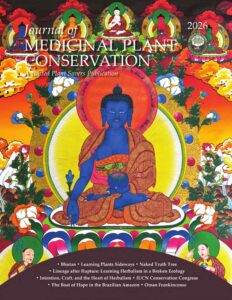
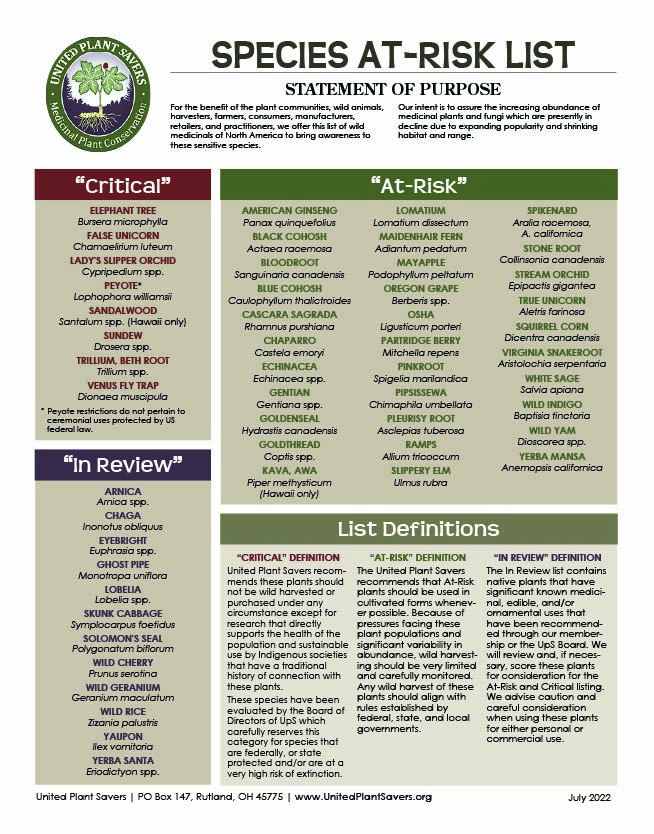
The UpS Journal has increasingly sought to lift Indigenous North American plant conservation issues and voices. Certain iconic plants like white sage (Salvia apiana), osha (Ligusticum porter), and Hawaiian sandalwood (Santalum spp.) have been featured extensively in particular.
The Journal has increasingly maintained a partial focus on the ethnobotanical practices and trade within medicinal plants internationally. Some countries featured recently include Bulgaria, China, Ethiopia, India, Iran, Jordan, Kenya, Laos, Madagascar, Nigeria, and Pakistan. The essential oil trade particularly tends to be a multi-national affair that also uses large amounts of plant material for precious little oil at the end. We have also had a presence at the last two IUCN meetings in Hawaii and France furthering our outreach and connections abroad.
Name Changes
UpS has removed terms that are considered offensive by many Indigenous folks in our naming practices and have advised similar actions for industry groups such as the American Herbal Products Association and the American Botanical Council. We also continue to follow the evolving literature on this subject and encourage others to do the same.
Ohio Elders Project
United Plant Savers hosted an exposition of the Ohio Herbal Elders Project. Folks like Christian Totty who has Black, Indigenous, British, and Scottish heritage and Annie Hsu Griffin of Korean descent are a couple examples of diverse folks recognized in this initiative.
Future work of United Plant Savers will continue to highlight a range of voices from the Ohio Appalachian region at our new Brickhouse event facility in Pomeroy and at the Sanctuary nearby in Rutland.
Residency
United Plant Savers has a deep ecology residency wherein we welcome a diverse array of voices to create art and other media.
Botanical SanctuariesUnited Plant Savers organizes a large Botanical Sanctuary network throughout the United States and parts of Canada with over 150 locations. UpS also inherited a program of Sacred Seeds Sanctuaries in 2014 that have a more international focus including locations in Bolivia, Colombia, Costa Rica, France, Ghana, Laos, Nigeria, Peru, Sri Lanka, the United Kingdom, and Vietnam. This is, of course an area for vast potential growth as every place in the world has a medicinal and sacred plant seed tradition! Unfortunately, like so many traditions, these are currently constantly under threat due to many pressures including climate change, development, and general loss of botanical knowledge due to urbanization. The more places and programs that can be maintained as depositories for local cultural wisdom and ideally curated by the people of the community themselves the better.
Aspirational Goals
United Plant Savers is working toward establishing a web page that can serve as a hub for all our activities regarding diversity, equity, and inclusion. For a relatively small organization, we collectively get a lot of things done in a range of spheres. Entire categories encompass a multitude of initiatives we have in the realm of plant conservation. A primary goal is to foster more diversity of belief and representation within our Articles, Board Members, Educational Gardens at the Sanctuary, Interns, Plant Sanctuaries, Residencies, and Staff and Web Page Resources. Continued diversity training of board and staff members will help to illuminate further opportunities along all the vital elements of our organization to have a broad spectrum of voices with seats at our tables.