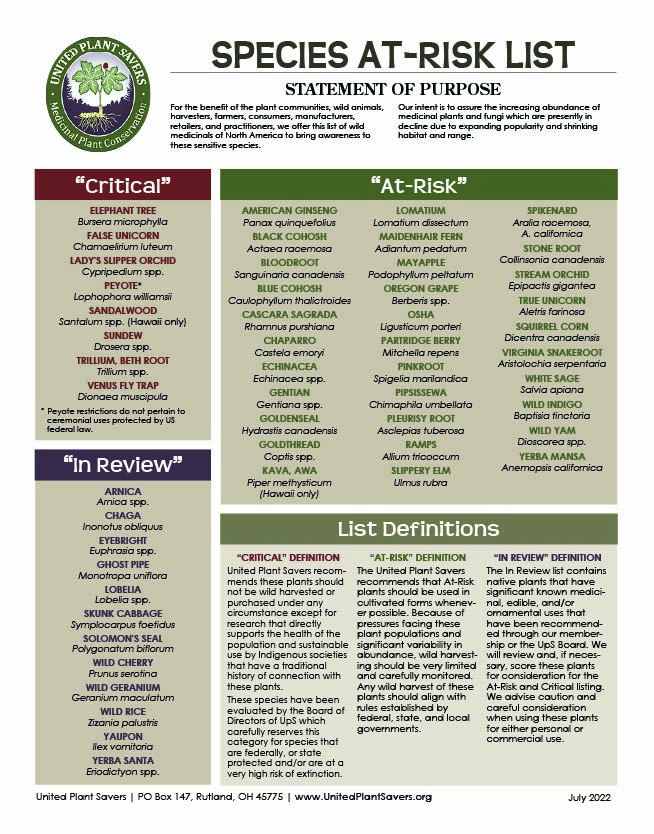
True Unicorn Root
(Aletris farinosa)

Overall At-Risk Score: 46
Latin Name:
Aletris farinosa
Common Name:
True Unicorn Root, White Colicroot, White Stargrass
Family:
Nartheciaceae (Asphodel family)
Lifespan:
Perennial
Reproduction:
Flowering through most of the summer, A. farinosa extends a flowering stock up to a meter tall in a long spike of white, tubular blooms that become similarly shaped seed pods filled with small seeds.
Geographic Region:
- Most of the population of Aletris farinosa is centered around the Carolinas and around the coast of Lake Michigan, but it can still be found in many other states as well. Specifically, Aletris farinosa can be found in Alabama, Arizona, Connecticut, Delaware, Florida, Georgia, Illinois, Indiana, Kentucky, Louisiana, Massachusetts, Maryland, Maine, Mississippi, North Carolina, New Hampshire, New Jersey, New York, Ohio, Oklahoma, Pennsylvania, Rhode Island, South Carolina, Tennessee, Texas, Virginia, Wisconsin, and West Virginia.
- True Unicorn Root is also found in the Canadian province of Ontario.
Habitat:
True Unicorn Root can survive in a variety of habitats, from rich woods to open prairies. The two constants of the species are that it prefers sandy soil and lots of sunlight.
Status of Endangered/Threatened (by state):
Aletris farinosa is of “Special Concern” in Rhode Island, “Threatened” in New York, “Endangered” in Pennsylvania, and “Possibly Extirpated” in Maine.
Part of Plant Used/Active Medicinal Compounds:
Not much is known about the medical compounds of A. farinosa, but diosgenin is definitely significant.
It was used historically primarily as a treatment for colic as late as the 19th century. Native Americans also used it for various gastrointestinal problems and as a treatment for dysentery. It has also been suggested that it may have a use in treating gynecological problems.
Vulnerability of Habitat/Changes of Habitat Quality and Availability:
Grasslands and prairies are often targets of agricultural development, fragmenting, and reducing habitat quality. Fire suppression is another big issue, as Aletris farinosa relies on regular fire cycles to prevent overcrowding and tree encroachment.
Recommendations for Industrial and Home Use:
Herbalists should try to rely on farm-grown and sustainably harvested A. farinosa. Cultivation of this species is relatively simple for the average gardener.
Citations
- eFloras, (n.d.), Aletris farinosa in Flora of North America, Missouri Botanical Garden, St. Louis, MO & Harvard University Herbaria, Cambridge, MA. Retrieved August 6, 2019, from http://www.efloras.org/florataxon.aspx?flora_id=1&taxon_id=220000415
- Hamel, Paul B. and Mary U. Chiltoskey, 1975, Cherokee Plants and Their Uses — A 400 Year History, Sylva, N.C. Herald Publishing Co., page 57.
- Hilty, (n.d.), Colic Root (Aletris farinosa), Retrieved August 8, 2019, from https://www.illinoiswildflowers.info/prairie/plantx/colic_root.html
- NatureServe. 2019. NatureServe Explorer: An online encyclopedia of life [web application]. Version 7.1. NatureServe, Arlington, Virginia. Retrieved August 8, 2019, from http://explorer.natureserve.org/servlet/NatureServe?searchName=Aletris+farinosa
- Speck, Frank G., R.B. Hassrick and E.S. Carpenter, 1942, Rappahannock Herbals, Folk-Lore and Science of Cures, Proceedings of the Delaware County Institute of Science 10:7-55., page 34.
- Taylor, Linda Averill, 1940, Plants Used As Curatives by Certain Southeastern Tribes, Cambridge, MA. Botanical Museum of Harvard University, page 7.
- USDA. (n.d.). Plants Profile for Aletris farinosa (white colicroot). Results compiled from multiple publications. Retrieved August 8, 2019, from https://plants.usda.gov/core/profile?symbol=ALFA2