By Ramona Moonflower Rubin, MPH
The Turtle and the Library
What is the responsibility of the artist in the context of cultural and ecological repair? I meditated on this question as I wandered the trails of the UpS Sanctuary in the first days of my Deep Ecology Artist Residency in August 2023. Exploring the land, I encountered pieces of story on the signage around the property. Walking slowly, reading signs, introducing myself to the trees, I hoped I would be able to recognize them the next time we met by the texture of bark and the distant shimmer of leaves. These stories of the trail wove together the place, the people, and the trees in words and poetry. Stories connect me, too, to these trees, to this land as well as to plants and lands afar.
Coming up a hill, my trail winds upwards through the lush green trees. Compared to the arid Mediterranean climate of my home in California, this area of southeastern Ohio is a tropical herbal paradise. I can tell from the abundance and variety of mushrooms and plants that this is a biodiversity hotspot. I observe there is an inverse relationship between the amount of biodiversity in an area and my optimal wandering speed, and I notice myself moving quite slowly through these woods.
I first visited UpS in 2005 after finishing graduate school in public health and before heading back out West. A friend invited me to visit the land, and we traversed the meadow full of wildflowers, swam in the Heart Pond, and nibbled spicy, bitter, and sweet medicinal plants. I left enchanted. Time passed and now I have returned, as an artist, a weaver, as a nature and forest therapy guide interested in how our sensory processing and the natural world shape and are informed by each other. This is my first artist residency, and I was eager to immerse myself in nature, reflection, creativity and explore weaving community and sense of place into my craft.
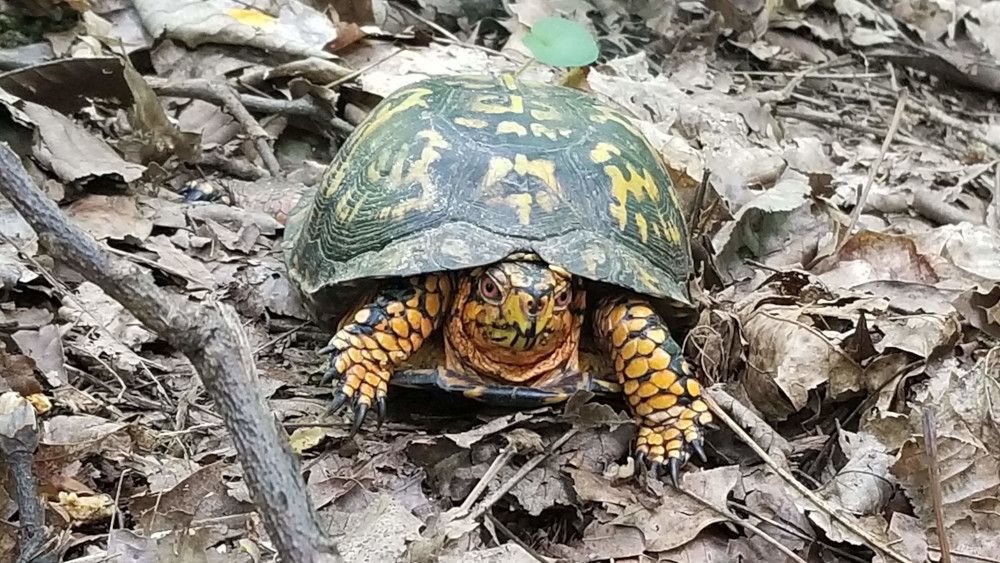
I was not expecting to meet a turtle that afternoon on the trail. But once I did, I knew enough to stop and see if I could learn from seeing the world from a turtle’s perspective. We moved slowly, navigating the world through our senses, including, in the case of this Eastern Box Turtle (Terrapene carolina), through olfactory receptors on our neck beneath our bony chin. Now that is a way to really learn the plants! With heightened chemical sensitivity, I bet a turtle has no trouble telling a beech (Fagus grandifolia) from a red maple (Acer rubrum) by a sniff of the bark!
Later that week, my head full of the poetry of the trail and the scents and textures of the natural world, I gazed around the Visitor Center at the magnificent library collection. I still felt the excitement of meeting a turtle in the woods as I browsed the bookshelves, opening a tome here and there, reading little bites of text, maybe chomping into a chapter before moving to the next. I was scanning contents and index for clues to a book’s purpose and utility. There were facts and information, but more than that, the collection as a whole, as a conversation, wove a story of love of plants, appreciation of their diversity, biochemistry, cultural uses, and traditions of medicine.
If the turtle could be said to have spoken to me, the message is The Medicine is In the Connections.
Seeking the confluence
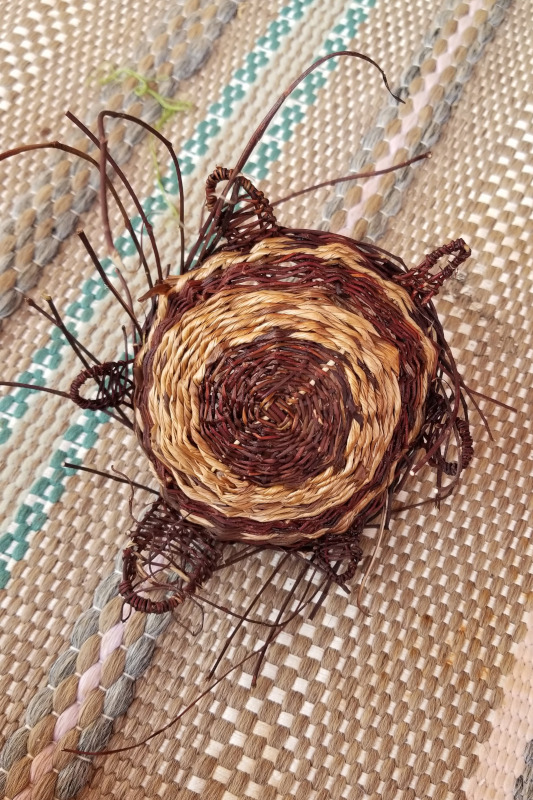
I got my first taste of basket weaving at an herbal medicine conference and became enamored with the way working with plant fibers informs us about our habitats and environments. I am fascinated by the way a pile of sticks and leaves, with some diligent effort, becomes a unified object of emergent beauty and reflection. Somewhere, there is a moment, when the natural materials stop being a collection of twigs and grass and emerge into an undeniable unified “thingness.”
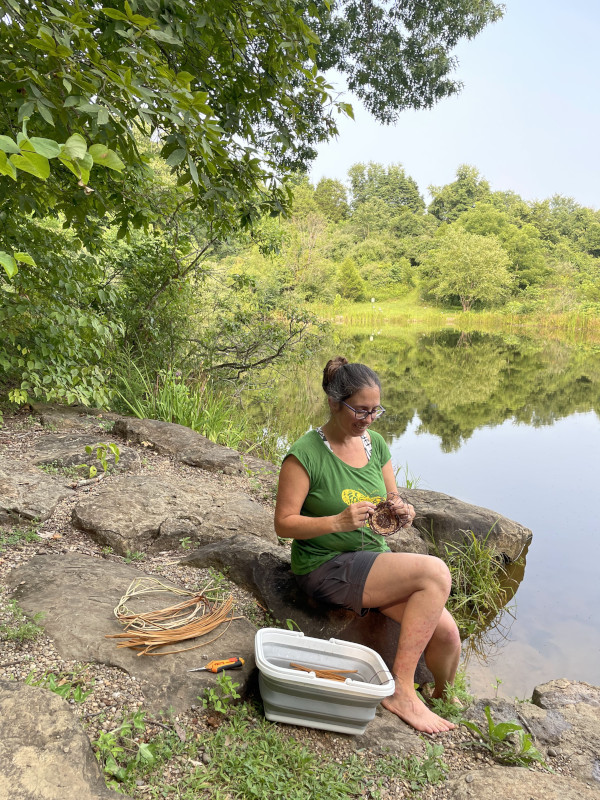
I hiked out to the Heart Pond with a few coils of the vines I had brought with me from home and my soaking basket to begin weaving. I felt slow and behind in creating works for the residency. My fellow artists of my had arrived with materials and works in progress. My desire to partner with the land in my artistic creation had led me on long slow meditative walks of the UpS trails. I sat for hours on the deck of the Tornado Cabin watching the day turn into night as the uninterrupted darkness stilled a restlessness within my being. As I filled my tub with pond water and placed in it the dry tendrils of vines I’d collected from my neighbor’s fence line, I felt the pond water bring the vines back to life, a different life, the life of this place where turtles tell stories of medicines tasted, and old strip mines are brought to life again with decades of care.
“What is the responsibility of the artist in the context of cultural and ecological repair?” I asked the other artists in my cohort, perhaps in an effort to make up in intellectual inquisitiveness what I lacked so far in weaving output. We had warmed up to each other gently, the structure of being thrown into a house together reminding me first of a reality TV show, but without the cameras and pitched drama. Inviting each other into glimpses of our creative process, sharing our inspirations and interests while cooking up delicious, shared meals together in the kitchen, we planned a day of sightseeing in the area. Amidst an itinerary of thrift stores, I volunteered that we should look for the confluence, referring to the place where Leading Creek, making its way down from the UpS Sanctuary, joins the mighty Ohio River.
Mapping a watershed is a wonderful tool for cultivating a sense of place. The watershed is one of nature’s most recognizable units of location, the equivalent of an area code or neighborhood affiliation for local plants and wildlife. So, armed with google maps and our senses of adventure, the three of us deep ecology resident artists found ourselves driving down roads that ended abruptly, in search of a joining of watersheds that proved to be elusive as a simple answer to my philosophical question.
I learned immensely from my fellow artists. I have come to think of myself as an artist only relatively recently. I initially picked up weaving as a craft or pastime, and it was only last year in a community college class in EcoArt that I began to grasp the vast possibilities of the artistic medium to reflect and guide cultural interpretations and social-ecological forces. Sometimes I’d share something I was pondering in my process and they would chuckle. “That’s just what it’s like being an artist” they would both say, almost in unison.
In my spare time around the Brickhouse I’ve been reading about the region, including Ann Armbrecht’s book, The Business of Botanicals where she recounts the history of herbal prospecting and trade that accompanied the early development and extractive profiteering of the region. In those days the Ohio River and the ginseng trade connected the region to the wider world and all the way to Asia. The Appalachian herb trade was one of the primary driving forces of the development of the region. The high demand for ginseng in Asia put pressure on American ginseng (Panax quinquefolius) populations, and continued economic forces led to scarcity and the decline of wild populations. Today as I sit reading on the porch, large barges of coal can be seen traveling up and down the river.
I have found that naturalists can be secretive about the medicinal plant populations they steward. In working closely with native medicinal plant populations so commercially valuable and prized, a certain amount of discretion comes with the territory. I noticed that the ginseng observations on the app iNaturalist are mostly obscured, so that no one can use this citizen science and identification tool to propel their own greed and poaching. Nonetheless, when I saw those smatterings of observations across the map, I smiled, knowing the medicine plants are out there, growing silently, invisibly somewhere amongst the hills.
Although we never saw the place of the confluence of Leading Creek with the Ohio River, the elusive joining of waters, we were aware of its presence. Standing just across the river, on the southern bank in West Virginia, we looked across to a streaky shore and could imagine the flow of Leading Creek, somewhere in those deeper shadows, near the power lines, its current subsumed by the river, braiding into the river, disappearing into the river, yet carrying with it knowledge of the places it has been.
The strength of cordage
Before I left my residency, I took the opportunity to harvest a handful of stalks of dogbane (Apocynum cannabinum) from the meadow. A native plant in the milkweed family, hemp dogbane grows easily and aggressively and is known and named for the strong fibers and fine cordage it produces. This was my first opportunity to work with it. I’ve admired finely crafted and tightly woven pieces in museums and was excited to try creating with them myself. First, I selected and cut a few standing dry stalks of last year’s growth. After finding two rocks and a shady place to sit, I went to work, testing out the materials and my tools. I smashed the stalks between the rocks enough to crack the brittle pith and peel off the long slender bast fibers. Rolling those fibers between my fingers, I picked out the remaining pieces of the papery outer bark. When I had prepared a handful of fiber from the few stems. I took one piece and began to roll it into a slender cord; then looping it over itself, I began the back-over-itself-twist of making cordage. Quickly, the humid buzzing of the day and the rhythmic twist and flip of the cordage in my hands consumed my focus.
At the end of my residency I led a forest bathing session for my fellow artists. Forest bathing, or Shinrin Yoku in Japanese, refers to the intentional submersion of the senses into awareness of the natural world. Healing Forest walks, as I practice them, involve elements of inward awareness, outward observation, and social communion. On our last walk together we moved slowly, barefoot, tuning in to the rhythmic buzz of life coursing through the hills around us. The time of our residency together was coming to a close, and we made a ceremony of our parting, sipping tea among the swamp rose mallow (Hibiscus moscheutos) at the edge of the Heart Pond.
Before departing I took one last walk through the visitor center, admiring the layers of art and narrative adorning the space. My story has been entwined with this place, too. Just before leaving I left a woven tray in the shape of a sassafras (Sassafras albidum) leaf dangling in the window of the visitor center on a length of dogbane cordage. If it’s still there, you are welcome to move it around, use it as a platter, or perhaps leave it somewhere in the forest. Whether I find it or not, walking the trails sometime in the future, I know I’m woven to this place with story and with love for the plants.
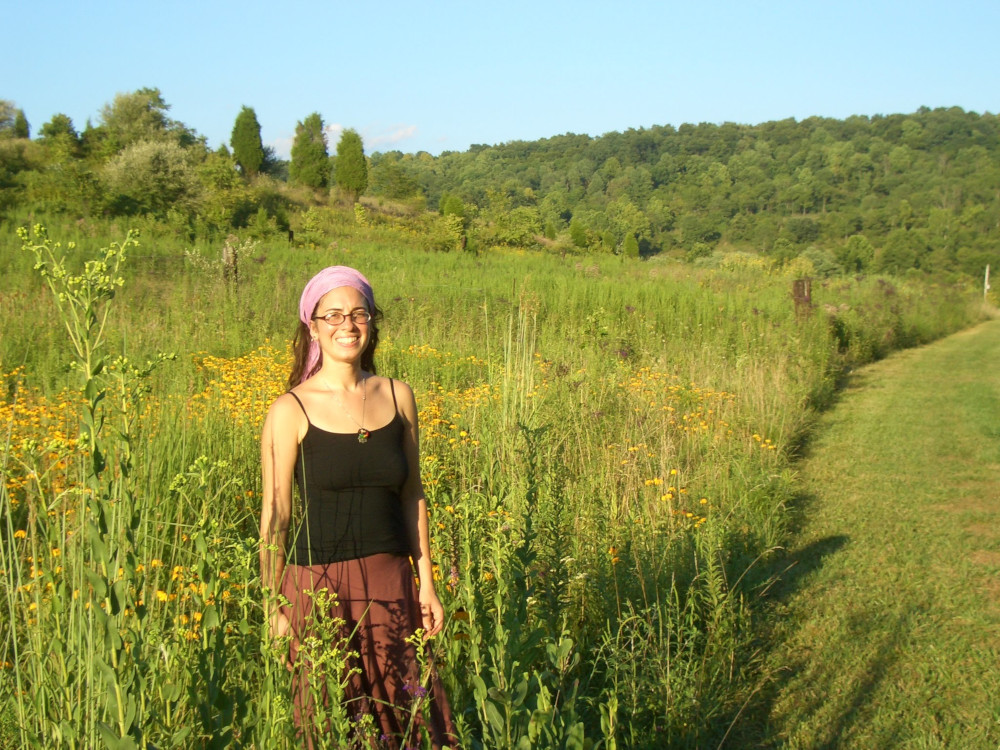
Ramona Moonflower Rubin, MPH (she/her) is a cultural ecologist, epidemiologist, nature artist, and forest therapy guide. She lives on Chochenyo Ohlone land in the Bay Area of California. Her diverse fields of scientific and spiritual interest inform her work as a weaver and culture creator. She founded Healing Forest Guide (www.healingforestguide.com) to facilitate a deep conversation about how we experience and relate to the natural world.