Yerba Santa
(Eriodictyon californicum)
Overall At-Risk Score: 53
Latin Name:
Eriodictyon californicum
Common Name(s):
Bear Plant, Bear’s Weed, Consumptive’s Weed, Gum Bush, Holy Weed, Mountain Balm, Tarweed, Yerba santa
Family:
Boraginaceae (Hydrophyllaceae/Namaceae)
Part(s) of Plant Used:
The leaves of narrow-leaf yerba santa (Eriodictyon angustifolium) have many traditional medicinal uses among the Hualapai, Paiute and Shoshoni Indigenous groups of the western USA.
Various parts and primarily the leaves of yerba santa (Eriodictyon californicum) have traditional medicinal use among the Atsugewi, Coahuilla, Coastanoan, Karok, Kawaiisu, Mahuna, Mendocino, Miwok, Pomo, Round Valley, Yokut and Yuki Indigenous groups of the western parts of the USA.
Thick-leaf yerba santa (E. crassifolium) has a documented unspecified traditional medicinal use among the Luiseno Indigenous group of California.
Wooly yerba santa (E. tomentosum) has a documented unspecified traditional medicinal use among the Luiseno Indigenous group of California.
The leaves of Hairy yerba santa (E. trichocalyx) have a documented unspecified traditional medicinal use among the Cahuilla Indigenous group of California whose name for it is Tanwivel.
The leaves of Hairy yerba santa (E. trichocalyx var. lanatum) have a documented unspecified traditional medicinal use among the Diegueno Indigenous group of California.
Geographic Region(s):
E. angustifolium is known from AZ, CA, NV, UT.
E. californicum is known from CA and OR.
E. altissimum, E. capitatum, Eriodictyon crassifolium,Eriodictyon parryi
Eriodictyon tomentosum, Eriodictyon traskiae, Eriodictyon trichocalx are only known from CA.
Eriodictyon lobiiis known from CA, NV and OR.
http://www.worldbotanical.com/eriodictyon.htm concludes that 11 species native to the southwestern United States and northwestern Mexico. 6 species are used by native people.
Habitat(s):
Typically found on dry rocky slopes and ridges, but varies by species
Life History:
All species are perennial plants.
Endangered/Threatened/Trade Status:
X = Presumed Extirpated H = Possibly Extirpated 1 = Critically Imperiled 2 = Imperiled 3 = Vulnerable 4 = Apparently Secure 5 = Secure NR = No Rank
Indian knob mountainbalm (Eriodictyon altissimum)is listed G1 globally, ranked N1 Endangered federally, and as S1 in CA.
Eriodictyon angustifolium
Eriodictyon californicum is ranked G4 globally and is not ranked at the federal or state level.
Eriodictyon capitatum is ranked G2 globally, N2 Endangered at the federal level, and S2 at the state level. It is endemic to Santa Barbara county and is only known from three locales.
Eriodictyon crassifolium is listed G3 globally, and is not ranked at the federal or state level. NatureServe recognizes two varieties var. crassifolium and var. nigrescens
Eriodictyon lobii (Nama lobii) is listed as G4 globally, S1 in Nevada, S4 in Oregon and not ranked in CA or UT
Poodle Dog Bush (Eriodictyon parryi/Turricula parryi) only grows in southern CA and is G4 but state unranked
Eriodictyon tomentosum is listed G3? globally
Eriodictyon traskiae is listed G3? globally
Sessile leaf yerba santa (Eriodictyon sessilifolium) is listed G4 globally, ranked N1 federally, and S1 at the state level. Though this can’t be seen currently on the Biota of North America Program (BONAP) or PLANTS USDA plant distribution websites.
Ability to Withstand Disturbance:
Rather tolerant of disturbance, including fire, but may be threatened by development, and a lack of viable reproductive populations among less common species.
Vulnerabilities and Threats:
Some spp. have very small populations, making them more susceptible to the effects of climate change, and development, fire and other forms of habitat loss.
Wild Harvesting Impact on Other Species:
Since the leaves are the focus of harvest there is minimal impact on other species in the area of harvest.
Lookalike(s):
Other large shrubby plants of dry rocky areas might be confused with yerba santa species but they are rather distinct in flower and leaf surface. That said, much more possible is the confusion of more rare species for the most common ones!
Demand:
Seems to be increasing from hundreds of pounds in 2011 to thousands in 2017. (AHPA)
Status Recommendation: At Risk
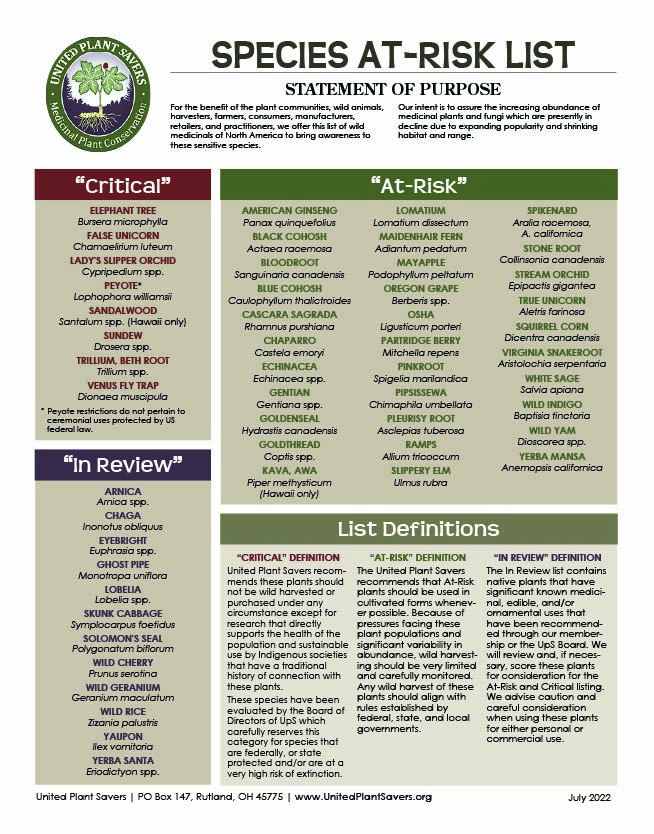
The United Plant Savers recommends that At-Risk plants should be used in cultivated forms whenever possible. Because of pressures facing these plant populations and significant variability in abundance, wild harvesting should be very limited and carefully monitored. Any wild harvest of these plants should align with rules established by federal, state, and local governments.
References:
- Bean, L. J., & Saubel, K. S. (1972). Temalpakh: Cahuilla Indian Knowledge and Usage of Plants (5th Reprint). Malki Museum, Rubidoux Printing Company.
- Cech, R. (2002). Growing at-Risk Medicinal Herbs: Cultivation, Conservation, and Ecology. Horizon Herbs.
- Chittum, H., Johnson, H., & Fletcher, E. (2021). Tonnage Survey of Select North American Wild-Harvested Plants 2011-2017. American Herbal Products Association.
- Densmore, F. (1974). How Indians Use Wild Plants for Food, Medicine, and Crafts. Dover.
- Erichsen-Brown, C. (1989). Medicinal and Other Uses of North American Plants: A Historical Survey with Special Reference to the Eastern Indian Tribes. Dover Publications.
- Foster, S., & Hobbs, C. (2002). A Field Guide to Western Medicinal Plants and Herbs. Houghton Mifflin Co.
- Gladstar, R., & Hirsch, P. (2000). Planting the Future: Saving Our Medicinal Herbs. Healing Arts Press.
- Hutchens, A. R. (1991). Indian Herbalogy of North America (1st paperback ed). Shambhala.
- Maher, P., Fischer, W., Liang, Z., Soriano-Castell, D., Pinto, A. F. M., Rebman, J., & Currais, A. (2020). The Value of Herbarium Collections to the Discovery of Novel Treatments for Alzheimer’s Disease, a Case Made With the Genus Eriodictyon. Frontiers in Pharmacology, 11. https://www.frontiersin.org/articles/10.3389/fphar.2020.00208
- Moerman, D. E. (1998). Native American Ethnobotany. Timber Press, Incorporated.
- Moore, M. (1989). Medicinal Plants of the Desert and Canyon West: A Guide to Identifying, Preparing, and Using Traditional Medicinal Plants Found in the Deserts and Canyons of the West and Southwest. Museum of New Mexico Press.
- Moore, M. (1990). Los Remedios: Traditional Herbal Remedies of the Southwest. Museum of New Mexico Press.
- Richards, A., & Chaurasia, S. (2022). Antioxidant Activity and Reactive Oxygen Species (ROS) Scavenging Mechanism of Eriodictyon californium, an Edible Herb of North America. Journal of Chemistry, 2022, e6980121. https://doi.org/10.1155/2022/6980121
- Taguchi, N., Hata, T., Kamiya, E., Homma, T., Kobayashi, A., Aoki, H., & Kunisada, T. (2020). Eriodictyon angustifolium extract, but not Eriodictyon californicum extract, reduces human hair greying. International Journal of Cosmetic Science, 42(4), 336–345. https://doi.org/10.1111/ics.12620
- Vogel, V. J. (1990). American Indian Medicine. University of Oklahoma Press.
- Walker, J., Reichelt, K. V., Obst, K., Widder, S., Hans, J., Krammer, G. E., Ley, J. P., & Somoza, V. (2016). Identification of an anti-inflammatory potential of Eriodictyon angustifolium compounds in human gingival fibroblasts. Food & Function, 7(7), 3046–3055. https://doi.org/10.1039/C6FO00482B
- Wang, M., Zhao, J., Avula, B., Lee, J., Upton, R., & Khan, I. A. (2023). Chemical characterization and quantitative determination of flavonoids and phenolic acids in yerba santa (Eriodictyon spp.) using UHPLC/DAD/Q-ToF. Journal of Pharmaceutical and Biomedical Analysis, 234, 115570. https://doi.org/10.1016/j.jpba.2023.115570
Additional Source(s) of Interest:
- https://www.wildflower.org/plants/result.php?id_plant=erca6
- http://naeb.brit.org/uses/search/?string=Eriodictyon&page=1
- https://pfaf.org/user/Plant.aspx?LatinName=Eriodictyon
- https://www.calflora.org/entry/psearch.html?namesoup=Eriodictyon&countylist=any&plantcomm=any&format=photos&orderby=taxon
- https://plants.usda.gov/home/plantProfile?symbol=ERAL12
- https://plants.usda.gov/home/plantProfile?symbol=ERAN2
- https://plants.usda.gov/home/plantProfile?symbol=ERCA6
- https://plants.usda.gov/home/plantProfile?symbol=ERCA7
- https://plants.usda.gov/home/plantProfile?symbol=ERCR2
- https://plants.usda.gov/home/plantProfile?symbol=ERPA7
- https://plants.usda.gov/home/plantProfile?symbol=ERTO
- https://plants.usda.gov/home/plantProfile?symbol=ERTR6
- https://plants.usda.gov/home/plantProfile?symbol=ERTR7
- http://bonap.net/Napa/TaxonMaps/Genus/County/Eriodictyon
- https://explorer.natureserve.org/Taxon/ELEMENT_GLOBAL.2.136633/Eriodictyon_californicum
- https://explorer.natureserve.org/Taxon/ELEMENT_GLOBAL.2.128239/Eriodictyon_crassifolium_var_crassifolium
- https://explorer.natureserve.org/Taxon/ELEMENT_GLOBAL.2.147492/Eriodictyon_crassifolium_var_nigrescens
- https://explorer.natureserve.org/Taxon/ELEMENT_GLOBAL.2.983162/Eriodictyon_sessilifolium
- https://explorer.natureserve.org/Taxon/ELEMENT_GLOBAL.2.152109/Eriodictyon_tomentosum
- https://unitedplantsavers.org/ups-list-of-herbs-analogs
- https://ecos.fws.gov/docs/five_year_review/doc3606.pdf