Last summer, on a hillside somewhere above 9,000 feet in Bhutan, I was camping alongside a clear rushing river with my group awaiting my first taste of matsutake mushroom. There was a local family who had set up the most beautiful iconic campsite, and they were cooking for us. These locals knew matsutake’s season, the elevation at which it preferred to grow, and, critically, how many could be taken from a single patch before you were taking too much. These valued wild collected mushrooms are a local favorite but also a shared economic boom and the community had guidelines to how they could be sold to outside markets.
I had come to Bhutan on what I can only describe as a bucket list journey: a mushroom tour organized around the country’s extraordinary fungal diversity and the sustainable harvesting traditions that have kept it intact. The premise was unusual and immediately appealing: we would not simply be learning about forest biodiversity through fungi, but actively foraging for wild mushrooms, drying our collections, and contributing new specimens to Bhutan’s Department of Mushrooms. We were not travelers. We were participants.
Our lead mycologist, Max Mudie (@allthingsfungi), a specialist from the UK with a particular affinity for micro-fungi, had a way of pulling the invisible into focus. While the rest of us were scanning the forest floor for the charismatic caps and brackets of larger species, Max was already on his knees with a hand lens and his amazing camera, opening an entirely different world. Small things are beautiful!
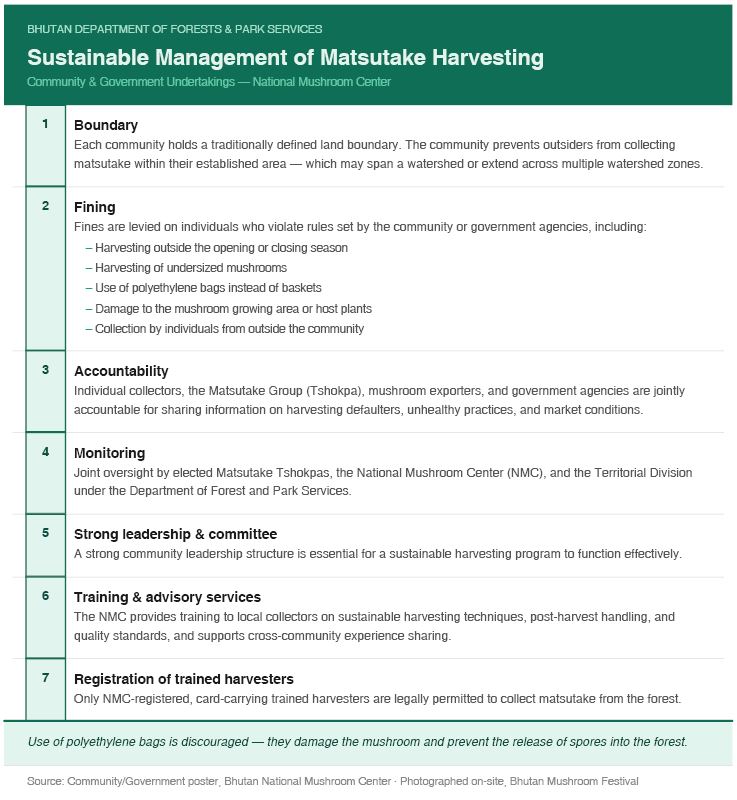
At the festival, a government poster laid out the principles for matsutake harvest: community boundaries, seasonal rules, fines for undersized collection, mandatory use of baskets rather than plastic bags. That last rule stopped me. Plastic bags are discouraged, the sign explained, because they prevent spores from releasing into the forest. Someone in a government agency had written a regulation not just to protect this year’s harvest, but to protect the mushroom’s ability to reproduce, protecting the forest’s future relationship with itself. That is a different way of thinking about a resource. And it pointed toward a different way of thinking about medicine.
Bhutan Dept. of Forests & Park Services
CLICK FOR LARGER VIEW
Bhutan is a country that has, against considerable pressure, chosen to keep its healing knowledge alive. The fungi my guide harvested that afternoon were not curiosities or commodities; they were part of a living pharmacopeia, ingredients in a traditional medical system called Sowa Rigpa that has been practiced continuously for over a thousand years and is today formally protected by the Bhutanese state. Standing in that forest, I kept thinking about home, about the Appalachian slopes I know well, where plants with nearly identical stories grow in dwindling numbers, tended now by the herbalists, hunters, foragers, wildcrafters, researchers, forest land owners, and Indigenous knowledge keepers that mainstream medicine spent the better part of a century trying to erase.
This is a story about two mountain cultures on opposite sides of the world, the plants and fungi that connect them, and what happens when a society decides that ancient healing knowledge is worth protecting, and what is lost when it decides otherwise.
— A Continent Apart, A Botanical Kinship —
Begin with the plants themselves. Long before either tradition developed its healing practices, the continents were connected. The Asa Gray disjunction, identified in the 1840s–1850s, describes the striking botanical similarity between disjunct temperate forest plants in Eastern Asia and Eastern North America, which Gray proposed are remnants of a formerly widespread Northern Hemisphere forest fragmented by geological and climatic changes during the Tertiary period. The result is a botanical kinship that still surprises botanists: American ginseng (Panax quinquefolius) and Asian ginseng (Panax ginseng) are cousins, shaped by parallel pressures in parallel ecosystems. Solomon’s seal, mayapple, and various members of the Panax family appear in both traditions’ pharmacopeias: different names, similar applications, converging intuitions about what these plants do in the body.
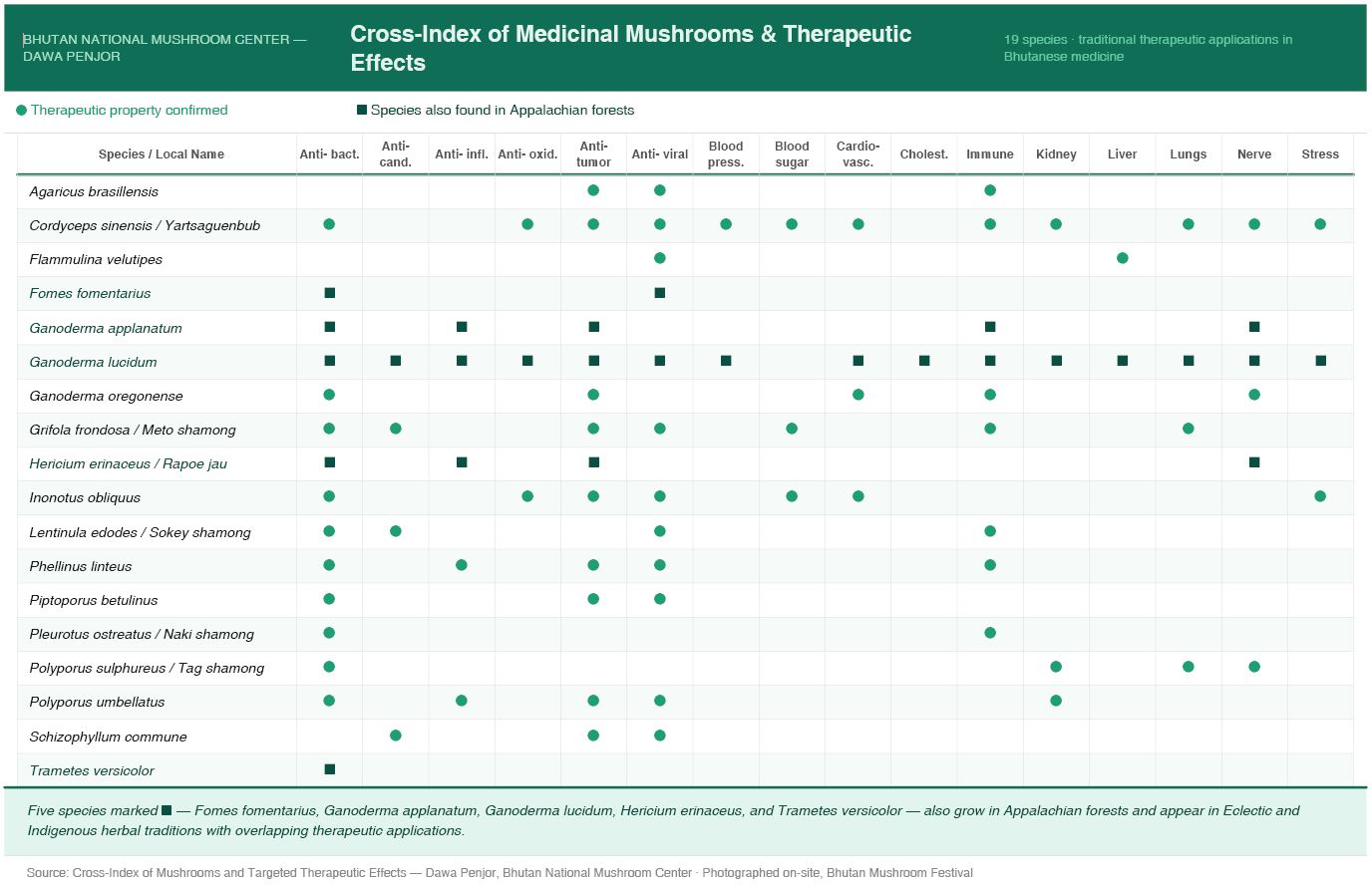
The same kinship extends to fungi, though its more widespread, some use the term circumglobal that describes a species that is cosmopolitan and widespread in its range or ubiquitous everywhere at once. Several species documented in Bhutan’s medicinal mushroom traditions, including Ganoderma lucidum (reishi), Fomes fomentarius (tender fungus), Hericium erinaceus (lion’s mane), Trametes versicolor (turkey tail), also grow in Appalachian forests and appear in Eclectic and Indigenous herbal traditions, albeit under different names and with overlapping but not identical applications. A cross-index of therapeutic mushrooms compiled by Bhutanese mycologist Dawa Penjor lists 19 species with documented uses ranging from antibacterial and anti-tumor to cardiovascular support, nerve tonic, and stress reduction. Ganoderma lucidum alone carries therapeutic markers across nearly every category on the chart. Cordyceps sinensis, the famed caterpillar fungus known in Bhutan as Yartsaguenbub, carries the broadest profile of any species: antibacterial, antioxidant, antitumor, antiviral, blood pressure modulator, blood sugar regulator, immune enhancer, kidney tonic, lung and respiratory support, nerve tonic, sexual potentiator, and stress reducer.
Medicinal Mushrooms: Selected Species from Bhutan’s Cross-Index (Dawa Penjor)
- Cordyceps sinensis (Yartsaguenbub): broadest therapeutic profile: antitumor, antiviral, cardiovascular, kidney tonic, nerve tonic, stress reducer, and more
- Ganoderma lucidum: antibacterial, anti-inflammatory, antioxidant, antitumor, antiviral, blood pressure, cholesterol, immune, liver tonic, lungs, nerve, sexual potentiator
- Hericium erinaceus (Rapoe jau): antibacterial, anti-inflammatory, antitumor, nerve tonic
- Grifola frondosa (Meto shamong): antitumor, antiviral, blood sugar, immune, respiratory
- Trametes versicolor: antibacterial
Note: Several of these species also grow in Appalachian forests and appear in Eclectic herbal records.
Bhutan’s healers work with approximately 300 to 600 plant and fungal species. Appalachian herbalists draw on a tradition shaped by three overlapping inheritances: Indigenous plant knowledge from Cherokee, and many other nations; African botanical knowledge brought, and often kept hidden; and European herbal practice carried by Scots-Irish and German settlers. Where Bhutanese medicine unified these influences into a formal system, Appalachian knowledge braided them into something more dispersed, more oral, and ultimately more vulnerable.
— Two Systems, Two Philosophies —
Bhutan’s healing tradition, known as Sowa Rigpa, or in the local vernacular, nangpai men, “Buddhist medicine”, is one of the oldest continuously practiced medical systems in the world. Its roots reach to the 8th century, when Tibetan medicine traveled into the region alongside the spread of Buddhism. In the 17th century, the arrival of Zhabdrung Nawang Namgyal formalized the system, weaving medicine, monastery, and statecraft together into a coherent institution.
At its spiritual center is the Medicine Buddha, or Bhaishajyaguru, depicted in a luminous lapis lazuli blue that Bhutanese tradition associates with boundless wisdom and the power to eliminate illness. He holds a bowl of medicinal nectar in one hand and the myrobalan fruit, considered a near-universal remedy, in the other. His image appears throughout Bhutan’s healing spaces as a constant reminder that physical and spiritual health are not separate concerns. Sowa Rigpa practitioners combine herbal preparations, acupuncture, and moxibustion within a framework that treats illness as a disturbance in the relationship between body, mind, and environment.
Appalachia’s Eclectic tradition understood health in a strikingly similar way, though it arrived there from different directions. The Eclectics, formally organized as a medical school movement in the mid-19th century, synthesized Indigenous plant knowledge with African botanical practice and European herbalism into a pluralistic system that served rural and low-income communities. They were not folklorists preserving old ways; they were practitioners with clinical training, publishing journals, running hospitals, and advocating for medicine that met communities where they were.
Both systems share a foundational skepticism of the idea that health is merely the absence of disease. Both see the patient as embedded in a larger ecological and relational context. Both rely on polyherbal preparations (combinations of plants working synergistically) rather than the isolation of single active compounds. And both have faced the same accusation from mainstream biomedicine— that they are insufficiently scientific, unproven, and therefore dangerous.
— The Festival on the Mountain —
The trip, started at Bhutan’s mushroom festival, and it was there that something unexpected happened to me. Walking through the displays set up by the Department of Forests and Park Services, past posters explaining fungal ecology and sustainable harvest, past tables offering new mushroom teas to taste, I had a sudden and disorienting sense of recognition. I could have been at a forest farming gathering in Appalachia.
The energy was identical with the mix of scientific rigor and community pride, the herbalists and mycologists and farmers in easy conversation, and the handmade displays carrying knowledge that universities tend to overlook. The difference was that here, this gathering had the full weight of the state behind it. The Prime Minister himself spoke at the opening, addressing the crowd about what a treasure Bhutan holds in its forests and its fungal heritage and asking his people to be proud of that knowledge. I stood there trying to imagine an equivalent scene in the United States, imagining a political figure standing before a gathering of Appalachian herbalists and telling them their tradition was a national treasure. Things that make you go hmmmm.
Then the masks came out, and the dancing began. The cultural celebration that closed the festival, featuring traditional mask dances rooted in Buddhist ceremony and costumes brilliant against the mountain backdrop, was a reminder that in Bhutan, the knowledge of plants and fungi is not separate from art, from ritual, from the full texture of a living culture. It is woven in. That integration is precisely what makes it durable. Knowledge that lives only in scientific papers is fragile. Knowledge that lives in dance, in ceremony, in the hands of a harvester who learned from his community—that knowledge has roots.
Working alongside the team from the Department of Mushrooms over those days, contributing our foraged and dried collections to their growing archive, I understood something I had only theorized before: that the difference between a tradition that survives and one that disappears is impacted by whether the state decides to be a partner or an adversary. Bhutan chose partnership. The United States, in 1910, chose otherwise.
— The Divergence: 1910 and Its Aftermath —
Here is where the two stories part ways.
In Bhutan, traditional medicine was never severed from its institutional home. The 20th century brought formalization rather than suppression: in 1968, under His Majesty Jigme Dorji Wangchuck, Sowa Rigpa was formally incorporated into Bhutan’s national healthcare system. Rather than replacing traditional medicine, the government built a parallel structure; today, Bhutan’s traditional medicine hospitals operate alongside allopathic hospitals, treating different conditions, drawing on different frameworks, and referring patients to one another. The 1982 establishment of a Pharmaceutical and Research Unit added scientific documentation without dismantling the system’s spiritual and community foundations.
In Appalachia, the opposite happened. The Flexner Report of 1910 —recommended stripping accreditation from institutions that did not conform to a model laboratory science curriculum. Eclectic medical schools, which had trained physicians in plant-based and community-embedded medicine for decades, were shut down. The knowledge they held was not absorbed into the emerging biomedical mainstream; it was dismissed as unscientific and excluded from institutional legitimacy. What remained were living fragments: oral traditions held by mountain herbalists, knowledge carried by Indigenous healers, remedies passed through families without the infrastructure to document, protect, or transmit them formally.
The Flexner Report is often described as a triumph of scientific rigor. It was also a consolidation of power, one that served a narrowing, commercializing biomedical monopoly and actively disadvantaged rural, Black, and Indigenous communities whose healing traditions operated outside the approved framework. Now we have the Dietary Supplement Act, which allows companies to sell herbs but just not make medical claims and therefore prevent the mainstream medicine from using them or allow health insurance to cover the cost of the most cost-effective medicine.
— Toward Exchange —
Sowa Rigpa’s great strength is its institutional survival. Because it was protected rather than dismantled, it retains a complete system: trained practitioners, documented formulas, living relationships between knowledge holders and communities, and a framework for understanding health tested across centuries. Bhutanese practitioners today can trace a direct lineage from 8th-century texts to contemporary clinical practice. The same could be said for Aruvedic in India and Chinese Medicine in Asia.
Appalachia’s Eclectic-herbalist tradition holds something different and equally valuable: a documented history of how healing knowledge crosses cultural lines. The Eclectic tradition was explicitly pluralistic. It drew on indigenous plant medicine, on the botanical knowledge of Africans and many other cultures, including European herbalism, and synthesized these into working clinical practice. That synthesis, and the cautionary story of its suppression, has urgent relevance for the state of our health and most important a connection and value for the natural world.
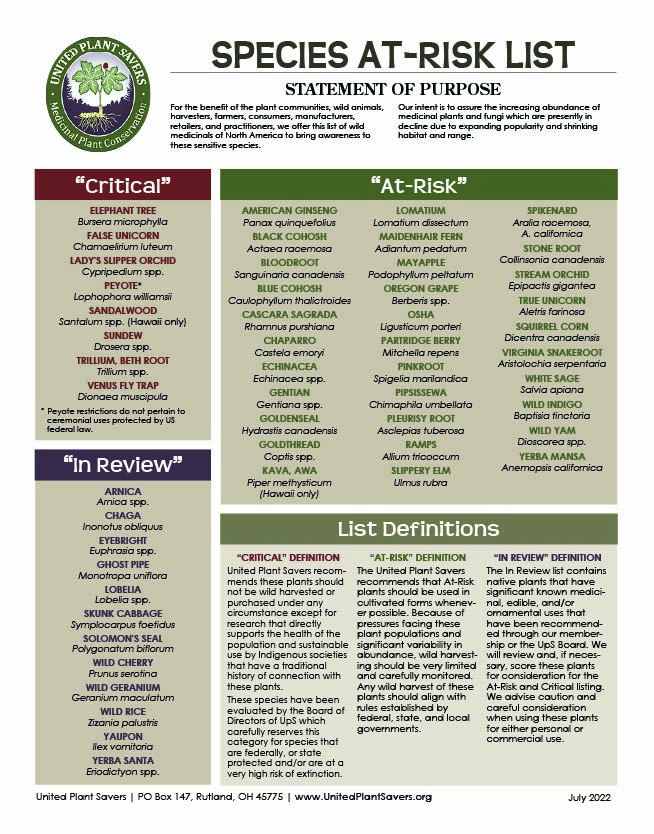
There are also the plants themselves, still growing in both places. American ginseng, once abundant across Appalachian slopes, is now listed as a threatened species due to logging, habitat loss, loss of predators and thus overpopulated deer and in part overharvesting, largely driven by export demand from Asian markets that prize it precisely because of its kinship with Panax ginseng. The matsutake I watched my guide harvest in Bhutan is a species that commands premium prices in Japanese markets, creating the same extractive pressure on Bhutanese forests that ginseng faces in Appalachia. Both communities are navigating the same tension: the outside world has finally noticed the value of what they have, and that attention is dangerous.
— What Each Tradition Holds —
What would it mean for these two traditions to learn from each other? Not in the extractive sense, where outside researchers arrive, catalog indigenous knowledge, and depart with intellectual property, but in a genuine bidirectional exchange—Bhutanese practitioners sharing how a living knowledge system is maintained and institutionalized; Appalachian herbalists and Indigenous healers sharing what a pluralistic, cross-cultural synthesis looks like at its best and what the cost of losing it looks like, too.
The sustainable harvesting framework I photographed on that Bhutanese hillside, with its seven principles governing community boundaries, seasonal rules, registered harvesters, and basket requirements, is itself a model worth studying. It is not a relic of pre-modern thinking. It is a sophisticated governance system, developed over generations, that has kept a forest productive and a community sovereign over its own resources. Appalachian plant stewards are rebuilding exactly this kind of infrastructure, largely from scratch, because theirs was taken from them.
The plants are already in conversation. The fungi fruiting on both sides of the world carry the same biochemical vocabularies, the same antitumor compounds, the same nerve-protective properties. The knowledge systems are beginning to be. What remains is building the infrastructure for that conversation to continue, on terms set by the communities themselves, in forms they control, toward ends that serve them.
“Mountain cultures have always known something that centralized, industrial systems tend to forget: that healing is local, seasonal, relational, and deeply entangled with the land.”
The ginseng pushing through Appalachian soil and its cousin in a Bhutanese valley, the reishi growing on a fallen oak in the Smokies and the Ganoderma lucidum listed in Dawa Penjor’s cross-index: these are reminders that this knowledge, however separated by history and geography, shares common roots. The work now is to tend those roots before they are lost entirely.
I ended my tour by taking a few extra days to tour the Traditional Medicinal Hospital where herbs were dispensed freely by trained herbalists, where acupuncture and steam baths were part of the regular treatments. The Doctor I interviewed said that the traditional hospital can treat breathing and sinus issues, pain management, headaches, ease the life changes in the body, while the allopathic hospital can tackle complex surgery and advancements in science. The two work together, and it’s a choice for the people to have these options. I had to visit the local stone baths, where spring water merges with hot rocks and soak in the fact that there is a country that values biodiversity over profit. This is not just a dream—it’s Bhutan.