A visit to Les Colombières, on the Côte d’Azur
Christopher Nolan’s The Odyssey with Matt Damon opened in movie theaters this month to the kind of numbers usually reserved for superheroes. What you may not know is there’s a real garden near Menton, in the south of France, that told this story in stone a century before Nolan did on screen.
Tucked into a walled courtyard there, at the historic villa and gardens of Les Colombières, is a pool ringed by murals of Odysseus’ voyage, painted a century before Nolan ever picked up a camera. The mural is next to a fountain showing the exact moment Nausicaa finds himself shipwrecked on the beach. Ferdinand Bac built the gardens himself and called them “Jardin d’Homère” (a.k.a. “Homer’s Garden”).
A name that was already a homecoming story
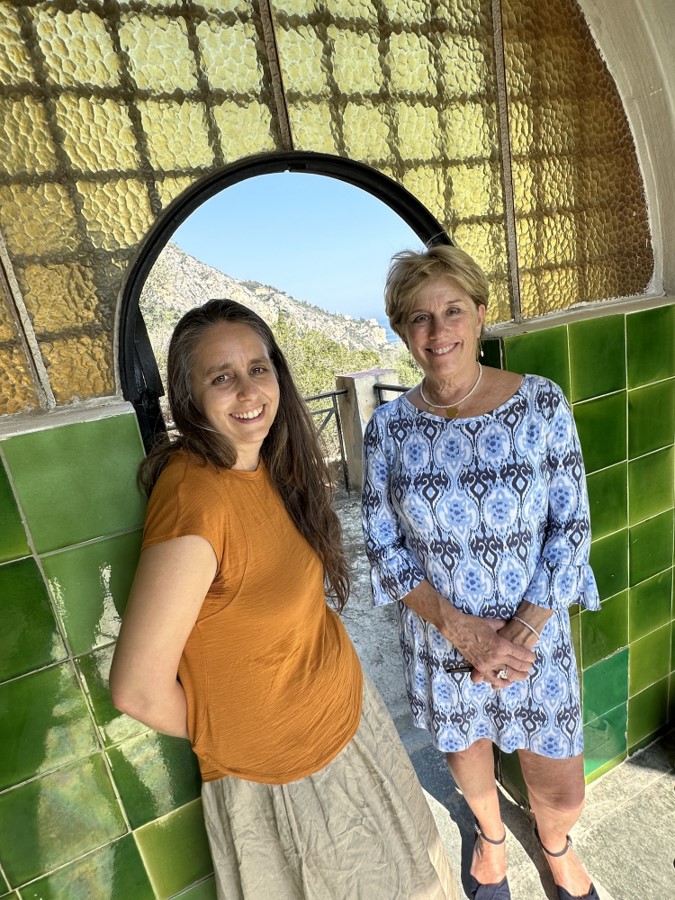
I was beyond fortunate to get to spend a night at Les Colombières a few years ago. And as Homer’s poetry has garnered mainstream attention, I’ve reflected upon my time there, and wanted to share the details with you!
The villa’s namesake is a colombière, a wall of small niches built for doves and pigeons to come home to night after night. In English, it’s called a “dovecote.” Historically, these weren’t just picturesque; a working dovecote supplied the richest fertilizer an estate could ask for, so the name is equal parts sentiment and practicality. The birds always return, and the place is richer for it.
A house conceived as a single work of art
Les Colombières wasn’t finished until 1927, and the villa itself was never meant to be separate from the garden Bac treated the two as one continuous idea. Its first owners, Emile and Caroline-Octavie Ladan-Bockairy, gave their friend Bac the task of finding them a property to create a getaway in the south of France: a place that could embody the spirit of Mediterranean life going back to classical antiquity.
Building a Mediterranean world in miniature
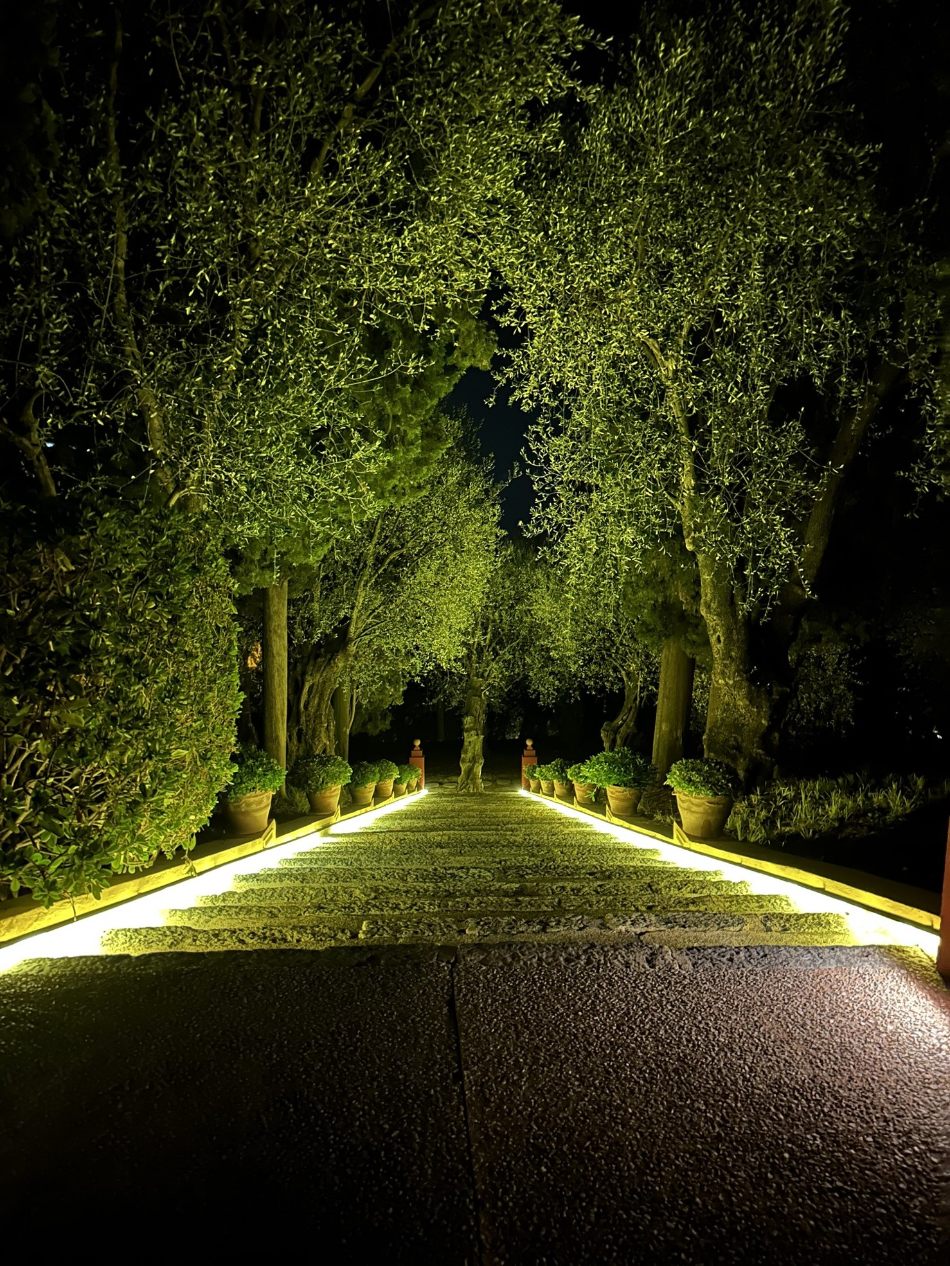
Bac was the illegitimate grandson of Jérôme Bonaparte, Napoleon’s younger brother, and he first arrived on the Riviera in 1911 already well known as an illustrator, political satire and writer. He had lived in Paris as a political caricaturist, skewering the powerful in the popular press. In 1919, he was hired to find a site for a Mediterranean villa, and he found Les Colombières: seven hectares on a steep hillside above the harbor, of which about 3.5 remain part of the garden today. He lived there for the next seven years, from 1920 to 1927, and what he built outdoors was a synthesis: Mediterranean beauty as it had passed, culture by culture, from Egypt to Greece, to Rome, to North Africa, to Spain and of course the south of France.
The Homer Garden itself
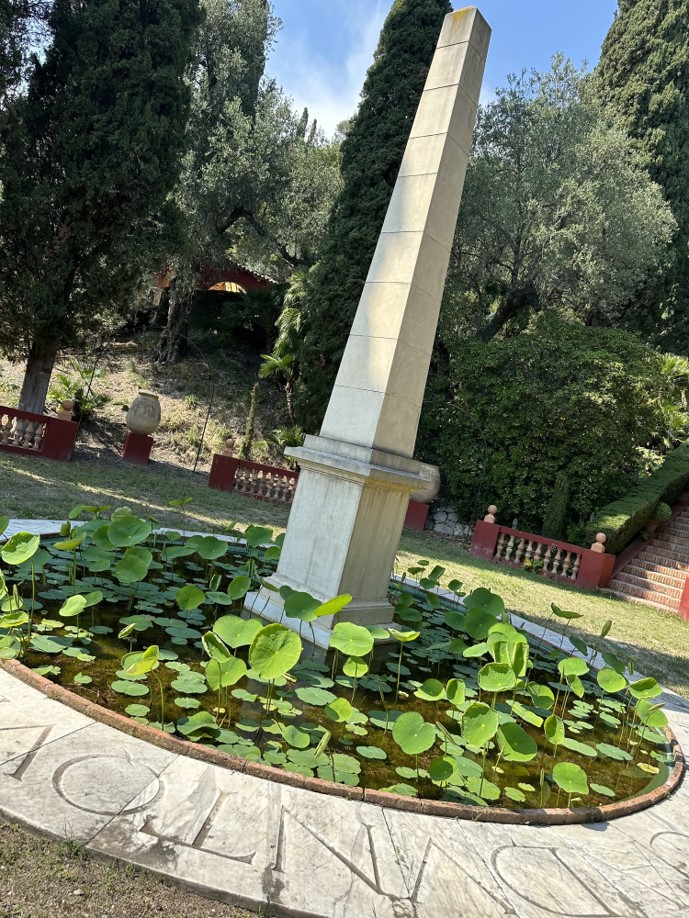
That synthesis has a keystone, and it’s the one room on the property built around a single author. The Jardin d’Homère, a small, walled atrium near the villa’s entrance, is deliberately hidden from view of the driveway. At its center is a still pool, and running around it, painted directly onto the surrounding walls, are murals of scenes from Homer’s Odyssey. Just next to it, closing off the same enclosed space, is the Fontaine de Nausicaa: a niche of painted ceramic showing the Phaeacian princess Nausicaa discovering the shipwrecked Odysseus on the beach and giving him clothes. It’s the moment in Book Six where the whole poem quietly pivots from disaster toward homecoming. Bac built the two pieces to be read together, one continuous scene wrapping around the little courtyard.
Bac himself explained the choice by pointing to local legend. He believed the cult of Homer belonged here specifically because tradition placed the cave Ulysses describes at the rocks of Grimaldi, the actual prehistoric caves on the France–Italy border, close to the garden. For Bac, the Odyssey wasn’t a myth borrowed from somewhere else in the Mediterranean. It was, as far as he was concerned, a story that had partly happened inspired by the scenic landscape.
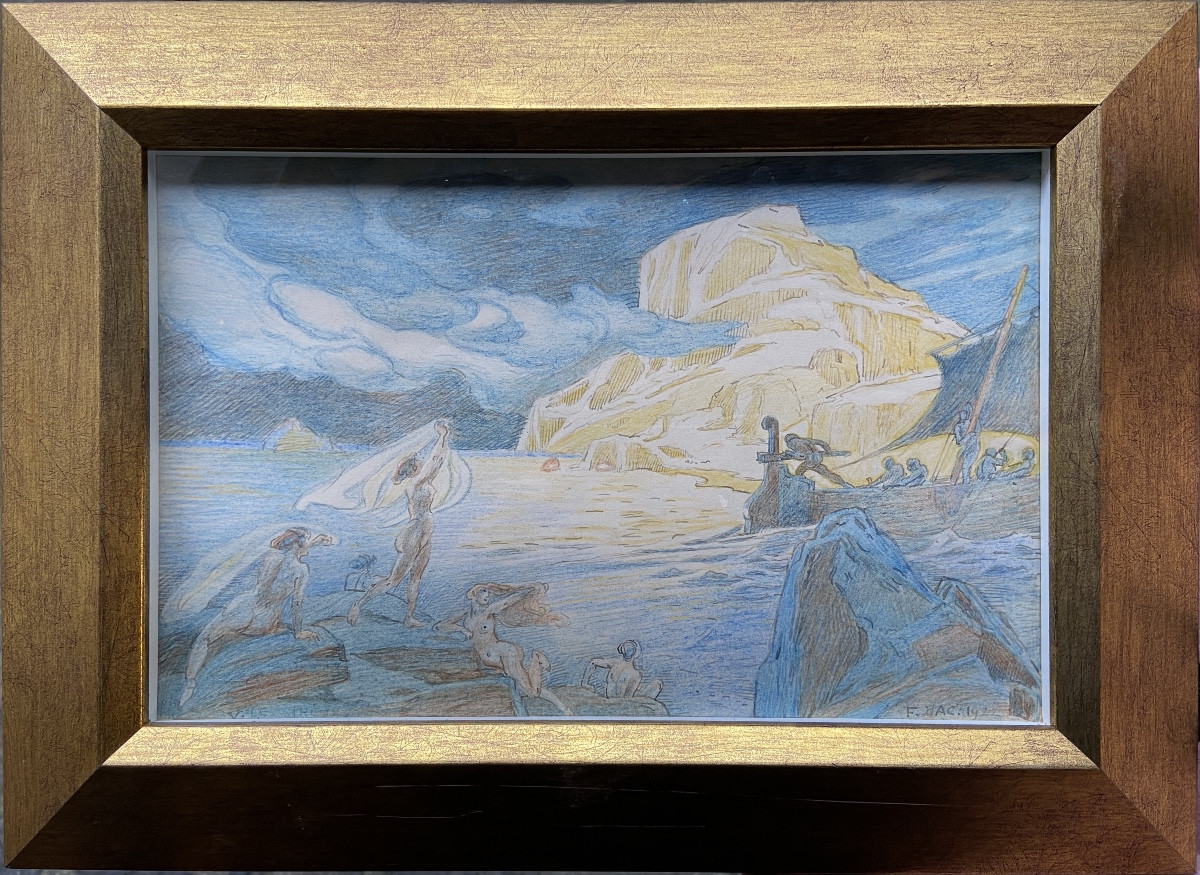
The Homer Garden also isn’t an isolated piece; it’s one stop on a route Bac designed on purpose. The ancient carob tree, already standing on the hillside before Bac ever arrived, anchors one end of a sequence that crosses a bridge of sixteen columns he added and ends at a viewpoint he called the Bella Vista, framed by cypresses and looking out toward Italy, and in spirit, toward Greece beyond it. Nearby stands that same carob tree, believed to be a thousand years old: older than the poem in spirit if not in fact, and older by far than any script or any studio.
And it wasn’t just a garden room. In 1923, while he was still in the middle of building all of this, Bac published L’Aventure Singulière d’Odysseus en Quarante et une Fresques, a full illustrated retelling of the Odyssey in forty-one of his own Art Nouveau plates. He was working through Homer in two mediums at once, the same years he was painting the Lares fresco and laying stone for the Homer Garden: one Odyssey in ink on paper, one in cypress and water on the hillside.
The paintings that carry the same story indoors
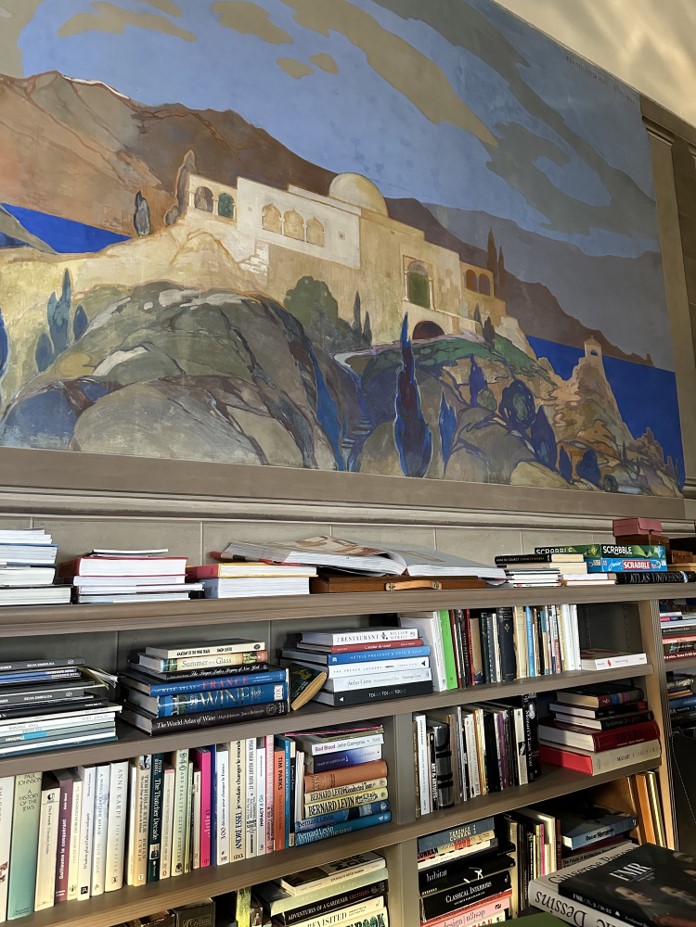
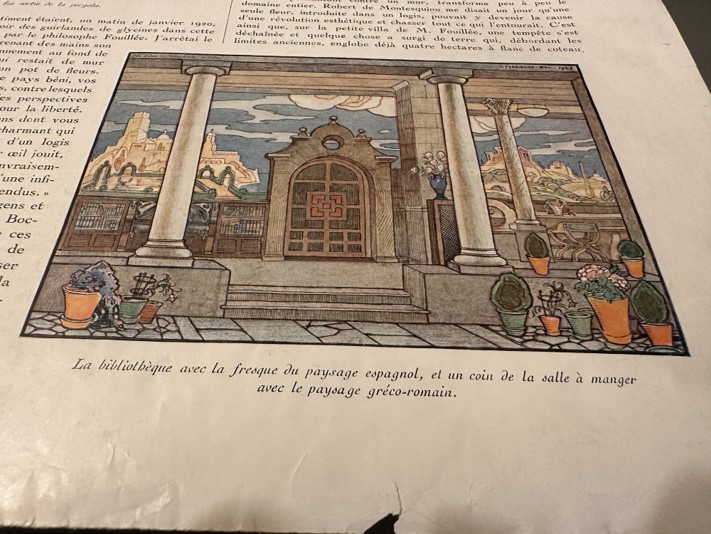
The Homer Garden’s murals aren’t the only paintings doing this work. Bac carried the same idea through the house. The library holds his “Spanish landscape,” a sun-bleached hill town over blue water; the dining room, just across the hall, holds its companion piece, a “Greco-Roman landscape” of colonnades and open water. He illustrated both for a 1925 feature in the French magazine L’Illustration.
Over the villa’s main door, Bac carved his own homecoming into stone. The inscription begins Spes et… and finishes as a kind of retirement speech to fate itself: I have found my haven of peace. Hope and chance, farewell. You have played with me enough. Now go play with someone else.
A garden built in the eye of the storm
Here’s the part I keep coming back to. Bac built all of this (the house, the frescoes, the Homer Garden, the whole Mediterranean synthesis) between 1920 and 1927. That’s not a random decade. It’s the exact, fragile interval between the two wars, when the French Riviera had become one of the great gathering points for art and culture in Europe: painters, writers, exiled aristocrats, and composers drawn to the same light and the same sea that had drawn the Greeks and Romans centuries before them. For about twenty years, this stretch of coastline got to behave as if peace were permanent and beauty were a reasonable thing to spend seven years building.
There’s an irony in that worth sitting with, given who was doing the building. This was a man who’d made his name satirizing power and politics in the Paris press – someone who spent his twenties and thirties finding the absurdity in the powerful. And then, in the one stretch of calm his generation got between two wars, he turned away from all of it and built the most apolitical thing imaginable: a garden with no argument to make except that beauty, myth, and home are worth the trouble. It’s hard not to read that as its own kind of commentary, especially in a moment like ours, when it’s tempting to think turning toward beauty instead of the news is a form of surrender rather than a form of defiance.
It wasn’t permanent, of course. When the war came, Menton was annexed by Italy, and Les Colombières, the estate built to hold the memory of an entire civilization was turned into a military hospital. By the time the fighting ended, the place had, in the words of Bac’s friend Hubert de Givenchy, “fallen into ruin.” Elsewhere on the grounds (not in the Homer Garden itself) Charles de Gaulle addressed people gathered there in 1945, marking Menton’s liberation and the return of the town to France. It’s a strange, fitting bit of symmetry: the same hillside built to hold the memory of Troy and Ithaca also, one generation later, hosted a real homecoming speech, for a real occupied town, at the end of a real war.
The synthesis Bac spent his career building came apart within a few years, as such things often do: culture takes generations to create and only moments to destroy, and war does not spare gardens or poems. Yet Homer’s poems endure, like a sandcastle washed away by the tide and rebuilt the next day.
What survived is the reason I think this garden and this new film are telling the same story. A last-minute listing as a Historic Monument in 1990 saved Les Colombières from developers; the Likierman family bought the property in 1995 and spent years bringing it back from the ruin Givenchy described. That’s the other half of the Odyssey that’s easy to forget once the sea monsters and the sirens are behind you: getting home isn’t the end of the story, it’s the start of the much slower work of rebuilding the house you were fighting to get back to.
Going home is the whole point
That’s the balance this hillside keeps better than almost anywhere I’ve stood is the swing between the dark ages that keep happening and the peace that has to be rebuilt every single time. Nolan needed six countries, IMAX film cameras, and a quarter-billion-dollar budget to put The Odyssey back in front of an audience. Bac needed a hillside, seven years, and conviction. Both were making the same argument: the destination was never really Troy or the wine-dark sea. It was always the hearth, the household gods, the doves coming back to the same wall of niches every night. Home isn’t where the journey ends. It’s the thing the whole journey was in defense of.
Go see the movie. Then, if you ever find yourself on that last stretch of the Riviera before Italy, go see the garden. Homer wrote the story of getting home. Bac built a house and a garden to prove it was worth the trip.
Planning a visit: Les Colombières now opens its garden and patio to the public on Wednesday afternoons from April through October (mornings in July and August), with tours capped at 15 people. Tickets run about €20 and can be booked directly at lescolombieres.com.