by Brandy Renee McCann
“I can’t reach the good ones,” I complained to my dad. We had been out looking for abandoned family graveyards in the hillsides of West Virginia when we passed by an enormous blackberry bramble caning its way along an old road that was more grass than dirt. Dad had barely stopped his little truck when I hopped out and dumped the remaining water from my big plastic cup. I began plonking the blackberries into my container, but the best ones were shining in the sun just out of reach.
“Here,” he said and gently pushed me out of the way as is his manner. He took a long-handled hoe and poked the bramble. “Let them snakes know we’re here,” he said in explanation. I paused. I had forgotten that childhood practice. In recent years I had made my home in a bustling college town, several hours away from my rural childhood home, and had forgotten to consider the copperheads. After beating the bushes a bit, dad used the hoe to pull the canes towards me so that I could fill my cup. I had thought to make a small batch of jam, but we ended up eating them fresh in milk and sugar that summer evening—a childhood delight I remembered well.
I think of blackberry as having three distinct seasons. First is flowering. Where I live in south-central Appalachia, blackberry canes typically flower in early May during a cold snap. We call this Blackberry Winter, with it being the last of our little winters—little winters are those cold, wet snaps throughout the unfolding warm season. This flowering in late spring is an important step for the berry harvest we’ll have in July. I’ve seen some poor harvests in late summer from dry conditions during Blackberry Winter in May. I harvest blackberry leaves in the late spring or earlier when they are tender and green.
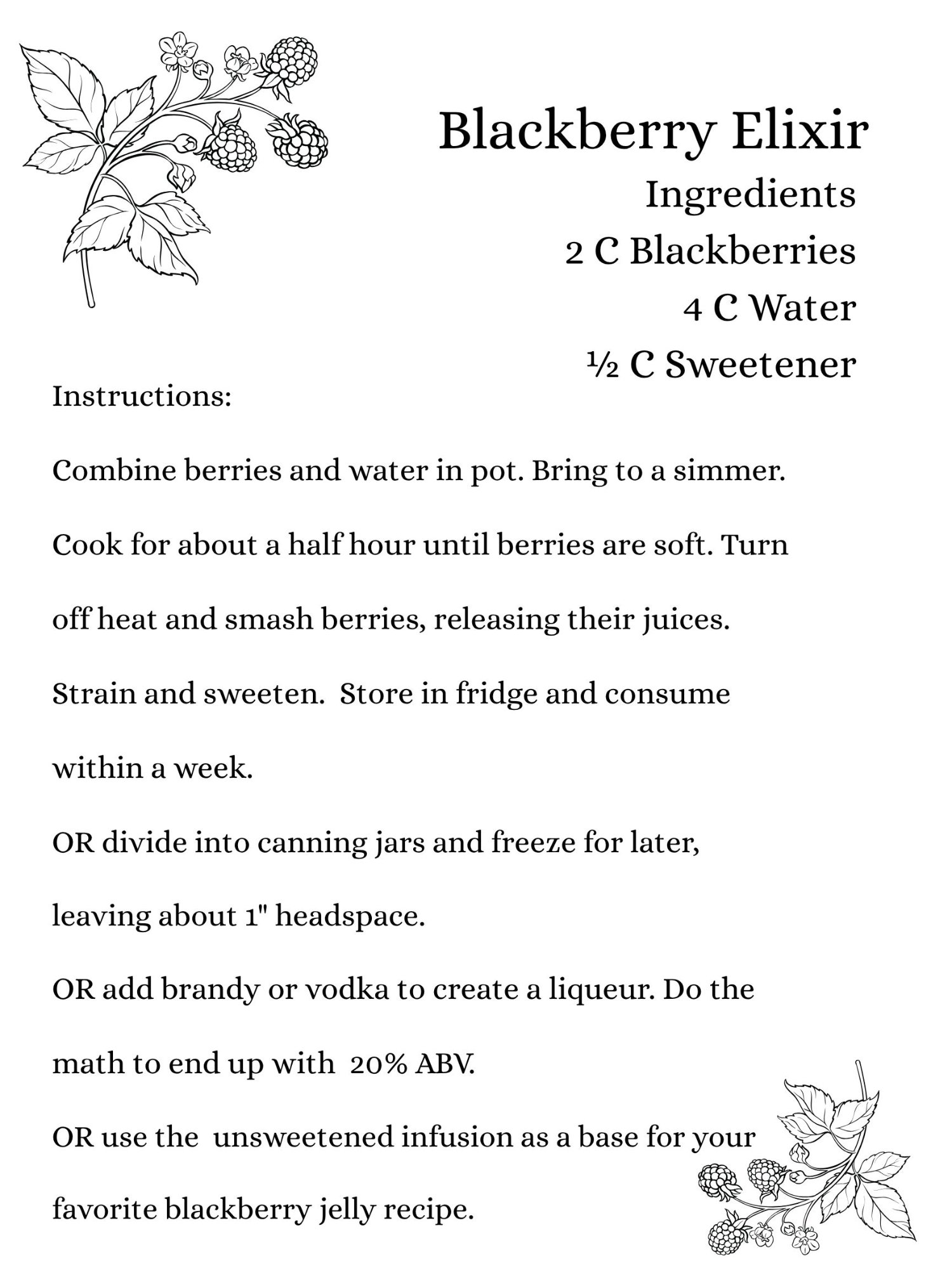
The second season for Rubus is the fruiting stage. This is my favorite season, for blackberries are one of my favorite fruits. I can blackberry juice, as well as jellies and jams, to enjoy and use throughout the winter any time I feel like my digestion is a little off—or just because I want a special treat. A small amount of blackberry juice can be combined with freshly made whipped cream to create a lovely, purple-colored frosting for a violet studded cake on my birthday the following spring (see photo).
The third season is the caning stage. In my yard, blackberry plants shoot up new canes throughout the growing season. I can harvest tender shoots and roots throughout spring to fall as I need them. Because fall is the preferred time to harvest roots of most plants, I gather blackberry shoots—roots and all—during the autumn. I trim off the shoot and chop and dry the roots. I’ll need them towards the end of winter when my kids bring home a stomach bug.
I have so much love for blackberry as he has saved me from many a trip to the E.R. Historically I have had unusually extreme reactions to intestinal illnesses and long recovery times. During my 20s I was hospitalized repeatedly for dehydration as I tried to ride out an intestinal virus. But in recent years, I’ve found that blackberry root or leaf tea, or simply the juice from frozen blackberries from the grocery store, has helped me tremendously.
Aside from digestion, dried leaves and roots make a wonderful tea/wash for the skin. Like other plants of the rosacea family, blackberry has a tonifying effect on the skin, whether you just need an after-shower toner or to get relief from a rash such as poison ivy.
Besides consuming Rubus, there is much lore around the passage through brambles. Generally, in folk healing, being carried through a naturally-made hole of some sort is thought to have healing powers. If you’ve done much hiking, you’ve likely seen some of these holes—either from rocks that form a passageway, the space between trunks in kissing trees, or a portal in brambles or rhododendron. They are striking, and one can see how these intriguing places would be the focal point of magical lore!
Ethnographers such as Wayland Hand have chronicled the phenomena of “passing through” as a method of healing. Across the globe there are records of various ways a person could be healed by moving or being moved through some natural object, such as a tree with a cleft or a copse of trees wherein a natural portal formed. In my family, we practice this sympathetically by creating a dollie of the ill person and passing it through a bramble wreath or a found piece of knotwood from a decaying tree (if you’re not familiar, it looks a bit like a doughnut where a small branch used to connect to the main truck of a tree). This passing through is rebirth of sort. Blackberry brambles are particularly effective since they have thorns, as their sharp points will pull poor health and ill luck from the afflicted person as they pass through the brambles.

In her book on wildcrafting, Rebecca Beyer discusses more folklore around blackberry. One practice I’ve adopted from her research is the burning of brambles. Given blackberry’s power to remove evil, figures such as the devil were thought to hate the plant. Therefore a bundle of canes bound with string to be lit for a wand can be used as a smoke cleanse. It is best to create wands with sturdy gloves so that the thorns don’t inadvertently snare your tender skin!
Many astro-herbalists consider brambles to be ruled by Mars due to blackberry’s sharp nature and tonic action on the vascular system (all those flavonoids!). But astro-herbalist Maeg Keane makes a compelling case that brambles are actually ruled by Saturn energy. She argues that brambles are a traditional hedge plant, grown into a literal structure separating private and public spaces. When Saturn energy shows up in our lives, it can be painful, yet ultimately healing, reminding us of our need to slow down, honor boundaries, and build supporting structures for our dreams. Whether Mars or Saturn, all can agree that blackberry is a potent medicine that demands that we pay attention and work within boundaries to build the structures of our lives.
Once a month I teach a gentle yoga class called Plant Energy Yoga. Each class is focused on one herb. As students sink into a pose for a few minutes (think a seated forward fold), I share tidbits about the focus plant. In midsummer we engage with Blackberry and I open the class with the poem August by Mary Oliver. In the poem, Oliver says that with “ripped arms” she spends all day “in the brambles/ nobody owns” single-mindedly picking and eating “the black honey of summer.” The students chuckle. Those who have gone blackberry picking in the hills and wild places know the pain of the torn skin along with the sweetness of the stained mouth.
And that is the lesson of Blackberry: good things come through persevering methodically through tough times. The daily practice, the intentional small steps, the careful combing through the brambles lead to a life filled with sweet abundance.
Bibliography
Beyer, Rebecca. (2022). Wild Witchcraft: Folk Herbalism, Garden Magic, and Foraging for Spells, Rituals, and Remedies. New York: Simon Element.
Hand, W. D. (1968). “Passing Through”: Folk Medical Magic and Symbolism. Proceedings of the American Philosophical Society, 112(6), 379–402. http://www.jstor.org/stable/985938
Keane, M. (2024). “Saturn’s Berry” on The Gleaming Feast (Substack).
Oliver, Mary. (1983). “August” in American Primitive. Boston: Back Bay Books.
Brandy Renee McCann, PhD, writes about Appalachian folk ways, including herbalism and plant magic from an interdisciplinary perspective. Her literary work can be found at Reckon Review, Still: The Journal, and Anthology of Appalachian Writers (2023 ed). In her everyday world, Brandy is a writer and researcher at the Center for Gerontology at Virginia Tech; her scientific work on aging in Appalachia can be found in a variety of academic journals. Follow her on social media @appalbrandy or Plant Energy Yoga.