By Jasmine Zenderland
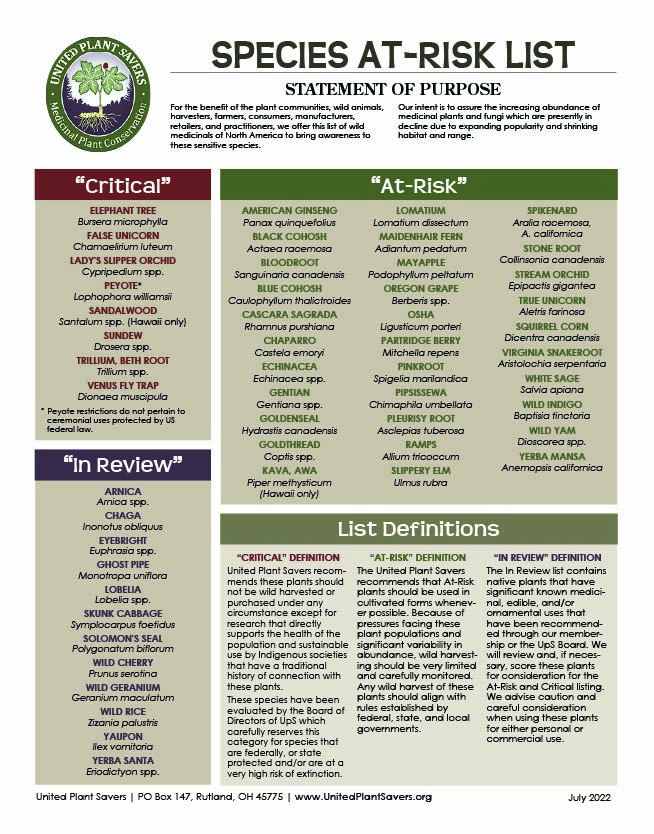
The first time I ever saw the plant bloodroot (Sanguinaria canadensis) was in the shade garden at the Missouri Botanical Garden in St. Louis, Missouri. In an unassuming corner of the garden, tucked below a canopy of oak and maple trees, there it was, with its dusty green lobed leaves, well past the stage of flowering. At the time, I was a botany student in Northern California, far from the native range of this plant. There I found myself, in the Midwest, meeting it for the first time, although I knew from my studies in herbalism that herbalists have traditionally used its latex-rich, red rhizomes in salves and other preparations. Elated by the sight of this at-risk medicinal plant growing before my eyes, I stayed to look around, only to find growing next to it Solomon’s seal (Polygonatum biflorum) and goldenseal (Hydrastis canadensis). “Is anyone else seeing this?” I thought to myself, amazed by the collection of important and increasingly rare American medicinal plants growing before me. By the end of my day wandering the garden, I must have seen ten more medicinal plants that I had only ever read about in my herb books or seen dried, and cut-and-sifted, sitting on the shelf at an herb shop. I have had many moments like these at botanical gardens—places that bring botany textbooks and materia medica to life and have long inspired botanists, gardeners, conservationists, and plant-lovers of all kinds.
Humans have long cultivated plants in organized gardens with documented examples dating back 3,000 or more years from China, Mesopotamia, Egypt, and Mexico. These cultures had documented systems of herbal medicine, so these gardens are presumed to have contained medicinal plants. Still, the first formal botanical gardens of Europe were established in the 16th and 17th centuries explicitly as institutions for the study of medicinal plants. These so-called “physic” gardens were developed as living classrooms where medical students of the time could study botany, a discipline once considered integral to the training of medical professionals. When I learned the origin story of botanical gardens as formal establishments for the study of medical botany, I was astonished to discover that these two fields from my studies in herbalism— the botanical sciences and the medical sciences—once overlapped significantly at the institutional level. In my own experiences in botanical education, I found that almost no time or attention was dedicated to exploring the beneficial chemistry of plants or their traditional medicinal uses beyond a passing mention, often presented as trivia or “fun facts”. More people are interested in learning about herbal medicines than I have seen in my lifetime. It is my plea that botanical gardens reclaim their role as prominent centers of herbal education by bringing interdisciplinary botanical training to aspiring clinical herbalists, herbal supplement industry professionals, and community members interested in medicinal plants.
Those who have studied history know that different forms of knowledge can be considered either “acceptable” or “unacceptable” within the dominant culture. There are myriad examples, including the dismissal of traditional ecological knowledge systems of indigenous groups and the hunting of women with folk healing knowledge, deeming them witches. Institutions and universities have largely been erected to proliferate certain types of knowledge, while other types of knowledge have historically been excluded. In the United States, this dichotomy persists. Western medicine practiced by doctors is perceived as evidence-based, while herbal medicine is often dismissed as untrustworthy pseudoscience. Botanical gardens, however, remain amongst the few places where scientific inquiry can live proudly alongside the documentation of ethnobotanical legacies—where the study of taxonomy, ecology, and plant evolutionary biology exists beside the study of traditional and cultural uses of plants, anthropology, and medical botany. As herbalists, we learn that the medicine a plant offers can be understood in many ways. It may be explained by its chemical constituents, its taste and energetics, or its spiritual qualities, and all are useful to examine when learning how an herb is used medicinally. This consideration of different knowledge systems enables a more complete understanding of the traditional and practical uses of plant medicines.
Botanical gardens are uniquely positioned to equip herbalists-in-training with the skills needed to become competent clinicians and community practitioners. Many of these institutions have well-developed research programs and employ our most skilled professional botanists, plant ecologists, and ethnobotanists. The study of botany has always been integral to good herbal training, and developing stronger foundations in botanical science and ecology would only be beneficial to those seeking to work with medicinal plants. Relevant biological skills are sadly underemphasized in many herbal training programs; after my own herbal training, I found myself far more acquainted with the herbal products at the health food store than the plants growing outside my home. Botanical gardens as centers of immense scientific expertise are well-suited to fill this gap. These research gardens house not only great taxonomic expertise, but also frequently document “folk taxonomies” and other indigenous knowledge systems of the natural world. This integration fosters an inclusive environment for incorporating traditional knowledge into clinical herbalism. The San Diego Botanic Garden recently hosted a Medicinal Plant Research Symposium to bridge science and traditional knowledge, facilitate interdisciplinary collaboration, and develop partnerships with tribal leadership and indigenous community members in the area. I am heartened by these partnerships, and I wish for more people from the herbal community to contribute to and benefit from events like these. Many ethnobotanists working with botanical gardens possess extensive knowledge of medicinal chemistry and the cultural uses of plants. In our American higher education system, it is rare to encounter teaching that integrates the traditional understanding of plants through an ethnobotanical lens with a scientific botanical lens. Botanical gardens are hubs for this type of learning, and many herbalists would find great value in an environment that does not pick and choose between the realms of the scientific and the traditional but uses each lens as a complement to the other.
The herbal supplement industry can also benefit from botanical gardens’ work. While working as a botanist for a large herbal supplement company, I quickly realized that many suppliers, wholesalers, and manufacturers lacked staff who could correctly identify the plants they sold or processed into herbal medicines. Botanical literacy in the industry is limited, and rigorous botanical training is startlingly rare. This poses a risk to consumers, as proper identification of plant species is a necessary first step to ensuring the quality and safety of herbal products. Botanical gardens do provide resources to support the herbal supplement industry; for example, Kew Gardens’ Medicinal Plant Names Service (a database of scientific, pharmaceutical, trade, and common names of medicinal plants). Of course, there is still room for growth. Expanded training of industry professionals in botanical identification using organoleptic, macroscopic, and microscopic techniques by those skilled in these methods would help close the gap between sourcing raw botanical materials and producing finished products of a high standard. Botanists working in botanical gardens are highly qualified to provide this type of instruction.
The lack of botanical training in the herbal industry matters not only for consumer safety but also for plant conservation. Even at a basic level, understanding the ecological context, taxonomic framework, and life histories of plants allows sourcing teams to better evaluate claims about identity, harvest status, and the overall ecological impact of medicinal plant harvests in commerce. With so many plants being overharvested for medicine and thousands of medicinal plants estimated to be threatened in the wild, the correct identification of botanical materials is crucial to avoid depleting already threatened plant populations. The ethical sourcing of plants in the herbal supplement industry could be significantly improved by increasing industry professionals’ overall botanical knowledge. There are over 1,000 botanical gardens in North America with living collections of at-risk plants, herbaria (libraries of plant life), robust conservation programs, and the infrastructure to support community education. As herbalists, we should become fierce advocates for these institutions. We should support their mission and, more, advocate for our shared objectives, including preserving plant life on this planet and fostering an appreciation and respect for how these organisms shape our health and livelihoods.
As someone who has studied plants in various settings, formal and informal, I am hopeful about the resurrection of botanical gardens as places where people can learn about herbalism. As centers of plant conservation, these gardens emphasize that we should not focus solely on preserving biological species but also on conserving the traditional knowledge associated with these plants, including ecological and traditional medical knowledge. Botanical gardens are centers of interdisciplinary plant learning that are well equipped not only to document this knowledge but also to disseminate it to the community and inspire people to reflect on their own relationship with plants.
My wish for those seeking to learn about plants is this—that we leave behind the fractured ways of American higher education and return to a more holistic understanding of plants as medicine. I would love to see universities offer classes on herbalism, citing both scientific evidence and ethnobotanical texts as sources and to see more botanists take an interest in cultural uses of plants and incorporate these perspectives into their work. I would love to see universities and botanical gardens once again take on their historical role of being places to learn about medicinal plants. The need to revive botanical studies as a whole has never been more dire. With herbaria and botany programs shutting their doors at an alarming rate, we must find new ways to carry botanical knowledge and train the next generation of plant learners.
Jasmine Zenderland is a botanist and herbalist whose work explores how people come into relationship with plants through both scientific and traditional pathways. She holds a B.S. in Botany from California Polytechnic University, Humboldt, and an M.A. in Ecology and Evolutionary Biology from Washington University in St. Louis, where she conducted research in collaboration with the Missouri Botanical Garden. Jasmine’s work focuses on botanical literacy, herbal education, and fostering ecologically grounded relationships with medicinal plants.