Introduction
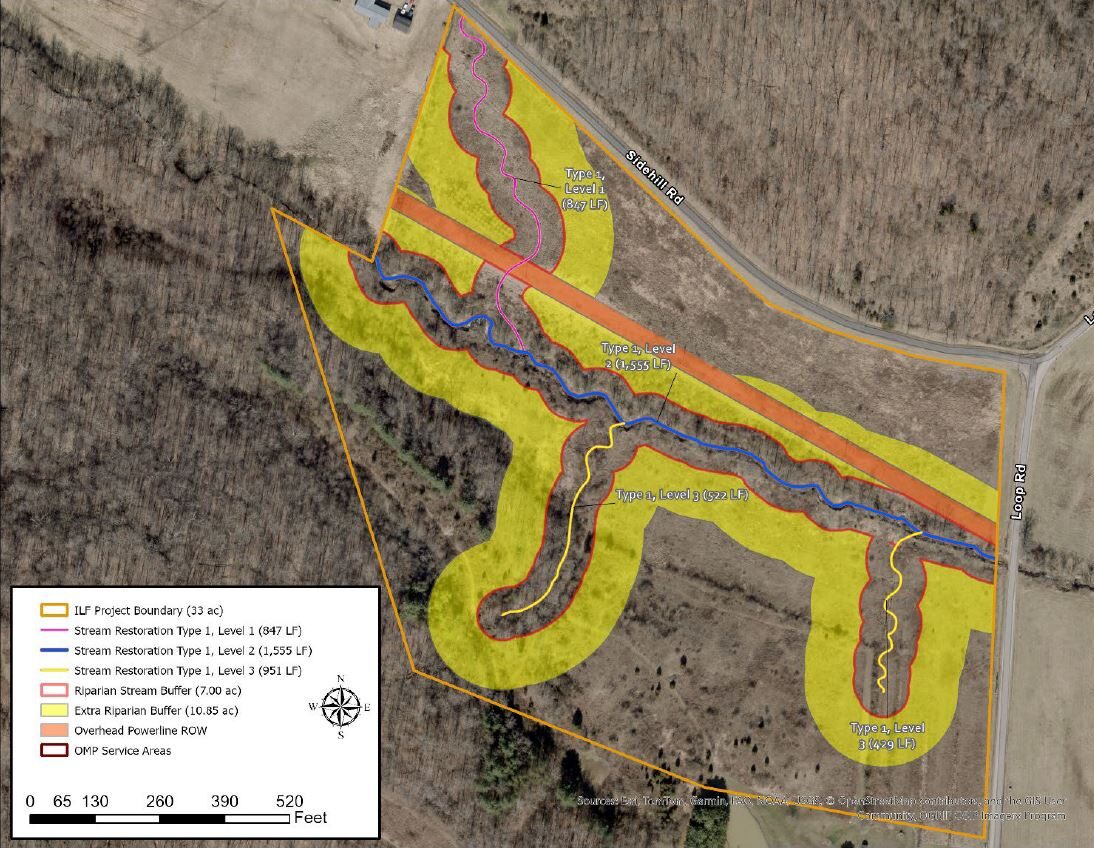
Over the past year, United Plant Savers has been engaged in discussions with the Nature Conservancy regarding a stream restoration project. The Nature Conservancy oversees the Ohio Mitigation Program (OMP), a state-run initiative that directs funds from development projects—such as road expansions that impact streams or wetlands—toward restoration efforts in the same watershed. United Plant Savers was approached as a potential location for this program, and we were excited about the opportunity to collaborate with the Nature Conservancy to enhance our local watershed.
Ultimately, the project did not move forward. When it became clear that glyphosate could be used as part of the restoration work, we made the decision to step away. Our commitment to maintaining the Botanical Sanctuary as a no-spray landscape is unwavering.
The Sanctuary’s History and Stewardship Approach
The sanctuary property possesses a complex history. The “Talking Forest Medicine Trail” guides visitors through a healthy hardwood forest, showcasing spring ephemerals and iconic woodland botanicals like ginseng and goldenseal. In contrast, the “Reclaim Trail” traverses an area previously strip mined. Under the initial stewardship of Paul Strauss and for over three decades, restoration efforts—undertaken without herbicides—have revived wildlife, established a prairie, and created the heart pond. Invasive species have been managed through manual removal and controlled burns, relying on careful observation and tending the wild with the help of staff, interns, and volunteers.
Within our forest farming workshops, we openly discuss the pros and cons of using herbicides, fungicides, and pesticides in forest management. Our demonstration gardens, forest farming research areas, and propagation protocols strictly avoid the use of these chemicals. Instead, we teach alternative techniques for managing ecosystems and demonstrate their effectiveness.
Addressing Invasive Species:
Autumn Olive and Anticipated Challenges
The primary invasive species present in the area designated for mitigation work is autumn olive (Elaeagnus umbellata), which has become established on the property. Restoration activities may disturb the land further, potentially opening opportunities for additional invasive species to appear. Despite these challenges, our team is confident in our manual removal methods for managing invasives. Years of experience and ongoing stewardship have prepared us to address both current and future invasions without resorting to chemical interventions.
Last fall, we began collecting native tree, grass, and prairie seeds from the sanctuary to grow and replant after stream restoration is complete. We envisioned this project as a model for removing invasives without herbicides and replanting with hyperlocal genetics for native plants.
Unfortunately, in the final weeks before signing the contract, we learned that the Nature Conservancy required the use of herbicides (such as glyphosate) to meet state and federal standards for non-native plant removal. Without our agreement to use herbicides, the Nature Conservancy would not proceed.
General overview photo of the proposed ILF Project area looking southeast
The Challenge of Large-Scale Invasive Removal
Managing invasive plants on a large scale is extremely challenging. Many organizations choose herbicides for restoring native habitats, as it requires less labor and time. We share our situation not to judge, but to highlight the complexity and uniqueness of each project. The controversy surrounding herbicides has grown, especially with lawsuits against Bayer (formerly Monsanto) linking exposure to Roundup (glyphosate) to cancer. Twenty-eight countries have banned glyphosate due to these risks, let that sink in. Beyond human health concerns, the ecological impact on soil and agricultural food systems is profound because of widespread chemical use.
We also wish to honor Dr. Eliane Ingham, founder of the Soil Food Web school, who dedicated her life to helping farmers restore soil health by fostering bacterial, fungal, protozoan, and nematode communities rather than relying on chemicals. Her work underscores the connection between soil biology and human health: “We are what we eat.”
Despite this serious setback to our goals and to our budget, we want to demonstrate that restoration can occur without poisoning the places we steward. We remain committed to United Plant Savers’ mission of conserving native medicinal plants and sharing knowledge about sustainable conservation practices.
Forestry Practices and the Impact of Herbicides
In the book “Finding the Mother Tree” by Suzanne Simard, the author recounts her experience in the Canadian forestry industry, examining the effects of using glyphosate after clear-cutting to eliminate “competing” deciduous trees. Her research demonstrated that the removal of species like birch did not benefit conifers; instead, it caused them to struggle, as birch acted as a protective nurse plant, passing carbon to young fir trees. Nevertheless, herbicide use remains a common practice in modern forestry.
Invasive Plants and Ecosystem Services
Invasive plants are a global issue, often resulting from the destruction of forests and native habitats without recognizing their valuable ecosystem services. Protecting native habitat is way more cost effective then restoring a disturbed ecosystem. These opportunistic species thrive in disturbed areas and can teach us important lessons. The book “Love Them to Death,” edited by Wendy Applequist and published by Missouri Botanical Garden Press, encourages readers to consider economic uses for regional invasive plants. This peer-reviewed volume brings together contributions from professionals and artisans, exploring plant uses for food, drink, herbal medicine, basketry, livestock forage, biofuel, structural materials, paper, and dyes. We need to shift the paradigm in how we value protecting ecosystems, and how we take on restoration and invasive plant management.
Policy and Advocacy
Recently, the news reported that the current U.S. President invoked the Defense Production Act to boost glyphosate production and grant immunity to corporations manufacturing these products. While much of the world moves away from toxic chemicals, the United States appears to be doubling down, creating a challenging situation for those advocating for chemical-free conservation.
Moving Forward: A Call to Action
We are determined to pursue this restoration project and serve as an example of conservation without glyphosate or other herbicides. Achieving this goal depends on the support of our members. If everyone reading this article encouraged a friend to become a member or joined themselves, we could continue this project and demonstrate the effectiveness of chemical-free stewardship. JOIN NOW.