By Goda Trakumaite
The first thing that struck me when I arrived at the Brick House for the residency was the across-the-streetness from the Ohio River. I used my phone’s map on satellite view to assess what there might be to visit at dusk on the waterfront and noticed the unusual feature of a dock at the nearby fast-food restaurant. I hopped on my bike and rode over there for an ice cream cone. Sitting down to eat it on the wooden steps above the water, I was greeted by a riverside stand of pink swamp mallows (Hibiscus moscheutos), gently wavering as the incandescent yellow of the restaurant’s tall “M” above us flickered on with the descending light.
Next afternoon, I made the 20-minute drive to the United Plant Savers Sanctuary. Pink and white swamp mallows were wavering there too, along the edges of Heart Pond. This plant was popping up for me this season in a way things sometimes do when you take the time to notice them. I had seen a stand earlier that summer at the lake in a park near my house. I had crushed up their baroque seed pods as part of a seed cleaning project. I had also taken a tray of their sad looking seedlings home from my new job at a wholesale nursery. I ended up forgetting about the little plants for months and eventually dumped them out onto the compost pile. But that’s time and space travel. For now I am back in Pomeroy and Rutland, noticing the swamp mallows on the edges of their waters.
These mallows persisted through the residency, offering the kind of recurrence or motif that for us humans call for interpretation or, at the very least, representation. I was pointing them out and photographing them everywhere I saw them, and they ended up making it into two of the three drawings I completed there. I also ended up embroidering one onto the pocket of my shirt during a workshop taught by one of the other residents. What was the mallow pointing to showing up in all these separate places?
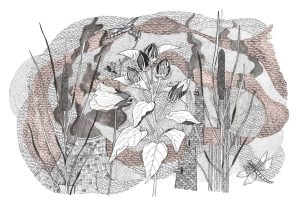
For one, it was inescapably pointing to the fact that both it, and I, liked spending time by the water. By inviting repeat visits, it couldn’t help but gradually reveal other things about itself and aspects of its role in the world around it. On one Heart Pond beach day, as I watched the sun playing on the water’s surface, I noticed that dragonflies seemed to be using the dried stalks of last year’s mallows, still standing amid this year’s blooms as resting places. This simple observation happily validated the naturalistic (and labor saving) imperative I try to follow to “leave the stalks for the insects” when gardening. I put this moment into a drawing next to reflections of smokestacks I had seen rippling in the river on a bike ride earlier that same day. Their smoke and steam were mingling in with the soft clouds of the blue summer sky until it was impossible to tell any difference between the two.
These two architectures next to each other—the human-made concrete stalks and the human-left-alone fibrous stalks of last year’s mallows—hint at the depth of the Deep Ecology in the residency’s title. Staying on the waterfront in Pomeroy, visiting the Sanctuary, and traversing the landscape between them, the other residents and I got to constantly observe one in the context of the other. The restored and tended Sanctuary (formerly part strip mine) did not feel separate from the developed and then run-down riverfront or from the long barges of coal we could watch float by through the windows of our kitchen.
To track this lack of separateness, one day we took a field trip to try and find the confluence, the place where the creek that runs through the Sanctuary empties out into the river. We crossed over the bridge and the state line and drove slowly parallel to the water, again consulting the satellites on our phones and letting other cars pass us by as we looked out for some waterfront access devoid of “No Trespassing” signs. Eventually we found an unmowed lot to park in and walked down an unkempt sandy riverbank. There it was, hard to fully make out, across the river from us—one small body of water joining a much larger one. It was an unmarked, barely visible living monument to the fluid links that tie together just about everything. Noticing the literal tie between the Sanctuary and the town is also noticing the inevitable connections and overflows between the “pristine” and the “polluted.” The metaphor, or the physical reality, carries into how we can understand the cause and effect of human interactions within these landscapes.
Sanctuary Steward Chip generously provided even more context to mull on during a hike on the medicine trail. He told us about how when he first started working at UpS decades ago, he vilified the diggers, whom he saw as ravaging wild populations of the local ginseng (Panax quinquefolius) and goldenseal (Hydrastis canadensis). But with time and deeper observation, his perspective inevitably widened, and what came to the forefront were the unavoidable pressures of an economically depressed region no longer able to reliably depend on coal mining for a livelihood. The lack of work opportunities, alongside the achingly familiar story of the opioid crisis reaching into so many crevices of the country, encouraged some to take advantage of the native medicinals for quick cash. The choice to indiscriminately dig did not come from nowhere. If anything was the villain, it seems it was the cycle of extractive logic inevitably permeating all aspects of how we stay alive.
The high value of ginseng and goldenseal has in recent history led to their devastation, but UpS’s work of teaching cultivation and sustainable harvesting methods suggests that it might be possible to remember and revive how this same value can instead lead to a committed tending of the medicine and the land that supports it. The difference in the two approaches boils down to whether or not we perceive the essential relationship between all things; to whether we viscerally understand that how we harvest now determines whether we are able to harvest at all in the future. Outside of some feel-good, seemingly impractical, and unscalable concept of relatedness, can we learn to see the sameness of all that we breathe in, ingest, dig up, sell, buy, care for, and eventually dispose of, abandon, excrete, and sometimes represent?
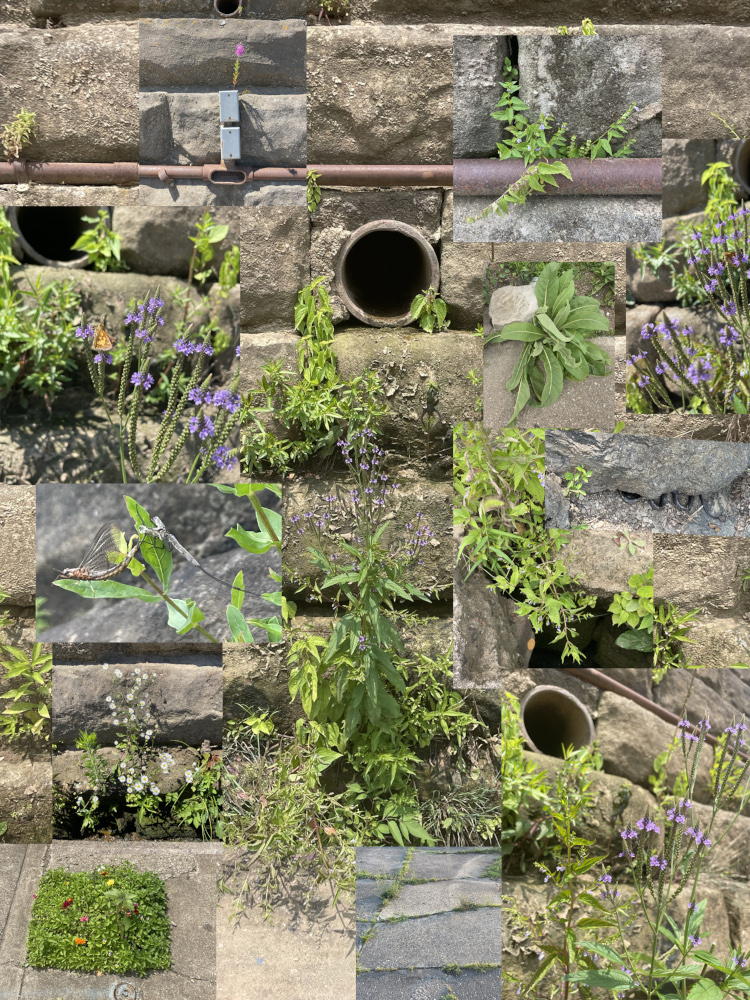
Another unmarked monument stands out when I reflect on my residency experience. On an afternoon foray outside the Brick House on my second or third day there, I noticed a blue vervain (Verbena hastata) and a skullcap (Scutellaria lateriflora) growing out of a crack in the retaining brick wall along the downtown dock. Closer investigation uncovered more of both plants poking out of other wall cracks, but these two exemplary specimens were gloriously in flower, positioned right below a pipe offering the wet feet both prefer for their fullest expression. I felt grateful for having had the time and the prior knowledge to notice these powerful native nervines amidst the more prevalent loosestrife (Lythrum salicaria) emerging elsewhere from the wall.
Almost every day after that I would return to notice this particular crack, and almost every day the visit would reveal something else. One afternoon I caught a swarm of mayflies mid-molt, shaking off their former skins and emerging into the next phase of their multi-staged life-cycle. It required not just close observation, but also a little bit of research to make sense of the strange process I was seeing. Looking at something I recognized as special led to a serendipitous witnessing of something I had not even known existed.
The final weekend of the residency coincided with Pomeroy’s Blues Bash. We watched the energy of the town and its riverfront morph as motorboats pulled up and parked to camp out by the usually sleepy Blue Vervain and Skullcap Dock. On our final evening there, I took one of the other residents down to the famous wall crack to show her these special plants. A group of festival attendees had set up a tented table right next to them. We apologized for intruding and explained what we were there to see and why, and after a brief awkward peek, ambled away, sensing the bemused stares behind us. I understood our role in that moment as annoying, interloping weird “artists,” clearly out of place on that version of the festival dock. Yet, then and now, I wonder what it would mean to shift collective attention more towards that which was thankfully showing up in the cracks of the crumbling structures we’ve built for ourselves.
When I got home from the residency, the swamp mallow seedlings I had tried to abandon seemed to be still somehow intact and alive in the lazy compost pile. Their roots were still healthy and white, exposed to the air and grasping tightly onto nothing but the soil in which they had germinated. Appreciating their resilience, I stuck them into a pot with more soil. There they stubbornly continued to persist and even grow taller into the fall, at which point I planted them out in the overflow area by my rain barrel. We will see if they pop up to waver there in the spring.
Goda Trakumaite is a multimedia artist and educator. She is currently gardening and growing seeds somewhere in between the Jersey pine barrens and the Delaware bayshore in the traditional territory of the Lenni-Lenape.