Vashon Island, Washington
Sanctuary Steward: Michael Laurie and Diane Emerson

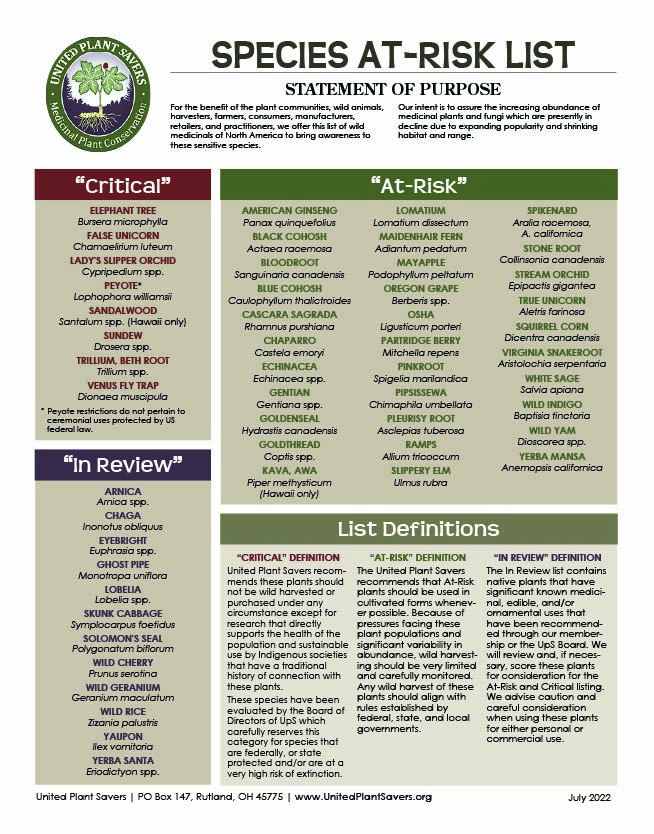
We are growing small quantities of medicinal plants on a 3 1/2-acre site on Vashon Island, Washington, a short ferry ride from Seattle. We are growing several plants on the at-risk and to-watch lists, including arnica (Arnica spp.), black cohosh (Actaea racemosa), cascara sagrada (Rhamnus purshiana), echinacea (Echinacea spp.), goldenseal (Hydrastis canadensis), maidenhair fern (Adiantum pedatum), mayapple (Podophyllum peltatum), Oregon grape (Mahonia aquifolium), osha (Ligusticum porteri), spikenard (Aralia racemosa), wild yam (Dioscorea villosa), and yerba mansa (Anemopsis californica). Our property has been a member of the UPS Botanical Sanctuary Network for over 10 years.
Right after purchasing the property 17 years ago, we went to work removing invasive plants, including holly, ivy, and Himalayan blackberry. And at the same time, we spent a few weeks transplanting several medicinal plants we started growing at another site. Not only are we growing several at-risk and to-watch plants, but we also are growing over 265 species of plants that are mostly either medicinal, native, or perennial edibles.
There are many reasons why growing medicinal plants here is important to us. I share the vision of helping to protect and restore medicinal plants that are over-picked in the wild. But I also think it is important for our island community to have a living pharmacy of medicines that they can make use of right here and hopefully for some of them, right out of their backyard. This makes sense to me because it is more resilient, it is cheaper than exclusively relying on pharmaceutical drugs, and it has a lower carbon footprint.
I have been making use of medicinal plants for over 45 years and have been growing medicinal plants for over 23 years. I first became interested in medicinal plants when I read about them in the Whole Earth catalog many years ago. It made perfect sense and seemed exciting to me to be able to take responsibility for some of my own medicine including growing some of it. I was encouraged by meeting other people through the years who shared my interest in medicinal plants.
But one disappointment to me has been how hard it has been to interest the general public in medicinal products and plants. I assumed that it would be an obvious evolution that more and more of the general public would adopt the use of medicinal plants. But while their interest has grown, it is still stuck at a much lower level than I expected by now. I feel bad that they are missing out on the joys of growing some of their own medicine and making use of medicine from plants that can be grown locally. I am at a loss as to how to get the pace of adoption of medicinal plants to increase. But I have not given up on spreading the word, growing the plants, and making the products.
We now have planted from starts or seeds over 20 species of native plants into the 3 acres of forest on the property in an attempt to restore the wild native forest. This forest borders on about 100 acres of forest on other property. So, this makes for a sizable forest to protect and restore. Recently we completed the building of a trail that goes down the slope behind our home through the forest that we are restoring to the ravine at the bottom. There are a number of old growth Western red cedar trees in our forest. So, by protecting and restoring the forest we are taking action to continue the carbon sequestering that these trees and the soil network are carrying out.

After purchasing the property and establishing and planting new medicinals, we made small quantities of tinctures and oils and dried some for use as tea. For a few years, I made and sold tinctures and oils at the Vashon Farmers Market. Now I mostly make these products for myself, my wife Diane, and friends and family. There are many plants that I have developed a special relationship with. One of the first plants that I wildcrafted was valerian (Valeriana officinalis) growing up in the Cascade mountains of Washington state. I was really impressed with how it helped me relax and fall asleep easily. We still grow and make use of valerian here. I also remember the first time I tried a few leaves of skullcap (Scutellaria baicalensis) from a garden.
The feeling of ease and clarity it provided impacted my whole day. Goldenseal works wonders for drying up the congestion I get from life-long allergies. Bleeding heart (Dicentra spp.) is a favorite for many reasons. When I sold tinctures at the market, bleeding heart was the most popular one. It is a native plant around here, and its flowers stick around for a long time to add their beauty to the garden and forest floors. I chose to have a tattoo of it on my ring finger for our wedding ring because Diane and I did not want to have the climate impact that comes from metal rings. And speaking of Diane, we both like the tea plant because it drew Diane’s interest on a garden tour of my property the first time we met. Her coming back to harvest some of the tea leaves led to us dating and eventually getting married.
We also focused on making the property a model of sustainability by adding some of the following measures: 5 rainwater systems, a rain garden, certified wildlife habitat, a green roof on the toolshed, drip irrigation, worm bins, a hugelkulture bed, use of sustainably harvested lumber from Vashon for the raised beds, Forest Stewardship Council (FSC) lumber for a deck rebuilding project, efficient home appliances, ductless heat pump heating, air sealing, and more.

We have led over 10 tours and classes here. The tours have typically provided information on our medicinal plants as well as the sustainability features. In 2017 we co-taught a 2-day class on growing and using medicinal plants. We also had two educational tours for permaculture classes and two classes on the design and installation of the rain garden.
In 2020, after we became a certified nursery, we had plans for many plant sales, but the pandemic led to a modification of that. We still had a few sales on site with one customer at a time with masks and social distancing. We also sold our medicinal plants and native plants through a Vashon based on-line system called Vashon Fresh. This system allowed us to make sales on-line, and twice a week we delivered the ordered plants to a pickup station on island.

Going forward we plan to continue selling through Vashon Fresh or on-site in a safe way. And when COVID is no longer a danger, we will have more tours, classes, and plant sales for the public on site. And we will continue to add more native plants to the forest and protect the ones we have already planted. Last Fall we saved seeds from over 40 species of natives and medicinals and planted some of them in the fall and winter. We plan to plant more of these seeds and hope to sell many of the starts next spring. And Michael took on the challenge of planting American ginseng (Panax quinquefolius) seeds last fall in a special bed in the shade of paw paw, hawthorn (Crataegus spp.), and ginkgos (Ginkgo biloba). He worked to make the soil more alkaline, and he put some other ginseng seeds in a bag of wet sand in the freezer. We look forward to what surprises these seeds will provide for us in the coming months and years.