By Susan Leopold
History of medicinal use
Trilliums have a rich history in medicinal use here in the United States but also in China, India, Pakistan, and other regions around the world where they grow. Trillium govanianum, native to Pakistan is an example of another species facing pressure due to its slow-growing nature and demand in the regional medicinal plant trade. The bioactive components of trillium roots/bulbs are steroid saponins. Plant derived steroid saponins occur in a wide variety of plants, and there are numerous articles on the health benefits of these plant steroids. Trilliums are also known to be astringent, tonic, and antiseptic, which makes for wide application in their being used as an ingredient in herbal formulas as well as single tinctures. The common name, birth root or beth root indicates that it has a history of use for women during and after birth and for preventing and mitigating hemorrhages. Further description can be found in Kings Dispensatory (1898) and in numerous early American herbals. There is a long history in rural Appalachia of side income derived from the trapping for the fur trade as well as digging roots and harvesting barks for the medicinal plant trade going back to the 1700s. Knowledge of native medicinal plants was derived from diverse encounters with the many Indigenous tribes of the North American region. Much of the plant knowledge and formulation of herbal products is based on folk knowledge that has been passed down over generations. The demand for herbal products in the United States hit a peak during the late 1800s and early 1900s when there were many schools of eclectic medicine that promoted the use of plant-based remedies. During this period it was common to purchase a plethora of herbal based medicines at any small store. This all changed with the dominance of trained allopathic doctors and the development and use of pharmaceutically derived medicines.
Currently we are witnessing a renaissance in the demand for plant-based products that are currently regulated under the Dietary Supplement Act passed in 1994. The legislation provides some regulation for herbal products but clearly states that no medical claims can be made on them. This regulation creates a conundrum on how products are marketed and the subsequent research on understanding the medicinal properties of these plants and how they are formulated. There are GAP (good agricultural practices) guidelines for handling and processing plant material to ensure that it is washed, dried, and handled appropriately, but these practices neither address conservation concerns nor proper identification when there are many similar species such as trilliums. Companies are required to document some form of tracking the plants in the supply chain. This can be done with a herbarium specimen or through the use of HPTLC or DNA but these “markers” or testing techniques are unable to properly identify similar species, and a company is only held accountable if they are audited by the FDA. Plants that are used in the making of pharmaceutical grade drugs must comply with much stricter conservation protocols, but for the Dietary Supplement Act these requirements on sustainability do not apply.
Information on the trade
The medicinal plant trade in general is unregulated in the United States unless a plant is listed on CITES and requires a permit for export. Trillium in not listed on CITES at this time and therefore is unregulated. Plants on the endangered or threatened list can still be harvested on private lands without consequence. On public lands such as the National Forest a permit may be required for digging plants, but the permit process varies from region to region. So how do we know what is happening on the ground in the trillium trade? The use of Facebook by dealers and diggers to advertise prices is one way to gauge current demand. There are well over a dozen or so dealer and digger Facebook pages with thousands of followers that provide a good sense of how large the network is across the southern region of Appalachia.
To supply the herbal products industry with wild harvested plant material it takes a big network over a large geographical area to accumulate enough wild harvested plant material. One example of an active Facebook page is the “Root Diggers of All Kinds” where the prices advertised for trillium over the summer of 2020 were one dollar per pound wet and two dollars per pound dried. Depending on the size of the trillium rhizome, a pound of dried root could range dramatically. Generally speaking, the rhizomes are often rounded and the size of a gumball, so a pound of dried root could be around 100 individual plants. Often dealers will advertise a lower price than the going rate and, depending on supply and demand, will negotiate the closing price at time of sale.
Another source of current information on trade can be found in the Root Report, a project of the Department of Forest Resources and Environmental Conservation at Virginia Tech. From 2013-2016 a confidential, voluntary questionnaire was sent to registered ginseng dealers in southwest Virginia, eastern Kentucky, and West Virginia about the other herbs they purchased. The goal was to be able to estimate the annual output of some of the more commonly traded medicinal forest products to better understand their value and where they are being harvested. In this report from 2013-2016 1,338 pounds of trillium were reported being purchased at an average price of $3.11 cents per pound. It is important to note that the number of dealers surveyed is just a fraction of those who purchased in those years or reported purchasing, so the number is most certainly higher in total pounds traded. The American Herbal Products Association also has a voluntary process where companies can report purchases of raw botanicals. The last survey year to be reported and published is 2010 when 594 pounds of wild harvested plants were reported for that year down from 2002 when 2,403 pounds were reported. It is important to note that cultivated trilliums have never been reported as a source. Certainly there could be a trend towards a diminishing demand in natural product companies using trilliums in products. Note that it is only a fraction of companies that chose to participate in the AHPA tonnage survey, so the numbers are obviously higher than the reports show. A quick search on Amazon or Google will reveal that trilliums are sold as a tincture by numerous companies and as a plant used both in capsule and liquid formulas.
The nursery trade in trilliums is difficult to report on because it is a very lucrative trade. Native plant nurseries and the native plant community have strict ethical guidelines against digging plants out of the wild for resale. Even though native plant regional societies and native plant nurseries have clear guidelines, trilliums are a highly sought-after plant in the nursery trade for their beautiful flowers and fondness as a spring ephemeral and sell for anywhere from five to fifteen dollars for a single plant. There is a huge discrepancy in the value of trillium as a living plant in the nursery trade and the value of the dried root for the medicinal plant trade. How can one pound of fresh root be valued at one to three dollars, when a pound of fresh root could be nearly 100 plants that could be sold for five dollars a plant, a value of five hundred dollars or 500% difference? In personal conversations with dealers, they lament that it is difficult to find diggers who have harvested and dried trilliums when they can sell a single rhizome fresh for a high price to those looking to repot and sell the plants into the nursery plant trade. In personal comments from a digger, the dealer told the digger that if she did not dig trillium in the spring, the dealer would not buy the digger’s ginseng in the fall. (link below to youtube video on the trillium trade)
The Geography of the Trillium Trade and Its Conservation Consequences
The trillium trade is a cash economy that is difficult to track. The conservation concern for trilliums is that the trade takes place in southern Appalachia, West Virginia, Kentucky, Ohio, Tennessee, and Georgia. The southern Appalachian region is also the center of diversity for trilliums in the world, and many of these species are threatened. Most trilliums are dug in the early spring as soon as their three leaves appear. Trilliums are spring ephemerals and after they flower, they start to disappear. Most diggers will dig any trillium species and may not be aware of which species are threatened or endangered, since the three leaves are a visual signature of trilliums and plants are often dug before they even flower, which also diminishes their ability to reproduce by seed. Even though Trillium erectum (a species that is not threatened and has a large geographical range) is the name used to market and sell dried medicinal trilliums in the medicinal plant trade, there is no way of knowing which species of trillium was harvested by looking at the dried root. Dried trillium can be found on sale via Amazon, Etsy, and several herb companies for around $40 per dried pound. The trade alone is likely not the main threat to trilliums. Deer browse due to over population and lack of top predators in the ecosystem, invasive species, the decline of healthy forests, and the fragmentation of the landscape combined create the perfect storm for vulnerable trillium species in the southern Appalachian region.
Ending the Trillium Trade in Commercial Herbal Products And Suggestions for Analogs
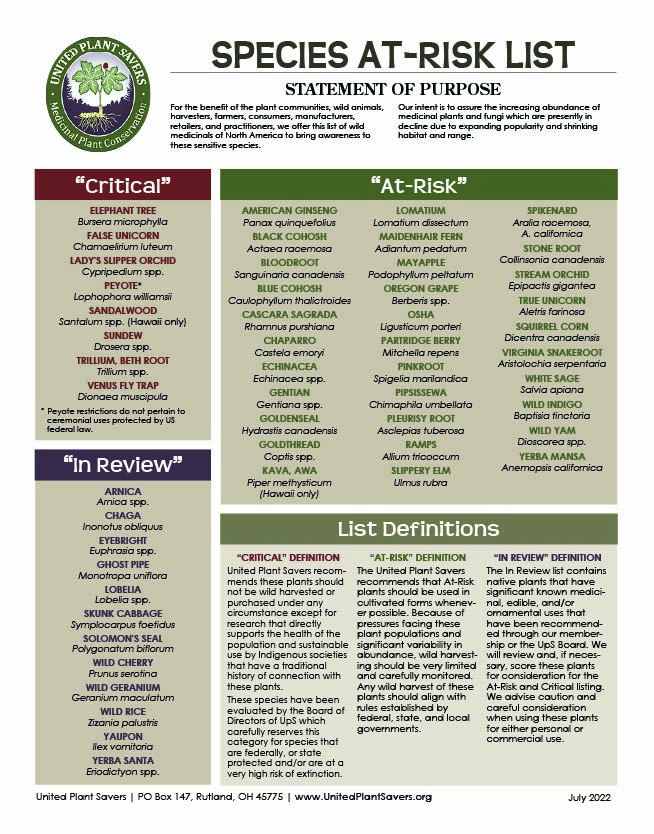
United Plant Savers, a non-profit founded in 1994 dedicated to native medicinal plant conservation, listed trillium species on its “At-Risk” list, but has now moved it to “Critical”. There are several common species that are abundant and easy to cultivate and provide accessible analogs for the traditional uses of trillium. Motherwort (Leonurus cardiaca) is an effective uterine tonic. Yarrow (Achillea millefolium) can be used as a plant that is very effective as an anti-hemorrhage herb as well as Shepherd’s purse (Capsella bursa-pastoris), which is also useful as an astringent. Raspberry leaf (Rubus idaeus) is used to tonify the reproductive system. United Plant Savers supports the work of those who are dedicated to cultivating trillium for the horticulture trade and for conservation purposes. Without any efforts to use cultivated sources of trillium for the commercial trade in herbal products, compounded by the fragility of such a slow growing woodland spring ephemeral, United Plant Savers advocates for the ending of the trillium trade in commercial herbal products.
References
- Article, https://unitedplantsavers.org/blooming-habitat-regeneration-of-trillium-govanianum/
- Root Report, https://www.rootreport.frec.vt.edu/docs/RootReport2020.pdf
- AHPA tonnage report, https://unitedplantsavers.org/wp-content/uploads/2016/05/Tonnage_06-10_Report_FINAL.pdf
- Digger interview, https://unitedplantsavers.org/lets-end-the-trillium-trade/
- Felter, H.W. and J. U. Lloyd. 1898. King’s American Dispensatory. Cincinnati: The Ohio Valley Company.
- PubMed https://pubmed.ncbi.nlm.nih.gov/
- Li, Manzhong; Ouyang, Junyao; Zhang, Yi; Cheng, Brian Chi Yan; Zhan, Yu; Yang, Le; Zou, Haiyan; Zhao, Hui. Effects of total saponins from Trillium tschonoskii rhizome on grey and white matter injury evaluated by quantitative multiparametric MRI in a rat model of ischemic stroke. 2018-04-06.
- Amazon listing, https://www.amazon.com/Beth-Root-Cut-Sifted-Wildcrafted/dp/B0032JZMA4
- Etsy listing, https://www.etsy.com/listing/757218891/beth-root-trillium-erectum-culitvated