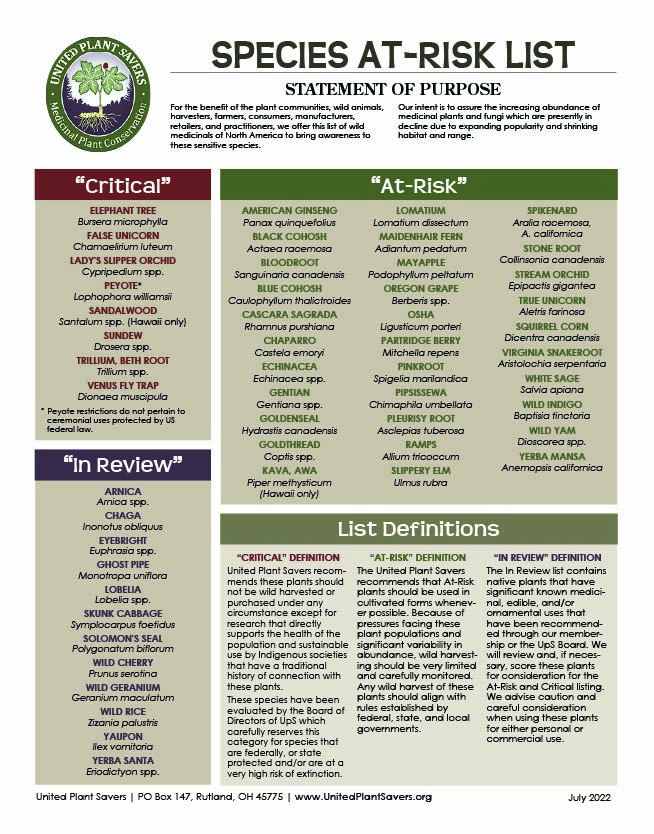
False Unicorn Root
(Chamaelirium luteum)
Overall At-Risk Score: 49
Latin name:
Chamaelirium luteum
Common Name:
Blazingstar, Devil’s Bit, Fairywand, False Unicorn (Root), Helonias
Family:
Melanthiaceae (Bunchflower family)
Geographic Region:
False unicorn root can be found in most of the eastern U.S. Specifically, it is found in the states of Alabama, Arkansas, Connecticut, Delaware, Florida, Georgia, Illinois, Indiana, Kentucky, Louisiana, Maryland, Massachusetts, Michigan, Mississippi, New Jersey, New York, North Carolina, Ohio, Pennsylvania, South Carolina, Tennessee, Virginia, and West Virginia. It is also found, rarely, in the southern portion of the Canadian province of Ontario.
Habitat:
False unicorn root prefers shady meadows and forests and moist, acidic soil.
Lifespan:
Perennial
Reproduction:
False unicorn root plants all have a distinct sex, and only the female plant is capable of producing seeds. These seeds are dispersed by both the wind and via passing wildlife getting the seeds stuck in their fur.
Ability to Withstand Disturbance and Overharvest:
Overharvest is the biggest concern when it comes to the wellbeing of the false unicorn root population because harvesting the rhizome–the part most commonly used for medicinal purposes–also kills the entire plant.
Status of Endangered/Threatened (by state):
Chamaelirium luteum is listed as “Threatened” in New York and “Endangered” in Connecticut, Indiana, and Massachusetts.
Chamaelirium luteum has not yet been evaluated by the IUCN Red List.
Part of Plant Used/Active Medicinal Compounds:
The rhizome of false unicorn root has been found to have a combination of steroidal saponins, such as aglycone diosgenin and chamaelirin. It has been used historically to treat menstrual issues and in an attempt to improve fertility and has modern uses as an anti-inflammatory, as well as a treatment for ovarian cysts.
Demand:
Demand for this plant has been steadily increasing over recent years, though it still remains relatively unknown when compared to more popular plants on the “At-Risk” list like Ginseng. It is commonly used both for its medicinal purposes, as well as a decorative plant in cottage gardens.
Wild Harvesting Impact On Other Species and Lookalikes:
Wild harvesting false unicorn root patches involves disturbing large areas of the soil, which can disrupt the ecosystem and allow invasive plants to become established.
Recommended Alternatives For Industrial and Home Use:
Almost all false unicorn root is wild-harvested, so it is best to avoid using it for medicinal purposes. Cultivating your own seeds is a viable option for those with extra room in their gardens, however, and more places are beginning to cultivate Chamaelirium in order to sell the seeds and make them more accessible for people.
You can find an article we wrote on false unicorn root cultivation here
Citations
- Carroll, C. (2011, May 2). False Unicorn Cultivation. Retrieved July 24, 2019, from https://unitedplantsavers.org/184-false-unicorn-cultivation/
- eFloras. (n.d.). Chamaelirium luteum in Flora of North America. Missouri Botanical Garden, St. Louis, MO & Harvard University Herbaria, Cambridge, MA. Retrieved July 24, 2019, from http://efloras.org/florataxon.aspx?flora_id=1&taxon_id=242101521
- Greenfield, J. MS. & Davis, J. M. PhD. (2018, March). False Unicorn, Fairywand Chamaelirium [Chamaelirium luteum (L.) A. Gray]. Retrieved from https://asdevelop.org/wp-content/uploads/2018/03/FalseUnicorn-gg.pdf
- Hill, S. R., PhD. (2006, November 7). Conservation Assessment for the Fairy-wand (Chamaelirium luteum (L.) A.Gray). U.S.D.A. Forest Service, Eastern Region.
- USDA. (n.d.). Plants Profile for Chamaelirium luteum (fairywand). Retrieved July 24, 2019, from https://plants.usda.gov/core/profile?symbol=CHLU
- USDA, Agricultural Research Service, National Plant Germplasm System. 2019. Germplasm Resources Information Network (GRIN-Taxonomy).
- National Germplasm Resources Laboratory, Beltsville, Maryland. URL: https://npgsweb.ars-grin.gov/gringlobal/taxonomydetail.aspx?402533. Accessed 24 July 2019.
Related Posts
Salvation for Medicinal Herbs
Salvation for Medicinal Herbs Ute Eberle und Susi Lotz Text | Katharina Poblotzki Fotos They reappear shortly after the last snow has thawed …
Endangered Plants and Women’s Health: Fertility Herbs At Risk
Written by Susan Leopold, PhD for Herbal Reality. It was early this spring in 2021 when visiting a friend in southern Virginia that I came across a …
Creating New Forests for Medicinal Plants
By Michael Pilarski United Plant Savers has done great work with 1) preserving what we currently have; and 2) encouraging more farming of medicinal plants …