By Matthew Alfs, MH, RH (AHG)
There is an old legend common to various Native-American peoples that goes roughly like this: When the two-legged ones (humans) began to hunt animals without mercy and respect, the various animals held councils to decide whether and how to strike back. The plants, however, felt sorry for the two-legged ones and decided to come to their aid, especially relative to the discomforts and diseases brought about by the insects. When reflecting upon this story, I have often thought that the plants displayed real empathy here, as they themselves had been continually harassed by insects that had infested them, sucked their juices, and even devoured them.
It is this very example of insect molestation that leads us to a most fitting illustration of how the plants offer their assistance to us two-legged ones. Here, in Minnesota, where my Midwest School of Herbal Studies (www.midwestherbalstudies.com) is located, we are particular harassed by a little winged creature that we jokingly refer to as “Minnesota’s State Bird”—namely, the mosquito. But we also harbor a healing herb that is the greatest repellant of mosquitoes known to us Midwesterners, which happens to be that feline delight known as catnip (Nepeta cataria). As a long-time outdoorsman who has chewed leaves of this odoriferous mint and applied them as a rub on my exposed skin for decades, I can testify to its remarkable effects in this regard. Then, too, several scientific studies have shown catnip essential oil to powerfully repel mosquitoes (Birkett et al 2009; Feaster et al 2009; Peterson et al 2009).

I have a special fondness for this plant, as it was the very herb that introduced me to the power of herbal medicine—way back in the late 1970s—and has offered its assistance to me ever since in a plentitude of ways. One thing that herbalists have long appreciated, however, is that, if we are willing to pay attention, the plants themselves can inform us as to how they can be used for healing.
The Doctrine of Signatures
Herbalists have long appreciated that a plant’s color, shape, habitat, and even personality can clue one into its medicinal applications. This understanding has been called The Doctrine of Signatures. Let me illustrate this with a landmark discovery in my clinical career. A little over a decade ago, I was struggling with how to help some clients with autoimmune joint conditions that produced terrible stabbing pain and stiffness. Perhaps providentially, I came across an old herbal that related how an elderly female folk herbalist from the hills had healed a young girl afflicted with just such a malady (nowadays referred to as a spondyloarthropathy) with the herbage of bull thistle (Cirsium vulgare), the scariest looking of all the thistles, with its nasty spines that can jab a person something fierce and even blind an eye that comes in contact with them. Looking at the photo of the plant as featured here, you can observe the sharp spines and the overall stiff look of the plant, which practically shout out its healing potential to those afflicted with stiffness and stabbing pains. In fact, the plant proved to be nothing short of miraculous in helping my suffering clients to heal. Nowadays, then, whenever I run across bull thistle in the wild, I thank it profusely for its aid here. In doing so, I get the strong impression that it has been very happy to help out, per the Native-American story referred to above.
Hawthorn (Crataegus spp.) shrubs also have large, stabbing thorns and, correspondingly, have been used for the lancinating pain of angina. This was further surmised from the color of the flowers and fruits—red, the color of the heart and blood. Interestingly, almost every herb used to support cardiovascular health is red or reddish in color. Think here of cinnamon (Cinnamomum spp.), motherwort (Leonurus cardiaca), prickly ash (Zanthoxylum americanum), red sage (Salvia miltiorrhiza), rose (Rosa spp.), rosemary (Rosmarinus officinalis), wild bergamot (Monarda fistulosa), anise hyssop (Agastache foeniculum), bloodroot (Sanguinaria canadensis), and wild cherry (Prunus avium). Shepherd’s purse (Capsella bursa-pastoris) has heart-shaped seed pods and thus has also been used to support cardiovascular health, especially with reference to hypertension and bleeding.
Plants that are deep or dark yellow and thus the color of bile have been thought to heal the hepatobiliary system, and thus we think of dandelion (Taraxacum officinale), celandine (Chelidonium majus), toadflax (Linaria vulgaris), turmeric (Curcuma longa), yellow dock (Rumex crispus), yellow goat’s-beard (Tragopogon spp.), yellow root (Xanthoriza simplicissima), goldenseal (Hydrastis canadensis), and boldo (Peumus boldus). Many nervines, on the other hand, have bluish or violet-colored flowers, e.g., skullcap (Scutellaria lateriflora), pasqueflower (Pulsatilla pratensis), aster (Aster spp.), catnip (Nepeta cataria), chicory (Cichorium intybus), lavender (Lavandula spp.), and blue vervain (Verbena hastata).
Leaves shaped like a brain have induced herbalists to use them as nootropics. Ginkgo biloba and gotu kola (Centella asiatica) are prime examples. On the other hand, plants rich in fluid and with translucent stems revealing such, including jewel weed (Impatiens palida) and clearweed (Pilea pumila), have been recognized as having the ability to heal illnesses fed by stagnant fluids such as yeast/fungal infections. (Re: clearweed, not well-known among herbalists, and its antifungal effects, see: Sinville, Alfs, and Dimick Gray 2022.) Mullein (Verbascum thapsus) leaves are shaped like lungs, with their hairs approximating cilia, and so have traditionally been used to heal pulmonary affections. Self-heal (Prunella vulgaris) flowers bear prominent lips and have been applied to close the lips of wounds and to heal herpes sores on oral/vaginal lips.
Even the location of plants has provided clues as to their ideal applications. For instance, fireweed (Epilobium angustifolium) grows only in burned-over areas because its seeds need a high temperature in order to germinate, thus serving to heal the burns of the earth. And so, it has effectively been used to heal burns in people as well. Boneset grows in marshy areas and heals infections (yellow fever, dengue, malaria, etc.) brought about by the mosquitoes that proliferate in such regions.
The Value of Spending Quality Time with the Plants
While plant signatures may provide clues as to how to use a plant in a general sense, it is most important to be open to any sort of assistance that the plants are willing to provide, which may involve a more mystical means of communication than simply the apprehension of their sig-natures. This may come by way of dreams, visions, or strong impressions. Spending quality time with the plants in their environment is most helpful in securing this type of illumination, as I will illustrate below.
In my herbal novel published in 2017, Diary of a Country Herbalist, I related an experience I had in real life that I projected onto the protagonist in the story—an herbalist named Samuel Rogers—from which I will quote, below>
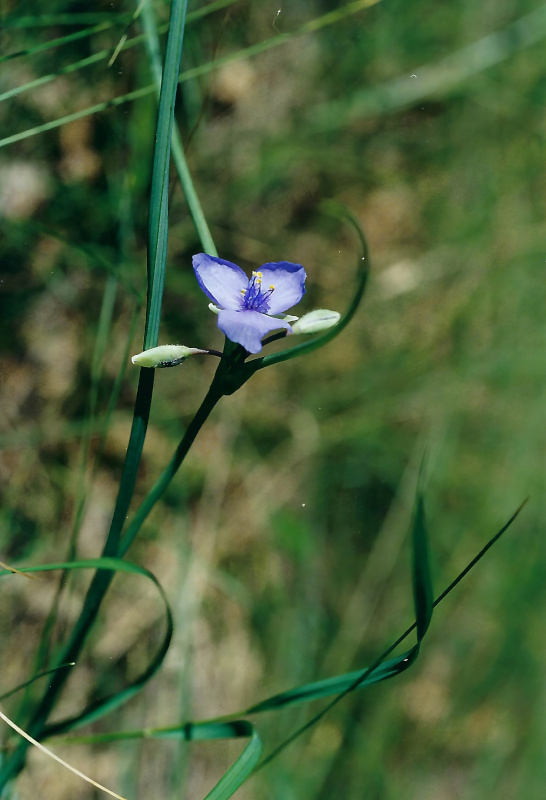
“I re-entered The Meadow. There, I noticed something that had earlier eluded me: a lone spiderwort (Tradescantia spp.) plant, flowering in a particularly sunlit area. Although I was supposed to be in the Meadow on a mission involving other plants, I felt the spiderwort pulling me toward it, like some kind of irresistible magnet. ‘OK, my little, blue-violet friend,’ I spoke to the plant softly, as I lay myself down beside it. ‘What do you wish to tell me about your power to heal?’ I felt prompted to ask that question because I knew so little about this odd-shaped wonder of the fields. I knew only that certain Indian tribes had used it for stomachaches from over-eating and, in some undefined way, for skin cancer. Yet, I was desirous of learning something more about this plant—something that I would then be able to apply toward complaints that I hear more often from herbal clients than the gastrointestinal aftereffects of gluttony.
“It was then that I became quite absorbed in the dainty spiderwort and proceeded to drink in its sublime beauty for hours, experiencing a peace beyond practically any-thing I’d ever felt. During that most grand encounter, my attention was drawn to the perfect symmetry of the plant’s three flower petals, which suggested to me its power to harmonize the three components of man: body, mind, and spirit. That idea certainly accorded with the flower’s blue-violet color, which has always been nature’s way of highlighting medicines for the nervous system.
“As I lay beside the plant still further, I witnessed its flower head slowly close, upon which a jell-like fluid began exuding from the ball-like enclosure that it had become. It almost looked as if the spiderwort was crying. At that moment, I remembered that an alternate name for the plant is ‘widow’s tears.’ I then began to wonder: ‘Is that the secret of this plant? Is it the long-sought remedy for the sadness and crying that can occur when the body, mind, and spirit are out of harmony? Could it perhaps be the harmonizer par excellence—the long-sought key to mind-body-spirit homeostasis?’”
“Convinced that this was a notion worth pursuing, I implored it to lead me to a colony of its brethren so that I could gather a few leaves and flowers here and there in order to tincture for use with melancholic clients. In this, I was not to be disappointed, for I soon encountered just such a colony, from which I was able to gather a small sack of plant segments. Then, as the task for which I had originally come to the Meadow had been forgotten, I turned to head for home, infused with joy at the ecstatic encounter I had just experienced.”
Note how spending a good amount of time with the spiderwort plant—watching it intently and even lying with it—led to a realization of its ability to heal the deep kind of sadness that results in tears and to reintegrate mind, body, and spirit. Although such an application of the plant is not widely appreciated by today’s herbalists, the blossom is nevertheless used in flower essence therapy for “releasing emotional trauma” (https://livingtheenchantedlife.com/products/spiderwort) and for a “merging of mind, body, and spirit.” (https://www.pegasusproducts.com/shop/flower-essences/spiderwort-tradescantia-virginica-positive-attitude/) You may find it interesting to know that I only discovered these uses of the flower essence sometime after I had the mystical experience with the plant that I wrote about above.
Concluding Thought
You, dear reader, will no doubt discover in your own herbal journey a number of plants that will speak to you and which you will find to be highly effective as healing agents, as long as you bend your ear to listen to them.
References:
Birkett MA. et al. 2009. “Repellent Activity of Catmint, Nepeta cataria, and Iridoid Nepetalactone Isomers against Afro-tropical mosquitoes, Ixodid Ticks and Red Poultry Mites.” Phytochemistry. 72(1):109-14.
Feaster, JE, et al. 2009. “Dihydronepetalactones Deter Feeding Activity by Mosquitoes, Stable Flies, and Deer Ticks.” J Med Entomol. 46(4):832–40.
Peterson, CJ, and Coats, JR. 2012. “Catnip Essential Oil and Its Nepetalactone Isomers as Repellants for Mosquitoes.” In: Paluch, G, and Coats, JR, editors. Recent Developments in Invertebrate Repellants. Washington, DC: American Chemical Society. 200pp.
Sinville RD, Alfs MG, Dimick Gray SM. 2022. “Phytochemical Investigation of Pilea pumila (Clearweed), Laportea canadensis (Wood Nettle), and Boehmeria cylindrica (False Nettle): Three Members of the Urticaceae Family. Natural Product Communications 17(2).
Matthew Alfs, MH, RH(AHG) has been a clinical herbalist since 1997 and is the founder and director of the Midwest School of Herbal Studies. He is the author of the books 300 Herbs (rev. ed. 2020), Edible & Medicinal Wild Plants of the Midwest (rev. ed. 2020), and Diary of a Country Herbalist (2017).