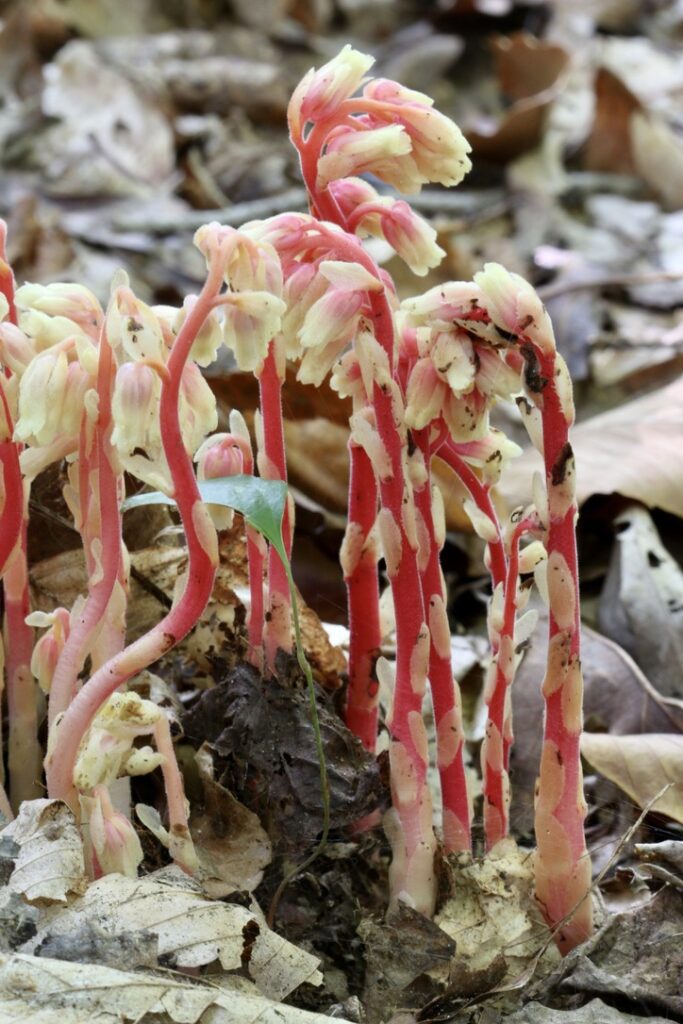
Ghost Pipe
(Monotropa uniflora)
Overall At-Risk Score: 72
Latin Name:
Monotropa uniflora
Common Name(s):
Fit-Plant, Ghost Pipe, Ice-Plant, Snowdrop
Family:
Ericaceae formerly Monotropaceae

Part(s) of Plant Used:
Root used medicinally by the Cherokee, Mohegan and Potawatomi. Flower use by Cree, leaves by Mohegan, and stems by the Thompson Indigenous groups.
Geographic Region(s):
This plant occurs mostly in the eastern USA and Pacific Northwest but also in Mexico and parts of Asia.
Habitat(s):
Occurs in a variety of coniferous, deciduous or mixed forests that vary from wet to dry and in extent from sea level to 3,000 m. Often grows in acidic soil conditions in cool moist habitats.
Life History:
A perennial mycoheterotroph that grows in association with fungi and in particular those from the Russulaceae.
Endangered/Threatened/Trade Status:
X = Presumed Extirpated H = Possibly Extirpated 1 = Critically Imperiled 2 = Imperiled 3 = Vulnerable 4 = Apparently Secure 5 = Secure NR = No Rank
Monotropa uniflora is considered a G5 globally and an S1 in AK, NE, OK, SD an S2 in CA and an S3 in FL and ND. However it has not been assessed and ranked at all by 26 states!
Ability to Withstand Disturbance:
Monotropa is normally portrayed as liking more moist and shady environments meaning logging may cause a challenge though some evidence exists that it can persist even in xeric environments as well.
Vulnerabilities and Threats:
Not a major trade item but interest for everything from pain relief to help with opioid addiction are some uses ascribed and demand therefore may be growing. Given that these plants typically grow in cooler more mesic habitats the phenomenon of increased hot and dry weather due to climate change may represent a threat. Monotropa also depends at least in part on bees from the Bombus genus and other insects like Halictid bees and Syrphid flies for pollination so effects to these creatures may affect the success of Monotropa as well.
Wild Harvesting Impact on Other Species:
Not explicitly available but presumably its loss could possibly affect its pollinators as well as potentially its fungal compatriots.
Lookalike(s):
Potentially at least four other relatives look somewhat similar in form but tend to differ in color. One is Sweet Pine Sap (Monotropsis odorata) which is listed as G3 and S1 in AL, GA, MD, WV S2 KY, SC, TN and S3 in NC and VA.
Another is (Monotropa hypopitys) and it is listed as S1 in Manitoba and Saskatchewan and S3 Alberta, Newfoundland and Prince Edward Island. It is listed as S1 in FL, IA, KS, OK and S2 in CO, DE, LA and WY. Listed as S3 in IN.
The last are Monotropa brittonii and Monotropsis reynoldsiae recognized in Weakley’s flora of the southeast. Additionally a new genus has been proposed including Hypopitys lanuginosa formerly recognized as Monotropa lanuginosa or as part of Monotropa hypopitys sensu lato as well as some yet to be described H. spp. According to NatureServe H. lanuginosa is listed as a G5 globally but S3 in NC and NH and S5 in KY while being unranked throughout the rest of its range. Montropsis reynoldsiae is listed as endemic and possibly endangered by the Florida Plant Atlas and only occurs in six counties in the central to northeast part of the state.
None of these lookalikes has a known documented tradition of use other than Monotropa hypopitys as a love potion for the Indigenous Kwakiutl in British Colombia.
Demand:
Some referenced applications are listed as an analgesic, bactericide, nervine, sedative and for issues with epilepsy, eyes and spasms. More recently it has become popular through online forums. Not a major trade item but interest for everything from various forms of pain relief to help with opioid addiction are some uses ascribed and demand therefore may be growing precipitously.
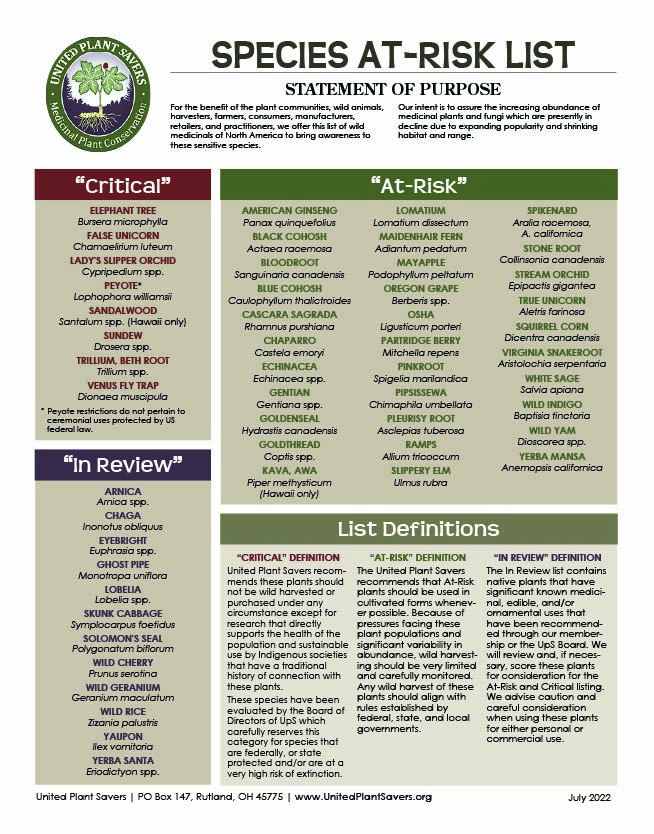
Status Recommendation: At Risk
The United Plant Savers recommends that At-Risk plants should be used in cultivated forms whenever possible. Because of pressures facing these plant populations and significant variability in abundance, wild harvesting should be very limited and carefully monitored. Any wild harvest of these plants should align with rules established by federal, state, and local governments.




References:
- Anez, S. G., Burkhart, E. P., & Kellogg, J. J. (2025). Ghost Pipe Then and Now: The Influence of Digital Media on the Medicinal Use of Monotropa uniflora in the United States. Economic Botany. https://doi.org/10.1007/s12231-025-09637-1
- Beatty, G. E., & Provan, J. (2011a). High clonal diversity in threatened peripheral populations of the yellow bird’s nest (Hypopitys monotropa; syn. Monotropa hypopitys). Annals of Botany, 107(4), 663–670. https://doi.org/10.1093/aob/mcr003
- Beatty, G. E., & Provan, J. (2011b). Phylogeographic analysis of North American populations of the parasitic herbaceous plant Monotropa hypopitys L. reveals a complex history of range expansion from multiple late glacial refugia. Journal of Biogeography, 38(8), 1585–1599. https://doi.org/10.1111/j.1365-2699.2011.02513.x
- Duddridge, J. A., & Read, D. J. (1982). An Ultrastructural Analysis of the Development of Mycorrhizas in Monotropa Hypopitys L. New Phytologist, 92(2), 203–214. https://doi.org/10.1111/j.1469-8137.1982.tb03377.x
- Duke, J. A., & Foster, S. (2014). Peterson Field Guide to Medicinal Plants and Herbs of Eastern and Central North America (3rd ed.). Houghton Mifflin Harcourt.
- Freudenstein, J. V., & Broe, M. B. (2024). Phylogenetic Relationships within Monotropoideae (Ericaceae): Implications for Taxonomy and Character Evolution. Systematic Botany, 49(2), 412–426. https://doi.org/10.1600/036364424X17151801116385
- Gruzdev, E. V., Mardanov, A. V., Beletsky, A. V., Kochieva, E. Z., Ravin, N. V., & Skryabin, K. G. (2016). The complete chloroplast genome of parasitic flowering plant Monotropa hypopitys: Extensive gene losses and size reduction. Mitochondrial DNA Part B, 1(1), 212–213. https://doi.org/10.1080/23802359.2016.1155090
- Hull, E. D. (1914). Occurrence of the Indian Pipe (Monotropa uniflora) in a Xerophytic Habitat. Torreya, 14(6), 101–105.
- Keesling, A. R. (2020). Reevaluating the species status of the Southern Ghost Pipe, Monotropa brittonii [Master of Science, The Ohio State University]. https://etd.ohiolink.edu/acprod/odb_etd/etd/r/1501/10?clear=10&p10_accession_num=osu1587574637151549
- Keesling, A. R., Broe, M. B., & Freudenstein, J. V. (2021). Reevaluating the Species Status of the Southern Ghost Pipe, Monotropa brittonii (Ericaceae). Systematic Botany, 46(4), 1067–1079. https://doi.org/10.1600/036364421X16370109698722
- Kernan, M. J., & Finocchio, A. F. (1983). A New Discomycete Associated with the Roots of Monotropa uniflora (Ericaceae). Mycologia, 75(5), 916–920. https://doi.org/10.2307/3792787
- Klooster, M. R., & Culley, T. M. (2009a). Comparative Analysis of the Reproductive Ecology of Monotropa and Monotropsis: Two Mycoheterotrophic Genera in the Monotropoideae (Ericaceae). American Journal of Botany, 96(7), 1337–1347.
- Klooster, M. R., & Culley, T. M. (2009b). Comparative analysis of the reproductive ecology of Monotropa and Monotropsis: Two mycoheterotrophic genera in the Monotropoideae (Ericaceae). American Journal of Botany, 96(7), 1337–1347. https://doi.org/10.3732/ajb.0800319
- Kong, A., Cifuentes, J., Estrada-Torres, A., Guzmán-Dávalos, L., Garibay-Orijel, R., & Buyck, B. (2015). Russulaceae Associated with Mycoheterotroph Monotropa uniflora (Ericaceae) in Tlaxcala, Mexico: A Phylogenetic Approach. Cryptogamie, Mycologie, 36(4), 479–512. https://doi.org/10.7872/crym/v36.iss4.2015.479
- Kunze, R. E. (1878). Monotropa uniflora, L. Botanical Gazette, 3(6), 53–54.
- Leake, J. R., McKendrick, S. L., Bidartondo, M., & Read, D. J. (2004). Symbiotic germination and development of the myco-heterotroph Monotropa hypopitys in nature and its requirement for locally distributed Tricholoma spp. New Phytologist, 163(2), 405–423. https://doi.org/10.1111/j.1469-8137.2004.01115.x
- Liu, X., Liao, X., Chen, D., Zheng, Y., Yu, X., Xu, X., Liu, Z., & Lan, S. (2020). The complete chloroplast genome sequence of Monotropa uniflora (Ericaceae). Mitochondrial DNA Part B, 5(3), 3168–3169. https://doi.org/10.1080/23802359.2020.1806754
- Lutz, R. W., & Sjolund, R. D. (1973). Monotropa Uniflora: Ultrastructural Details of Its Mycorrhizal Habit. American Journal of Botany, 60(4), 339–345. https://doi.org/10.1002/j.1537-2197.1973.tb05934.x
- Moerman, D. E. (1998). Native American Ethnobotany. Timber Press, Incorporated.
- Roberts, M. R., & Zhu, L. (2002). Early response of the herbaceous layer to harvesting in a mixed coniferous–deciduous forest in New Brunswick, Canada. Forest Ecology and Management, 155(1), 17–31. https://doi.org/10.1016/S0378-1127(01)00544-8
- Rose, J. P. (2012). The Systematics of Monotropsis (Ericaceae) [Master of Science, The Ohio State University]. https://etd.ohiolink.edu/acprod/odb_etd/etd/r/1501/10?clear=10&p10_accession_num=osu1338309433
- Rose, J. P., & Freudenstein, J. V. (2014). Cryptic and Overlooked: Species Delimitation in the Mycoheterotrophic Monotropsis (Ericaceae: Monotropoideae). Systematic Botany, 39(2), 578–593. https://doi.org/10.1600/036364414X680762
- Yang, S., & Pfister, D. H. (2006). Monotropa uniflora plants of eastern Massachusetts form mycorrhizae with a diversity of russulacean fungi. Mycologia, 98(4), 535–540. https://doi.org/10.1080/15572536.2006.11832656
Additional Source(s) of Interest:
- https://bonap.net/Napa/TaxonMaps/Genus/County/Monotropa
- https://phytochem.nal.usda.gov/phytochem/ethnoplants/show/11566
- https://pfaf.org/user/Plant.aspx?LatinName=Monotropa+uniflora
- https://explorer.natureserve.org/Taxon/ELEMENT_GLOBAL.2.133249/Monotropa_uniflora
- https://explorer.natureserve.org/Taxon/ELEMENT_GLOBAL.2.144581/Monotropsis_odorata
- https://explorer.natureserve.org/Taxon/ELEMENT_GLOBAL.2.129213/Monotropa_hypopitys
- https://explorer.natureserve.org/Taxon/ELEMENT_GLOBAL.2.898863/Hypopitys_lanuginosa
- https://plants.usda.gov/home/plantProfile?symbol=MONOT
- https://unitedplantsavers.org/lessons-on-stewardship-chinquapins-chiggers-and-indian-pipes/
- https://unitedplantsavers.org/at-home-with-the-land/
- https://fsus.ncbg.unc.edu/main.php?pg=show-taxon.php&plantname=Hypopitys
- https://fsus.ncbg.unc.edu/main.php?pg=show-taxon.php&plantname=Monotropa
- https://fsus.ncbg.unc.edu/main.php?pg=show-taxon.php&plantname=Monotropsis
- https://www.washingtonpost.com/home/2025/07/15/ghost-pipe-foraging-controversy/