by Danna Leaman

From left to right: Danna Leaman, Susan Leopold, Alison Ormsby, Anastasiya Timoshyna
United Plant Savers will once again be attending the largest global conservation gathering when the IUCN conservation congress takes place 2025. This conservation congress happens every four years. This is the current report of the IUCN Medicinal Plant Working Group. In addition United Plant Savers has been working on the Red Listing of White Sage. We hope to be sharing the publication of the listing soon.
MPSG Report 2024
IUCN SSC Medicinal Plant Specialist Group
Danna Leaman and Nastya Timoshyna, co-chairs
The Medicinal Plant Specialist Group (MPSG) is a global network of specialists contributing within our own institutions and in our own regions, as well as world-wide, to the conservation and sustainable use of medicinal plants. The MPSG was founded by the Species Survival Commission (SSC) of IUCN (International Union for Conservation of Nature) in 1994 to increase global awareness of conservation threats to medicinal plants, and to promote sustainable use and conservation action. The group currently has 117 members.
MPSG’s aim is a significant increase in knowledge of the conservation status of medicinal and aromatic plant species worldwide, planning and actions to conserve and sustainably use these species, and broader industry and consumer awareness of and participation in the conservation of threatened species.
As part of SSC’s global network composed of thousands of volunteer experts deployed in more than 180 Specialist Groups, Red List Authorities, Conservation Committees and Task Forces, MPSG’s members contribute to the IUCN programme by working to achieve specific conservation-relevant targets within the SSC strategic plan. As the current IUCN-SSC programme cycle (2021-2025) comes to a close, MPSG is working to complete the following targets:
Network building: Maintain six formal partnerships providing in-kind support to MPSG targets 2021-2025
Our partnership with New Mexico BioPark Society / Albuquerque BioPark advances our priorities for Red List assessments globally, supported in North America by our partnerships with NatureServe and United Plant Savers. Our partnership with the FairWild Foundation advances our work on sustainable use of wild-harvested medicinal and aromatic plants globally. We work closely with TRAFFIC and the CITES Secretariat on international trade issues, and with the American Botanical Association and the Sustainable Herb Programme on outreach to the herbal industry.
Assess the conservation status of medicinal plants: Complete global assessments of all North American medicinal plant species and complete re-assessment of European Medicinal and Aromatic Plants
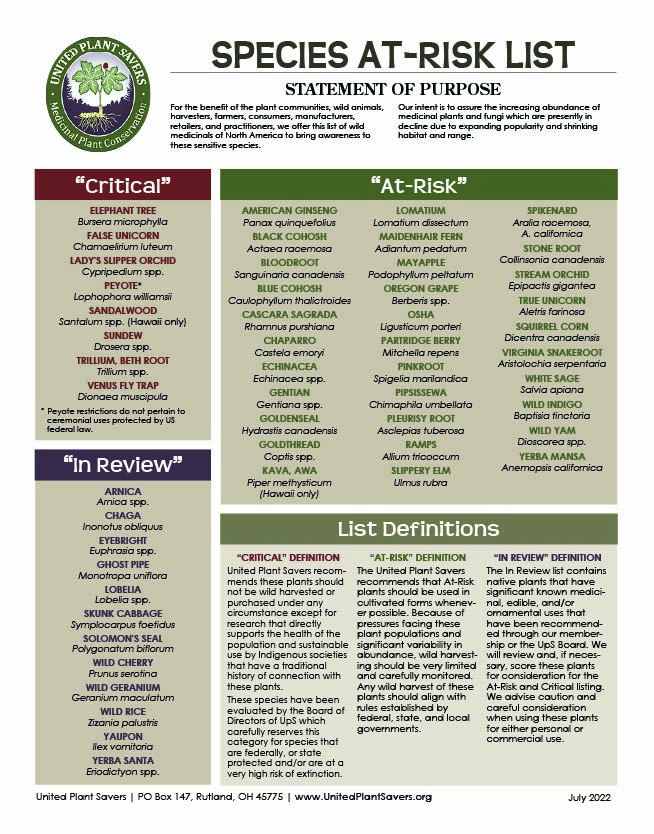
So far, we have completed assessments or draft assessments of nearly 700 of the 1700 species of medicinal plants native to North America (USA and Canada). In 2024, draft assessments were completed for 60 medicinal plant species native to North America that are included in the United Plant Savers “At Risk” list. These assessments are currently in review. Completion of remaining assessments is underway.
Draft reassessments were completed for all medicinal plants native to Europe, completing the reassessment of ca 400 species. Draft assessments are currently in review.
Conservation planning: Contribute technical expertise to policy development and implementation for medicinal plant conservation and sustainable use
In 2024, MPSG members contributed to the 27th CITES (Convention on International Trade in Endangered Species of Fauna and Flora) Plants Committee meeting in Geneva, Switzerland, and to the 16th Convention on Biological Diversity meeting held in Cali, Colombia. In preparation for the CITES Plants Committee meeting, MPSG contributed to a study undertaken on behalf of the CITES Secretariat by TRAFFIC, in partnership with the Royal Botanic Garden Kew. The study identified key actors involved in supply chains for CITES-listed medicinal and aromatic plants (MAPs), including candelilla (Euphorbia antisyphilitica), holy wood (Bulnesia sarmientoi, recently reclassified as Plectrocarpa sarmientoi), African cherry (Prunus africana), and orchids (such as Dendrobium spp.) used in biomedical, traditional and alternative medicine, in cosmetics and personal care products, and in food sectors. The full details of this study are outlined in CITES CoP19 Decision 19.26. Conclusions of the study are summarized in a draft report (https://cites.org/sites/default/files/documents/E-PC27-32-01-Add_0.pdf), presented as a document for consideration by CITES PC27 . The findings of the study will be presented at CITES CoP20 in November 2025. Additionally, MPSG contributed to a draft Resolution on medicinal and aromatic plant species to be considered at the next PC (following the CITES CoP20) which will be discussed during the next meeting of the CITES Plants Committee. At the CBD CoP16, held in Cali, Colombia in October 2024, side-event discussions on conservation and sustainable use of plants offered opportunities to highlight a new initiative to which MPSG contributes: “Scaling the conservation of Himalayan plants and fungi through sustainable trade’ (2024-2029), implemented by TRAFFIC, supported by the UK Government Darwin Initiative. Jatamansi (Nardostachys jatamansi), a Critically Endangered, CITES-listed medicinal plant, is among the keystone species addressed by the project.
Conservation action: Contribute to sustainable use of priority species of medicinal and aromatic plants
Members of MPSG contributed to the implementation of the FairWild Standard for Sustainable Wild Collection by providing assessments of harvest risk for candidate and certified species of wild-harvested plants and providing technical inputs to the implementation of a new version (3.0) of the FairWild Standard, published in early 2024 (https://www.fairwild.org/fairwild-standard-overview). The MPSG also contributes to application of the FairWild Standard to a broader range of taxa, such as fungi, to reintroduced and naturalised plant populations, and to landscape-level conservation and management (1.7 million ha of managed harvest areas in 2024), benefiting more than 12,000 harvesters of FairWild-certified ingredients (https://www.fairwild.org/our-impact). MPSG contributes, in partnership with TRAFFIC, to the Darwin-funded initiative “Scaling conservation of Himalayan plants and fungi through sustainable trade in Nepal’s Himalayas”, implemented in Nepal, India and China, and linking to European trade chains (https://www.traffic.org/news/supporting-communities-and-preventing-biodiversity-loss-in-the-himalayas/). MPSG contributed to three innovative tools and mechanisms supporting the design of approaches for better conservation and sustainable use practices: 1) Trialling Wild Harvest Improvement Projects for a sustainable wild plant trade, with piloting experience in Uzbekistan (liquorice harvesting) and Morocco (argan nut harvesting). These projects create opportunities for access to voluntary certification and markets through continuous improvements, inspired by the fisheries management approaches (https://www.traffic.org/trialling-wild-harvest-improvement-projects-for-a-sustainable-wild-plant-trade/). 2) Five-dimensional Sustainability Assessment Framework, developed jointly by IIED, TRAFFIC, IUCN SuLi, Epic Biodiversity, and EWT. The framework provides a minimum set of meaningful principles and criteria describing wild species harvest, use and trade, which is sustainable from ecological, social, economic, health, and welfare (relevant to fauna species) perspectives (https://iucn.org/es/node/40442). 3) Guidance on integrating sustainable use of plants and fungi in restoration projects and programmes. MPSG contributed tools (risk assessment, sustainable species management guidance) to the development of the tool, which will be launched in 2025 (https://www.endangeredlandscapes.org/project/enhancing-restoration-by-sustainable-use/).
Communication: Spotlight medicinal and aromatic plants conservation and sustainable use issues in media and with multiple stakeholders
MPSG members led and contributed to publication of a journal article reporting on work toward conservation and sustainable use of medicinal plants in the Nepal and proposing how it can be applied to developing conservation strategies for medicinal and aromatic plants across the globe: “A roadmap to sustainable management of commercial medicinal and aromatic plants, fungi, and lichens in Nepal” (https://conbio.onlinelibrary.wiley.com/doi/full/10.1111/cobi.14442).
Communication: Make MAPROW (Medicinal and Aromatic Plants of the World) database secure and accessible
MAPROW (Medicinal and Aromatic Plant Resources of the World) is an offline ACCESS database created and managed by MPSG’s previous Co-Chair/Chair, Dr Uwe Schippmann, with regular inputs from and outputs to support MPSG and many partners, including CITES, RBG Kew’s Medicinal Plant Names Services (MPNS), the IUCN Red List, TRAFFIC, FAO, the FairWild Foundation, and MPSG members. Database MAPROW contains records relevant to MPSG’s work on conservation and sustainable use and trade for more than 25,000 species of medicinal and aromatic plants (MAPs) globally. In 2024, MPSG implemented an SSC Internal Grant (received in 2023) to support the migration of MAPROW to a more secure platform and more accessible software. Much of the data migration was successfully completed in 2024. Additional work remains to ensure accessibility and sustainable management of MAPROW.
Network building: Maintain six formal partnerships providing in-kind support to MPSG targets 2021-2025
Our partnership with New Mexico BioPark Society / Albuquerque BioPark advances our priorities for Red List assessments globally, supported in North America by our partnerships with NatureServe and United Plant Savers. Our partnership with the FairWild Foundation advances our work on sustainable use of wild-harvested medicinal and aromatic plants globally. We work closely with TRAFFIC and the CITES Secretariat on international trade issues, and with the American Botanical Association and the Sustainable Herb Programme on outreach to the herbal industry.
We are currently considering MPSG’s priorities for the next IUCN quadrennium (2026-2029). These may include: conservation status assessment (or reassessment) of all CITES-listed plant species used medicinally; high priority species linked to health policy (e.g. the plant species included in the World Health Organization’s four monographs on traditional medicines); plant species with rapidly increasing demand in trade. We will also continue to engage in conservation planning and action on priority medicinal plant species, to improve the communication of conservation-relevant information about medicinal plants by making database MAPROW more accessible, and contribute to policies and tools that support the conservation and sustainable use of medicinal plants.