Introduction
by Andrea Miller, Rural Action and Tanner Filyaw, United Plant Savers
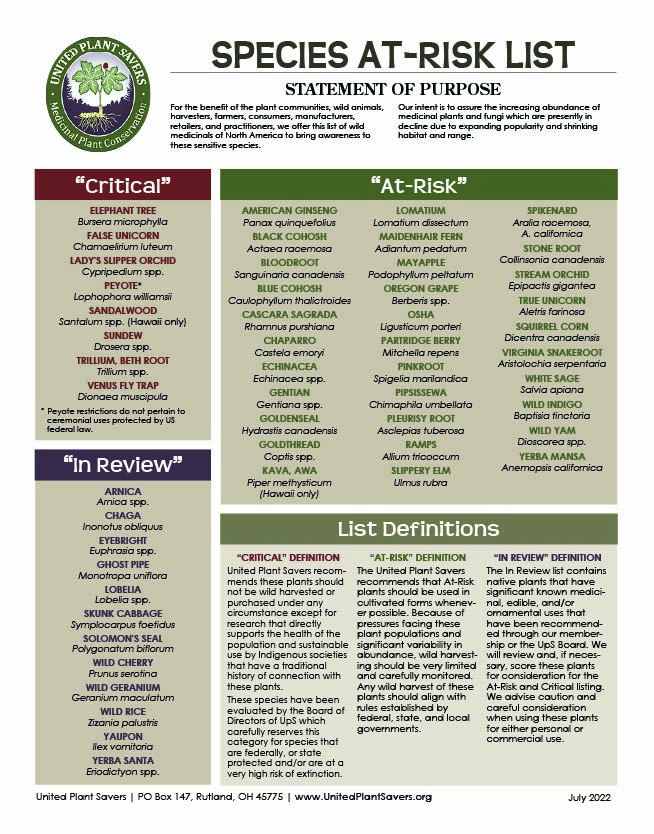
Goldenseal (Hydrastis canadensis) is a high-value specialty crop with a long history of cultivation, harvest and management in Ohio. The current goldenseal supply chain is based around the harvest of wild plants from forest environments, and presents a significant threat to the conservation of wild populations. There is currently no organized monitoring of wild populations in the United States, making it difficult to quantify the extent of population loss across goldenseal native range. In 1914, as a direct result of the disappearance of goldenseal in woodlands across Ohio and the eastern forest region, the USDA funded research on the intentional cultivation of goldenseal as an alternative to wild harvesting, and began to recognize the commercial significance of this species. In the more than 100 years since these USDA-funded cultivation studies, goldenseal’s commercial value has continued to increase, and has become a crop of primary interest for forest farmers. Despite the growing interest in goldenseal cultivation, most current research has focused on plant chemistry, genetics, and novel uses and applications, rather than basic cultivation practices, such as successful seed stratification and germination, propagating new rootlets from seeds and root fibers, how plants perform in different cultivation “systems,” as well as anticipated growth and yields. In 2022, Rural Action and United Plant Savers partnered, and applied for funding through a USDA Ohio Department of Agriculture Specialty Crop Block Grant to assess cultivation practices. The project was awarded, and experimentation began in September 2023.
Goldenseal Cultivation Experiments
The primary goal of this project was to provide forest farmers and members of the herbal products industry with guidance on best cultivation and propagation practices that could help support the sustainability of the goldenseal supply chain, and create new opportunities for forest farmers in Ohio.
Efforts focused on the two primary cultivation strategies typically described in most forest farming resources, the “wild-simulated” method where plants are grown in a natural forest habitat without any amendments, and minimal site disturbance; and the “woods-cultivated” method, where plants are grown in tilled and amended beds under natural shade trees. As an experimental alternative, plants were also grown in an open field setting underneath a hooped trellis covered hardy kiwi vines to provide shade. These experiments taught us a lot about what works well, and where improvements can be made.
The primary goal of this project was to provide forest farmers and members of the herbal products industry with guidance on best cultivation and propagation practices that could help support the sustainability of the goldenseal supply chain, and create new opportunities for forest farmers in Ohio.
For growers interested in the wild-simulated approach to goldenseal cultivation, the most important thing to know is that success starts with a high quality growing site, with loamy, nutrient rich soils that will enable the plants to thrive and spread vegetatively as much as possible. After two years of growth in wild-simulated beds, we observed high rates of survival, but relatively small increases in plant growth and spread. Post harvest data analysis showed that on average wild-simulated roots only added about 0.012 ounces fresh weight after two years’ growth. Based on the observed trajectory, wild-simulated beds will take closer to 7 or 8 years until they are fully mature, and some may never produce much growth at all, depending on site conditions.
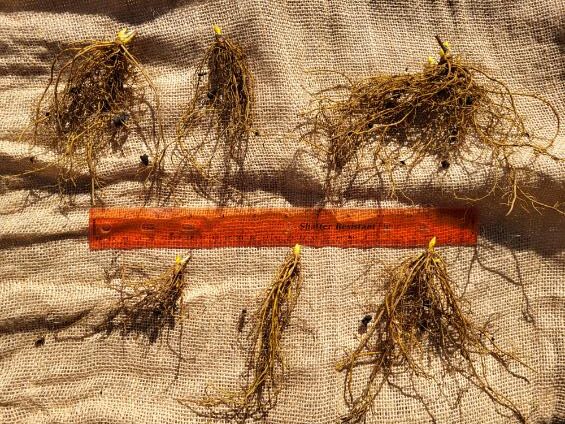
The wild-simulated approach could be a good strategy for a grower with abundant forestland and high quality growing sites that are able to support strong growth, and high rates of reproduction (i.e. seed production & vegetative reproduction), but would likely benefit from selective pruning to increase light availability. Because of the high rates of survival we observed, the wild-simulated method could also be a good strategy for “banking’ plants in the forest until they are ready for transplanting to other locations.
The “Woods-Cultivated” plots used for this project were selected to represent a more intensive agroforestry approach to goldenseal cultivation that would provide an alternative to the “Wild-Simulated” method previously described. Generally speaking, these sites were located along field and forest edges or underneath planted trees where goldenseal plants would have access to more sunlight, but where adequate shade was still available.
The soil in these beds were shallowly tilled, then amended with compost and pelletized gypsum to increase organic matter, and improve soil nutrients. Growth in these beds was observed to be much more vigorous, with many plants producing multiple tops from each rhizome, and setting multiple terminal buds for the next year’s growth. It is important to note that yield results were still variable between cultivation sites, but on average individual root weight increased by 0.32 ounces in woods-cultivated plantings, and as high as 0.65 ounces per root in one site. Ultimately, the loose, nutrient rich soil, and increased light availability were largely responsible for the rapid growth and high yields observed in this method of planting. We would strongly recommend growers consider incorporating this strategy, particularly if seed production and planting stock production are primary management goals.
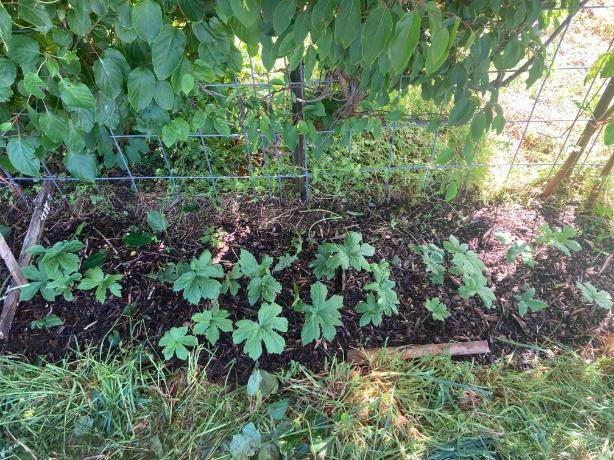
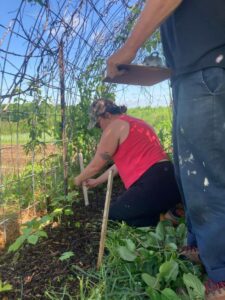
For growers who don’t have access to natural forest growing sites or adequate tree cover, cultivation strategies that utilize artificial shade are also possible. Typically shade in these systems is provided by polypropylene shade cloth, which can be costly for growers, and creates a more industrial and artificial environment. For this project we wanted to experiment with more natural ways to provide shade that could also produce potential companion crops simultaneously. For this experiment, we partnered with Trouvaille Farm in Athens, Ohio. Goldenseal was planted underneath a “low tunnel” made with sections of cattle panel fencing bent into a hoop structure, with passionflower and hardy kiwi vines trellised over the top to provide shade through the growing season. Growth in the artificial shade beds produced similar results to the woods-cultivated beds, with better seed production, the development of multiple stem plants, and decent growth. On average, root weight in this planting increased by 0.16 ounces per root after two years of growth. Overall, if well managed, this strategy could be implemented at a larger scale, and could create the potential for increased specialty crop production.
Propagating New plants from seeds and fiber roots
For growers, being able to successfully collect, stratify, and germinate your own seed stock is an essential part of expanding production. Through the Specialty Crop Block Grant program, we were able to experiment with several seed stratification and germination variables to see which techniques produced the best results, including testing different soil mixes, types of nursery beds and containers for stratification, and overwintering. Based on our experience, we found that planting seeds in a traditional nursery bed, filled with a 50/50 mix of potting soil and compost, and allowing the seeds to stratify naturally over winter produced the best germination results by far. A simple wood frame raised bed, 6”-8” deep, provided plenty of room for the plants to grow for up to two years, allowing them to develop a strong root system before transplanting. Stratification and germination in stack and nest flats was also tested, but did not produce good results. Ultimately the stack and nest flats were difficult to store over winter, and suffered from the effects of repeated freezing and thawing. With either method, nursery beds or flats, protecting seeds from pests (i.e. mice, moles, voles, chipmunks, cats, etc.) is essential.
Propagating Fibrous Root Fragments
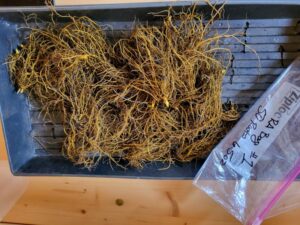
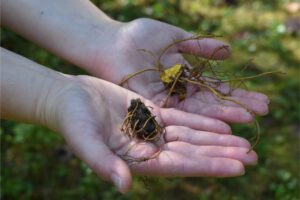
If seeds are in short supply, small seedling-like propagules can be successfully produced using fibrous root fragments from older plants. Fiber fragments are generally easy to come by, especially if you are doing any harvesting or subdividing mature rhizomes. Similar to our seed experiments, we tested the success of fiber root propagation in a variety of growing mediums and containers. The best results were produced when root fibers were layered in heavy-duty fabric pots, with a 50/50 mix of peat-based potting soil and sand, and then buried approximately 12” deep in a raised bed through the fall and winter months. Using this method we found that on average 55% of the root fibers developed an active growth bud or new leaf and stem by spring.

It could be advantageous for growers to utilize this technique and capitalize on goldenseal’s natural ability to regenerate, potentially creating a pathway for small growers to produce hundreds of new plants each year. A key part of this propagation strategy is burying the fabric bags with the fiber roots to reduce the effect of freezing and thawing while in storage. The fabric bags also provide more depth that allows for burying to an adequate depth. Traditional black plastic nursery flats, and stack and nest flats were also tested as potential containers, but resulted in higher root mortality, likely due to the factors previously mentioned.
Conclusion
The Specialty Crop Block Grant was successful as it enabled us to explore cultivation and propagation strategies and techniques that beginning and small-scale goldenseal (Hydrastis canadensis) growers often inquire about. The findings can be applied to small-scale forest farming operations to increase goldenseal production, which is necessary to relieve pressure from wild plant populations and move supply chains towards sustainability cultivated materials. Additionally, the results increase our capacity to assist growers with achieving good cultivation results and meet their production goals. We hope that beginning and experienced growers can learn from and/or adopt some of the practices we have experimented with, and that by doing so, they can contribute to an increase in sustainably produced goldenseal.