Partridge Berry
(Mitchella repens)
Overall At-Risk Score: 27
Latin Name:
Mitchella repens
Common Name(s):
Partridge Berry, Boxberry, Deerberry, Checkerberry, Chickenberry, Cowberry, Hive Vine, Odor Berry, Running Box, Snake berry, Stinking berry, Teaberry, Twinberry, Two-eyed berry, Pain-de-perdrix (French).

Family:
Rubiaceae
Part(s) of Plant Used:
Leaves and berries have a tradition of use with the Abnaki, Cherokee, Chippewa, Delaware, Iroquois, Menominee, Micmac, Montagnais, Ojibwa, and Penobscot.
Geographic Region(s):
Found from Maine to Florida in the east, and Minnesota to Texas in the west.
Habitat(s):
Acidic damp forested areas in the shade to part sun.
Life History:
Dioecious perennial that creeps along the ground and roots at the nodes. Berries are consumed by wildlife and thereby the seeds are distributed.
Endangered/Threatened/Trade Status:
X = Presumed Extirpated H = Possibly Extirpated 1 = Critically Imperiled 2 = Imperiled 3 = Vulnerable 4 = Apparently Secure 5 = Secure NR = No Rank
Global Status: G5 Canada N5 and United States N5
S5 in DE, District of Columbia, KY, NJ, NY, NC, WV
S4 in OK
S2/S3 Prince Edward Island
S1 IA
Ability to Withstand Disturbance:
With clonal growth and being easy to propagate it is fairly resilient to disturbance.
Vulnerabilities and Threats:
Potential threats include climate change, habitat loss, and/or over-popularization in the trade.
Wild Harvesting Impact on Other Species:
Most often grows in coniferous forests where few other species grow and because of the growth habit when harvested it does not disturb the soil so does not significantly impact the immediate environment.
Lookalike(s):
Could potentially be mistaken for Pipsissewa (Chimaphila umbellata) or Wintergreen (Gaultheria procumbens). Shares some common names, and may grow in similar habitat, but have alternate leaves instead of opposite and bell-like flowers versus the typically cross shaped ones of Mitchella.
Demand:
According to the American Herbal Products Association (AHPA) data, demand decreased from 1,114 pounds in 2011 to 322 pounds in 2017. Demand seems to be mostly driven by folk use, and not large-scale commercial harvest.
Status Recommendation: At Risk
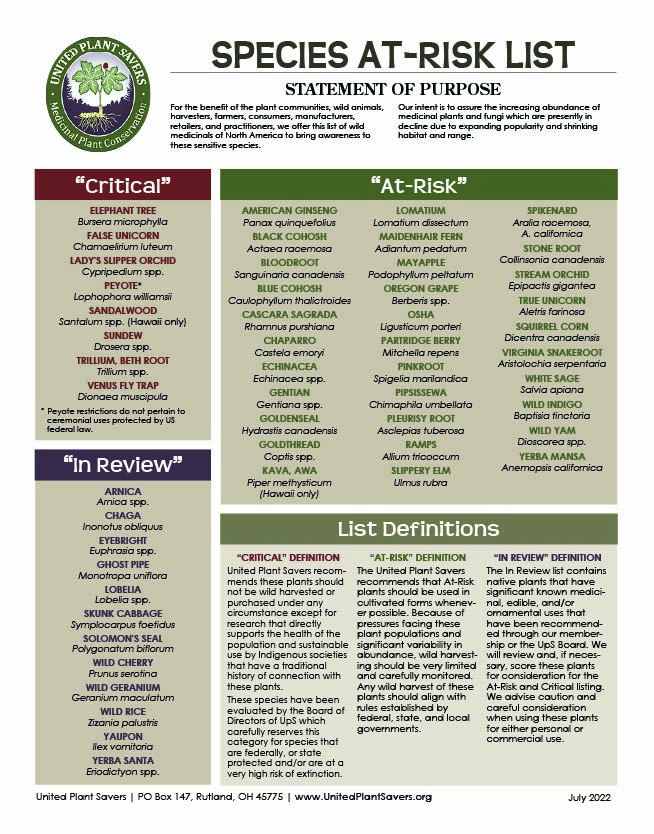
The United Plant Savers recommends that At-Risk plants should be used in cultivated forms whenever possible. Because of pressures facing these plant populations and significant variability in abundance, wild harvesting should be very limited and carefully monitored. Any wild harvest of these plants should align with rules established by federal, state, and local governments.


References:
- Christopher, J. R. (2014). School of Natural Healing (15th ed.). Christopher Publications.
- Clymer, R. S. (1973). Nature’s Healing Agents. The medicines of nature (5th ed.). The Humanitarian Society.
- Densmore, F. (1974). How Indians Use Wild Plants for Food, Medicine, and Crafts. Dover.
- Duke, J. A., & Foster, S. (2014). Peterson Field Guide to Medicinal Plants and Herbs of Eastern and Central North America (3rd ed.). Houghton Mifflin Harcourt.
- Erichsen-Brown, C. (1989). Medicinal and Other Uses of North American Plants: A Historical Survey with Special Reference to the Eastern Indian Tribes. Dover Publications.
- Gladstar, R., & Hirsch, P. (2000). Planting the Future: Saving Our Medicinal Herbs. Healing Arts Press.
- Hutchens, A. R. (1991). Indian Herbalogy of North America (1st paperback ed). Shambhala.
- Leyel, C. F. (1987). Elixirs of Life. Faber & Faber.
Additional Source(s) of Interest:
- https://www.fs.usda.gov/wildflowers/plant-of-the-week/mitchella_repens.shtml
- https://pfaf.org/User/Plant.aspx?LatinName=Mitchella+repens
- https://www.wildflower.org/plants/result.php?id_plant=MIRE
- http://naeb.brit.org/uses/search/?string=Mitchella
- https://explorer.natureserve.org/Taxon/ELEMENT_GLOBAL.2.132448/Mitchella_repens
- https://plants.usda.gov/home/plantProfile?symbol=MITCH