Pinkroot
(Spigelia marilandica)

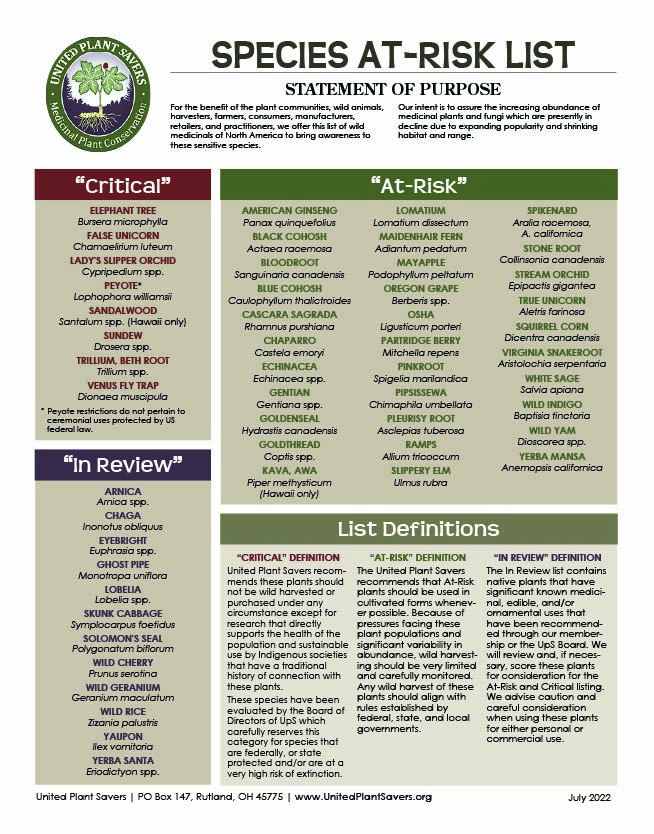
Overall At-Risk Score: 35
Latin name:
Spigelia marilandica
Common Name:
Woodland Pinkroot, Indian Pink
Family:
Loganiaceae (Loganias family)
Lifespan:
Perennial
Reproduction:
S. marilandica produces flowers in June that seed in early fall and use hummingbirds as the primary pollinators.
Geographic Region:
Pinkroot lives in most of the Southern U.S., centered around northern Mississippi. It can be found in the states of Alabama, Arkansas, Florida, Georgia, Illinois, Indiana, Kentucky, Louisiana, Maryland, Mississippi, Missouri, North Carolina, Oklahoma, South Carolina, Tennessee, Texas, and Virginia.
Habitat:
Pinkroot prefers part to full shade and rich moist soil and lives in forests and wooded stream borders.
Ability to Withstand Disturbance and Overharvest:
The primary concern when it comes to the disturbance of this species is other plants taking over its habitat. Pinkroot doesn’t handle growing around aggressive plants well and can easily be overcome by the presence of fast-growing invasive species.
Status of Endangered/Threatened (by state):
Spigelia marilandica is “Endangered” in Indiana.
Spigelia marilandica has not yet been evaluated by the IUCN Red List.
Part of Plant Used/Active Medicinal Compounds:
Spigelia marilandica was used historically by the Cherokee and the Creek to treat worms. It is important to note that every part of this plant contains the alkaloid spigiline, which is considered the active medicinal component but is also poisonous to humans. Symptoms include dimness in vision, nausea and vomiting, dilation of the eyes, and convulsions.
Demand:
Demand for pinkroot is on the rise, particularly by gardeners who prize the plant for its beautiful blooms that attract hummingbirds to shade gardens.
Recommendations For Industrial and Home Use:
Luckily, wild-harvest is on the decline as the popularity of pinkroot in horticulture increases. If you are planning on planting this species, make sure it is from a nursery that cultivates it, and please talk to your doctor before taking Spigelia marilandica or any other medicinal plant.
Citations
- Hamel, Paul B. and Mary U. Chiltoskey, 1975, Cherokee Plants and Their Uses — A 400 Year History, Sylva, N.C. Herald Publishing Co., page 40.
- Lady Bird Johnson Wildflower Center. (2015, June 18). Plant Database: Spigelia marilandica. Retrieved September 2, 2019, from https://www.wildflower.org/plants/result.php?id_plant=spma3
- NC State University. (n.d.). Spigelia marilandica. Retrieved from https://plants.ces.ncsu.edu/plants/spigelia-marilandica/
Stritch, L. (n.d.). US Forest Service Plant of the Week: Indian Pink (Spigelia marilandica L.). Retrieved from https://www.fs.fed.us/wildflowers/plant-of-the-week/spigelia_marilandica.shtml - Taylor, Linda Averill, 1940, Plants Used As Curatives by Certain Southeastern Tribes, Cambridge, MA. Botanical Museum of Harvard University, page 51.
- Witthoft, John, 1947, An Early Cherokee Ethnobotanical Note, Journal of the Washington Academy of Sciences 37(3):73-75, page 74.
- USDA, (n.d.), Plants Profile for Spigelia marilandica (woodland pinkroot), Retrieved September 2, 2019, from https://plants.usda.gov/core/profile?symbol=SPMA3