by Susan Leopold, PhD
 Enjoy reading the foreword to the newly published and updated English version. Contact United Plant Savers if you wish to purchase the book.
Quassia amara is a member of the Simaroubaceae family, which consists of 19 genera and 95 species of trees and shrubs that are mostly tropical in distribution. Folks in the temperate region may be familiar with the Tree of Heaven (Ailanthus altissima), which is also in the Simaroubacea family. It is known as an invasive to eastern North America but a native medicinal to those in China. Quassia, with 40 species in the rainforests of tropical America and Africa, contains trees and shrubs. Quassia amara is the source of bitter-tasting compounds and is used currently in commercial products as a vermifuge and as an insecticide. Among those in Costa Rica it is know commonly as Hombre Grande, translated as the strong man, to make a tea that can cure pain in the stomach, rid parasites, help with diabetics, and treat fever.
As folklore goes Gramman Quacy or Kwasi (1692-1787) was a slave brought to Surinam from Ghana, who had earned a reputation as a powerful medicine man. He helped the Dutch fight the maroons, earned his freedom and traveled to the 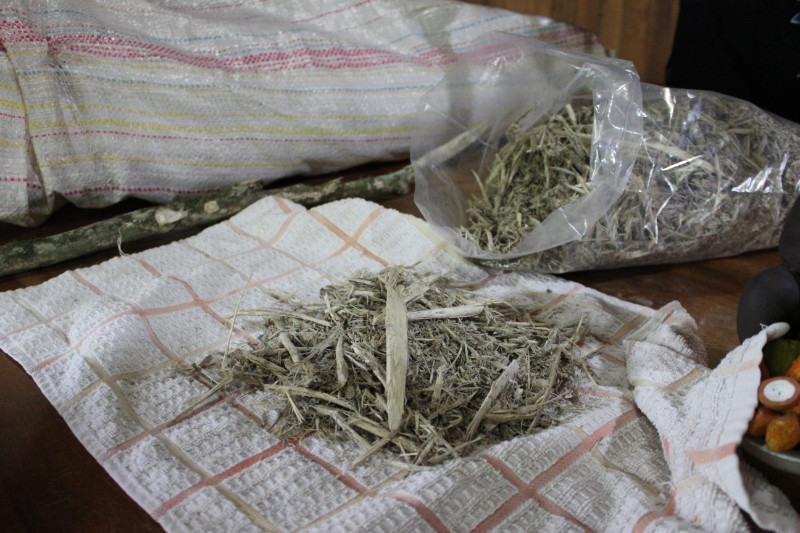 This quassia bark will soon to be ready for sale.Netherlands. One of his famous remedies was a bitter tea used for internal parasites and made from the bark of mysterious shrub. Linnaeus (1707-1778) named the mysterious medicinal shrub after the famous healer, Quassia amara thus meaning the bitter Quassia. John Uri Lloyd wrote about the species in 1897 in the Western Druggist regarding how it was being used in the European pharmacopeia as early as 1788. Quassia amara, being a smaller tree/shrub, was quickly over harvested in Suriname, and a larger tree found in Jamaica that has similar properties quickly became its substitute. It was commonly called Jamaican quassia (Picrasma excelsa). Though it is a larger tree, its range is much smaller and due to deforestation it was added to the IUCN redlist in 1988, and to date, Picramnia excelsa is an endangered species (Areces-Mallea 2009). There is also a related plant, Picramnia antidesma that is a smaller shrub and known medicinally with similar distribution as Quassia amara. In Argentina Quassi amara has been confused with Picrasma crenata, another species of bitter wood. Interesting to note that in Brazil Quassia amara is known as false quinine (Ocampo and Balick 2009). The common names can be confusing within the historical context of Quassia amara use and demand in trade over the last 300 years.
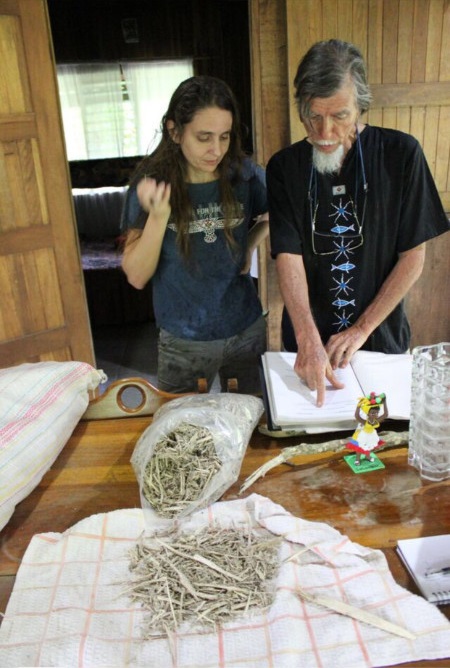 Rafa shows Susan his research on the quassia barkIn 1994 I transferred from Boston University to Friends World College in Costa Rica. I was a Geography major, but my passion was to study ethnobotany, and relocating south allowed me to pursue this path. It was not long after arriving in Costa Rica that I learned of Rafa Ocampo’s work as the preeminent and pioneering ethnobotanist. I also became intrigued with the Caribbean/Limon region of the country, known as the wet side with its Amazonian feel, as river tributaries flow from the Central and Talamanca Mountains down through tropical wet rainforest. The Limon region is a mix of indigenous cultures such as the BriBri and Cabekar with the afro-Caribbean people, who have a long history of respectful co-existence resulting in a rich and dynamic ethnobotanical reservoir of knowledge. It is in this region that Rafa Ocampo has his research farm, Bougainvillea, where he has meticulously studied agro-ecological/forest systems of important native species, one of those being Quassia amara. In this book he has gathered his knowledge and that of others to concisely describe critical data that is useful in the transition towards intentional management and cultivation of an economic and medicinally important species whose wild populations are under threat due to overharvest and loss of habitat.
 Rafa with the first quassia tree he planted.Rafa Ocampo is one of the founding members of the Sacred Seeds Sanctuary located at Finca Luna Nueva Eco Lodge and certified biodynamic farm near the majestic Arenal Volcano. Rafa is co-author (with Michael Balick) of the Sacred Seeds book that highlights the collection of 300 medicinal plants that are tended to in the garden. The Sacred Seeds garden sparked the establishment of an international network of gardens located around the world that share in the same mission — conservation of biodiversity and cultural knowledge of sacred plants.
United Plant Savers is a non-profit organization founded just around the time I set off on my journey to Costa Rica. UpS is the umbrella organization to the Sacred Seeds Network of Botanical Sanctuaries. It is with deep respect and admiration that I write the foreword to Rafa’s English version of his book “Bitter Wood: Cultivation, Conservation, and Commerce”. We are in a time of rapid changes to the landscape with unprecedented global and local demands on important medicinal plants, the majority of which come from complex forested ecosystems.  The quassia seeds.Agroforestry is critical because we can more intentionally cultivate and manage for economic and medicinally important species, instead of unsustainable harvesting from wild populations. Rafa Ocampo is a pioneer in the field of ethnobotany taking on the challenge to conserve native medicinal plants while also providing viable incentives to those living in the forest, embodying UPS mission of conservation through cultivation. Quassia amara is just one example of his many scientific contributions to the field of tropical ethnobotany. This book will serve as a valuable resource to those looking to weave Quassia amara into the disturbed wet tropical forest. It is the perfect addition to a tropical permaculture/ forest garden with its use as an important natural pesticide, de-wormer for animals, medicine for fevers and stomach aliments. In a time when mosquitos are carrying multiple tropical diseases it’s an easy preventive to add the bark to water to eliminate larva in stagnant water. It is a plant with an important conservation story and a timely medicinal with unique chemistry that provides tangible solutions to important needs.