By Alan Ritter and Olga Sher (United Plant Savers Grant Recipients)
We call ourselves Antinanco. We were founded in 2015 in Holmdel, New Jersey, our home today. Our mission is to preserve native at-risk plant species and provide access to education about the plant world through nature experiences, creative art projects, and environmental conservation projects. We involve communities of New Jersey, New York, and Pennsylvania in environmental stewardship, educating about the impact of our actions on the environment and providing resources and solutions to maintain the integrity of the Northeastern ecosystems.
This article provides an overview of Antinanco’s goals and the projects that support them. This is followed by a voyage into three jewel plants, American chestnut (Castanea dentata), pawpaw (Asimina triloba), and milkweed (Asclepias syriaca). We will end this article with an overview of Antinanco’s Native Plants of the Northeastern Woodlands Art Contest that we offered in the Winter of 2022.
From time immemorial, people of Earth-based traditions practiced ways of living with Nature that not only provided for all their needs, but also enhanced the fertility and biodiversity of the ecosystems around them. We strive to preserve and follow Earth-based traditions that honor this relationship and offer valuable lessons. These lessons hold the solutions we need to help heal Earth today and tomorrow. Among them are how we can rebuild the connections to Land and to traditional practices which protect the diverse fertility of Earth, as well as how to grow, gather, and preserve plant medicines and foods in respectful and harmonious ways, as to not take away from the overall balance of all relations.
Within this broad mission, we specifically focus on the restoration of native Medicinal and Food Forest systems that represent a fundamental segment of the Northeastern woods. The Northeastern forests are some of the most productive forests in the world and are the principal source of many medicinal and food-producing plant species. There is a growing and widespread concern that many of the species are being depleted and becoming rare and endangered due to increasing development and overharvesting. Our Medicinal and Food Forest Restoration projects started in 2018, initially focusing on restoring the American Chestnut tree and gradually expanding to other food and medicine producing trees, shrubs, and plants, such as American pawpaw tree, Eastern persimmon (Diospyros virginiana) tree, Eastern redbud (Cercis canadensis) tree, great blue lobelia (Lobelia siphilitica), bloodroot (Sanguinaria canadensis), bee balm (Monarda didyma), wild senna (Senna marilandica), and anise hyssop (Agastache foeniculum).
American Chestnut Tree
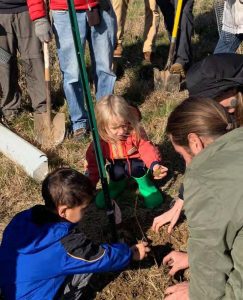
Our relationship with the American chestnut tree started in 2018, when Joseph Arnold Resch, Antinanco’s Director of Green Initiatives and Plant-Human Connections, suggested organizing an event in Emmaus, Pennsylvania to plant American chestnut trees with kids. In November of 2018, we procured our first group of 25 American chestnut hybrid seedlings from Musser Forests, a Pennsylvania nursery. The event was a tremendous success, filled with kids and adults digging in the dirt and snow, planting, and sharing old Appalachian stories about the legendary tree.
The American chestnut is native to the eastern North American forest ecosystem and is, tragically, considered functionally extinct. In the first half of the 20th century, an accidentally introduced pathogen, the chestnut blight (Cryphonectria parasitica), killed virtually all native American chestnut trees in the United States. The damage total was 4 billion trees, and the loss of the American chestnut tree is often cited as one of the worst ecological disasters in the United States. Although chestnut trees still exist in our forests today, they rarely have an opportunity to reproduce and mostly exist as understory sprouts.
Little did we know that this single event would take us on a five-year-long (and continuing) journey dedicated to lasting preservation of the American chestnut. With support of many friends and partners, including a grant from United Plant Savers, we have been restoring pure American chestnut trees that come from mature parents that survived the blight. We are applying novel biological methods and add companion plants to promote the trees’ optimal health and growth. We currently have close to 300 trees under our care. As the trees grow, so does our hope. As of the date of this article, out of 35% of trees affected by blight, all but one are surviving or thriving. Some of the one-year-old seedlings that kids lovingly planted in the Fall of 2018 are now over 9 feet tall!
A big part of the project is education. Just like all Earth-based traditions, where each person is considered to be a forest keeper, we believe that it is critical to involve as many children, families, and students as possible. Educating kids about the importance of this Keystone species and instilling a sense of responsibility and environmental stewardship will strengthen the long-term success of the undertaking, increase kids’ appreciation of the value of the species, and ensure continuity of the effort.

Our activities are tailored to the kids’ level of interest and understanding and involve playful and creative components. For the youngest ones, we offer games of interconnection and symbiotic relationships. One of the games calls for children to assume the roles of the American chestnut, its companion trees, animals, humans, and insects and gather in a circle connected by threads. The colorful threads represent various symbiotic relationships and interdependence of the species on one another. We then ask one of the players to step out of the circle, breaking the multi-layer network of mutual support, making it apparent how the loss of one affects the entire network.
For the elementary school-level children, we offer a collection of lesson plans, illustrations, myths, and stories. The materials have been lovingly put together by Sonia Horowitz, a wonderful educator, artist, and forager from Mason, Wisconsin. We distribute the lesson plans at planting events and invite a wider audience of kids and families to access the materials through our website, which also includes interactive plant identification games, printable sheets, and videos about the American chestnut.
Older children are encouraged to participate in the Project as citizen scientists by inspecting the trees, recording and sharing their findings throughout the trees’ planting and growing phases, and by planting chestnut trees in their own gardens and yards. Our goal is to grow a caring generation, which plants, monitors, nurtures, and observes.
In 2020, we published the American Chestnut Tree Conservation Field Course manual for high school seniors and undergraduate college students wishing to gain foundational knowledge about the history and plight of the American Chestnut tree as well as its care and maintenance.
Pawpaw Tree
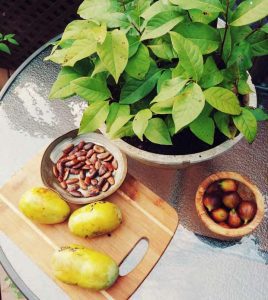
A true tropical-like wonder of the northeastern woodlands, the pawpaw tree appeared on our horizon through a local grower, Irina Popova, who as we later found out, grows a stunning mix of rare edible plants in her tucked-away urban garden in Edison, New Jersey. Irina gifted us two boxes of young pawpaw seedlings in the summer of 2020, and we were happy to add the younglings to our planting sites later that fall.
It seems that pawpaws are having their moment of fame these days as more and more groups get together for pawpaw festivals, pawpaw cooking extravaganzas, and to post trophy pictures of their finds. This is a great thing as this tree is currently considered endangered in New Jersey and threatened in New York. Back in the day, pawpaws were an important sustenance staple. According to Richard L. Thornton, a Creek Indian in the Coweta Creek Tribe, ancestors of the Uchee, Chickasaw, Choctaw, Creeks, and Catawba cultivated and protected pawpaw patches, harvesting fruit for food and using the tree’s fiber for ropes and nets. Pawpaws helped sustain Lewis and Clark on the journey to the West.
Last fall, we had a pawpaw festival of our own, where kids and families had fun sharing stories, examining pawpaw seeds and plants, exchanging growing information, and of course, enjoying its flavorful sumptuous fruits.
Milkweed
Common milkweed is a special and much respected member in our Holmdel, New Jersey garden. In addition to producing cheerful flowers, it attracts a diverse suite of pollinators and provides a valuable habitat to the dwindling Monarch butterfly populations.
The plant is never shy of human attention either. From spring to fall, it attracts a gang of kids coming to observe Monarch caterpillars, cheer for the butterflies as they emerge and fly away, collect milkweed seed pods, play with the milkweed fluff, and pack seeds. A few seasons ago, kids also had to face the task of urgently finding other milkweed growers and relocating some of the caterpillars, as their number grew so large that we ran out of milkweed! The upside of the challenge was more milkweed planted and more caterpillars adopted by more gardens.
The monarch caterpillars’ efficiency and resilience has been a subject of much curiosity and adoration. Their beautiful striped colors, loud chewing, rapid growing in size, tons of poop production, and pupation process have produced pages of observations in the young nature lovers’ journals. We are happy to be a part of destigmatizing the magnificent milkweed plant and sharing with the community about its superpowers.
The Native Plants of the Northeastern Woodlands Art Contest
Earlier this year, we offered a public art contest, which focused on the awareness about the plants in the Northeastern United States. The themes sprang naturally from our passion for the plants we hold dearest in our hearts.
About the Authors
Alan Ritter was born in Syracuse, New York. He has walked many backwoods trails and loves Nature. He hosts a wholesale produce club in Oaklyn, New Jersey wherein folks get access to affordable produce. He also consults and connects interested parties to wholesale resources in their area. Alan holds a PhD in Chemistry from the University of Pennsylvania.
Olga Sher was born in the Volga-Ural region of Russia. From an early age, she was interested in herbal studies, traditional healing modalities, medicinal plants and mushrooms. Presently, Olga’s home is in Holmdel, New Jersey, where she raises two children, practices law, and advocates for the preservation of earth-based ways and indigenous traditions through organizing community service projects, workshops, and classes with Antinanco. Olga has been involved with the American Chestnut Revival and Native Food-Forest Restoration projects since 2018.
Antinanco is a non-profi t community organization in Holmdel, New Jersey committed to preserving and sharing knowledge about the Earth and her inhabitants and ecosystems through environmental conservation and educational projects, while leaning on Indigenous traditions.
References and Resources
- Freinkel, S. American Chestnut: The Life, Death, and Rebirth of the Perfect Tree. University of California Press (2007).
- The American Chestnut Foundation at: www.tacf.org
- Sandra L. Anagnostakis’ extensive publications at https://portal.ct.gov/CAES/ABOUT-CAES/Staff-Biographies/Sandra-L-Anagnostakis
- American Chestnut Tree Conservation Field Course: Manual for Forest Ecology and Conservation of the North-East United States. Chechina M., Shotzbarger T., et al. Antinanco Earth Arts School (2020) www.antinanco.org/americanchestnutmanual;
- For the Love of Pawpaws: A Mini Manual for Growing and Caring for Pawpaws – From Seed to Table, Lukacs, L. (2021): www.petersonpawpaws.com/category/links-resources/
- Common Milkweed (Asclepias syriaca L.), Taylor, D., U.S. Forest Service: www.fs.fed.us/wildflowers/plant-of-the-week/asclepias_syriaca.shtml
- Antinanco’s American Chestnut Tree Revival Project: www.antinanco.org/american-chestnut-trees
- Antinanco’s Native Food Forest Restoration Project: www.antinanco.org/foodforest
- American Chestnut Tree Games, Lesson Plants and Stories on Antinanco website: https://www.antinanco.org/americanchestnuteducation
Get Involved
Stay informed about our American chestnut adventures, planting events, volunteer opportunities, and project developments by signing up for our mailing list here: https://www.antinanco.org/subscribe.
You can also contribute to this project by supporting the following public parks, which have generously offered their land as a safe home for the seedlings. These parks and the amazing caretakers of these lands are protecting our plantings for the future.
- Columcille Megalith Park in Bangor, Pennsylvania: http://columcille.org/
- The Land Conservancy of New Jersey, South Branch Preserve in Mount Olive, New Jersey: https://tlc-nj.org/portfolio-item/into-the-woods/
- Graver Arboretum in Bath, Pennsylvania: https://www.muhlenberg.edu/aboutus/graver