By Louise Lo Presti and Darlene Troge
“I can only compare these great aquatic [kelp] forests … with the terrestrial ones in the intertropical forests. Yet if in any country, a forest was destroyed, I do not believe nearly so many species of animals would perish as would here, from the destruction of the kelp. Amidst the leaves of this plant, numerous species of fish live, which nowhere else could find food or shelter; with their destruction the numerous cormorants and fishing birds, the otters, seals, and porpoise would soon perish also; and lastly, the [humans] … would … decrease in numbers and perhaps cease to exist.“
Charles Darwin, 1834
Introduction
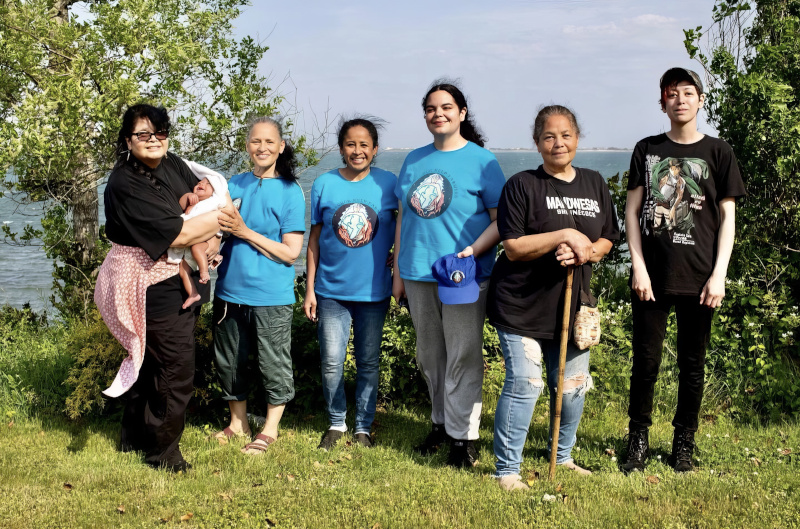
In a first-time initiative, IUCN’s Sustainable Use and Livelihoods Specialist Group is collaborating with the Shinnecock Kelp Farmers to document and evaluate one of the first modern Indigenous kelp farms, and the only one run solely by Indigenous women in the United States to combat marine environmental degradation resulting from human impact and climate change.

Background
For over 10,000 years, the Shinnecock “People of the Stony Shore” have inhabited coastal eastern Long Island, New York, an area now known as “The Hamptons,” one of the world’s wealthiest enclaves. The Shinnecock were fully displaced only in 1859 by the advent of the Long Island Rail Road. Now, the federally-recognized Shinnecock Indian Nation is confined to 900 acres on a narrow peninsula that is under serious threat from rising warming waters, coastal erosion, and algal bloom together with untreated septic waste and chemical run-off from adjacent “Billionaires Row” and a golf course. The Shinnecock coastline is projected to be underwater within 25 years, which will force Tribal members to relocate farther inland.
This environmental degradation significantly impacts marine and shore life, including commercially valuable fisheries. Shinnecock Inlet is New York’s second largest commercial fishing center, with an average of 10 million pounds of fish landings per year valued at $8 million including 39 species, primarily bluefish, angler, and skate as well as shellfish. Shinnecock Bay, itself, is a federally designated Critical Harbor of Refuge. Deteriorating water quality has resulted in depletion and weakening of species, most notably, the collapse of the commercially valuable scallop population.
Despite the Hampton’s wealth, average income on the reservation is at the poverty line. Economic opportunities are limited, especially since the Shinnecock were permanently enjoined from building a casino on tribal lands.
Taking Action
To help turn the tide, to heal Nature and to honor their heritage, six intergenerational Shinnecock activist women and Elders formed the Shinnecock Kelp Farm, which has shown significant success. In 2019, in ongoing advocacy to protect their lands from relentless development, these activist women came to the attention of GreenWave, a Connecticut non-profit organization specializing in regenerative ocean farming, notably, kelp farming, an emerging technology. GreenWave suggested kelp farming to these women and has supplied the now-Shinnecock Kelp Farmers with ongoing technical training and support. These farmers cultivate Sugar Kelp (Saccharina latissima) in Shinnecock Bay.
Cultivation of Sugar Kelp “and other native macroalgal species has the potential to diversify and strengthen New York’s mariculture industry while improving water quality through bioextraction, which is the removal of excess nutrients such as nitrogen from coastal waters through cultivation and harvest of macroalgae,” according to the New York State Department of Environmental Conservation.
Tribal Legal Mechanisms
The NYS DEC requires an Off-Bottom Macroalgae Permit for any commercial or non-commercial algae cultivation. A condition to obtain the permit is demonstrating prior authorization, title, or legal control of the site to be used for cultivation. As of the end of 2023, only one commercial permit has been issued, with four other pending applications.
The Shinnecock currently operate without the NYS DEC permit by asserting their unique tribal water and land rights dating from the 17th Century. In the original colonial Indian Deed of 1659, the Shinnecock retained their right to the water and shores. In subsequent agreements over the centuries, the Shinnecock affirmed and operationalized those rights. The Deed and subsequent agreements are all registered with the Town of Southampton and form the legal basis for the Shinnecock Kelp Farmers to cultivate kelp in the Bay. While the Shinnecock have gathered many types of seaweed over millennia, this project uniquely focuses on kelp, blending ancient tradition with science and technology.
The Kelp Farm Cycle
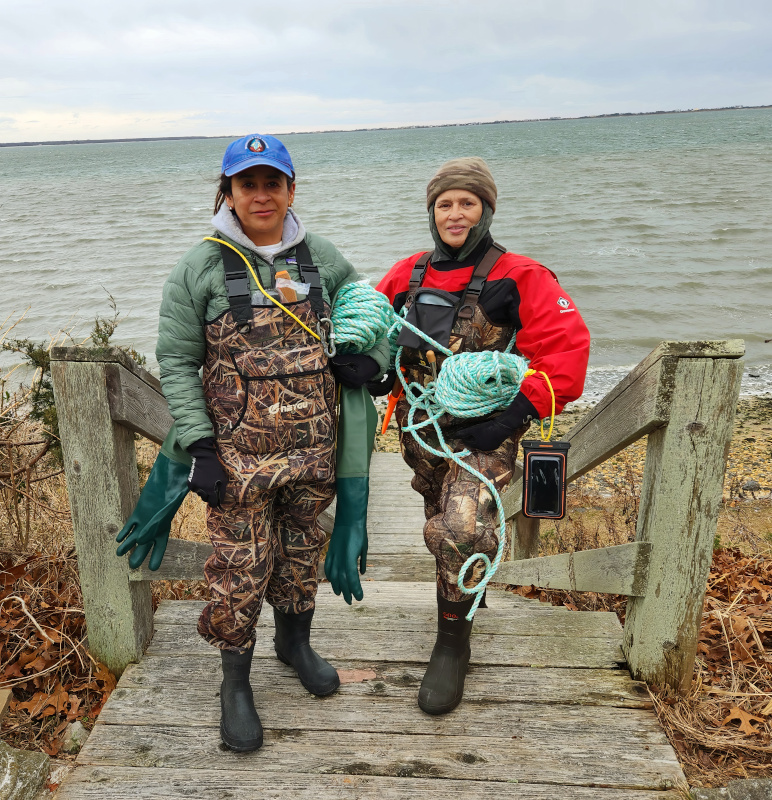
On a serene corner of Shinnecock Bay overlooking the reservation and Billionaires Row, the farmers work out of an interim hatchery in a cottage belonging to the Sisters of St. Joseph, an environmental activist order. Starting in September each year, these Shinnecock women spin threads of baby kelp onto a synthetic-blend string and in turn onto sections of PVC pipe. The threaded pipe sections are then placed in the hatchery tanks. Daily, the team feeds the kelp, changes the tank water, and monitors both algal growth and water quality. The entire process is manual and labor-intensive. Sugar Kelp is a cold-water species. The hatchery is kept at a constant 50oF. In December, the outplanting begins. Each pipe with its developed kelp growth is removed from the tank, wrapped first in toweling saturated with salt water, and then in plastic. The pipe is placed in a tray and then taken to the bay, where rows of anchored rope await. In waders and thermal gear, the farmers enter the water at low tide and begin the careful, meditative process of winding the kelp threads onto the rope. Outplanting is dependent on Mother Nature, and the combination of tide, weather, winds, and water can rule out a planned outplanting day. Harvesting begins in May when the mature kelp is removed from the water. The Shinnecock Kelp Farmers’ first harvest in 2020 was 800 feet of kelp, which increased dramatically to 7,000 feet in 2023. GreenWave founder Bren Smith says he’s impressed not only with the early success of the Shinnecock’s kelp growing but also with their coalition building and partnership strategies.
Most of the harvested kelp is sold as fertilizer locally, although the farmers hope to expand to additional products and customers. Notably, because the Bay plantings are under the 24-hour watchful eye of the Sisters of St. Joseph, there has been no illegal seaweed harvesting as occurs in Maine where entire valuable rockweed forests have been cut down to shrub-size, which depletes species dependent on the seaweed habitat.
Kelp’s Sacred Connection
Originally classified in the Plant Kingdom, Kelp is a Protist, with a fossil record going back more than 32 million years. Globally, kelp forests are estimated to cover 22% of the world’s coastline. Kelp holds a unique historic significance for coastal Indigenous cultures, with kelp forests comprising some of the world’s richest ecosystems. Many archaeologists and marine ecologists now believe that the First Americans arrived not by a land bridge but by water, following a “Kelp Highway.” “By about 16,000 years ago, the North Pacific Coast offered a linear migration route, essentially unobstructed and entirely at sea level, from northeast Asia into the Americas. Recent reconstructions suggest that rising sea levels early in the postglacial created a highly convoluted and island-rich coast along Beringia’s southern shore, conditions highly favorable to maritime hunter-gatherers. Along with the terrestrial resources available in adjacent landscapes, kelp forests and other nearshore habitats sheltered similar suites of food resources that required minimal adaptive adjustments for migrating coastal peoples. With reduced wave energy, holdfasts for boats, and productive fishing, these linear kelp forest ecosystems may have provided a kind of ‘kelp highway’ for early maritime peoples colonizing the New World.”
Franz Boas, “Father of Modern Anthropology,” was the first to chronicle the importance of kelp and other seaweed in the late 19th Century in the Pacific Northwest. “Kelp and other seaweeds had medicinal importance. They were often traded inland to treat iodine deficiency and goiter and included in medicinal steam baths (Turner 1995). The Saanich also shaved off pieces of bull kelp holdfasts to make a medicinal tea that helped with internal ailments” (Turner and Hebda 2012). For Indigenous coastal peoples, kelp is a cornerstone of traditional knowledge and lifeways. For millennia, Shinnecock people have depended on kelp for myriad uses from shelter, nutrition, livestock feed, and agriculture to medicine, healing, and ritual. The knowledge passed down through generations has formed the basis for healing practices that feature kelp as a medicinal remedy. Co-author Darlene Troge commented, “My mother Loretta, also known as Princess Silva Arrow would advise people in physical pain, ‘Go sit in the Bay for two hours’ as medicine.” Considered as part of Folklore and Folk Medicine, it was documented in the early 20th century that Shinnecock people used kelp for relief of pain and in the healing of rheumatoid arthritis.

Traditional Knowledge & Modern Science
While kelp and other brown algae are respected by many traditional cultures and by conventional medicine, the functional mechanisms of these seaweeds were not fully understood. Scientists have now focused on Phlorotannins and two main metabolites of brown algae—Fucoxanthin and Fucoidan—which are all found in Sugar Kelp. “Phlorotannins, a seaweed-based class of polyphenolic compounds, have proven to possess potential bioactivities such as antioxidant, antimicrobial, anti-allergic, anti-diabetic, anti-inflammatory, anti-cancerous, neuroprotection etc.” and are in great commercial demand. Current scientific research discovered that Fucoxanthin has unique functionality that regulates and inhibits disorders and disease. “Fucoxanthin (FX), a natural carotenoid present in edible brown seaweed, is known for its therapeutic potential in various diseases, including bone disease…. Therefore, FX is a potential therapeutic agent for osteoclast-related skeletal disorders including osteoporosis and rheumatoid arthritis.” Fucoidan is a polysaccharide that is being studied for its anti-cancer and anti-oxidant properties. Fucoidans “possess remarkable bioactive functions (anti-proliferative, anticancer, anti-coagulant, anti-thrombotic, anti-viral, anti-inflammatory, and anti-complementary agent.)” Fucoxanthin and Fucoidan “were found to be the most important active metabolites of brown algae as potential chemotherapeutic or chemopreventive agents…. Hence, discovery of new natural products and metabolites isolated from microorganisms, animals, and plants possessing high efficacy against tumor cells without any toxicity on normal cells is a big leap in scientific research.”
Consequently, scientific research validates the historic medicinal use of brown algae by the Shinnecock and by countless other Indigenous peoples. This article is the first to correlate traditional North American Indigenous medicinal uses of brown algae with modern science’s medicinal research of Phlorotannins, Fucoidans, and Fucoxanthins.
Environmental Stewardship
The Shinnecock Kelp Farmers’ cultivation, harvesting, and use of kelp is done in prayerful and mindful ceremony with Mother Earth, acknowledging the reciprocity of the relationship between humans and Nature and the obligation to rectify damage caused by humans. The Farmers are deeply committed to environmental healing. In a truly 21st Century initiative, traditional knowledge, scientific knowledge, and technology are woven together by the kelp farmers to restore a harmonious balance with Nature.
Challenges and Opportunities
The continued dumping of untreated waste including raw sewage and chemical fertilizer runoff into the Long Island Bays is a threat to the marine and coastal ecosystems, wildlife, and human life. In the face of environmental degradation and climate change, these Shinnecock Kelp Farmers believe that the integration of traditional knowledge, contemporary environmental management, and modern science forms a path we can all walk together to preserve the sacred relationship with Mother Earth. That movement is called “Mamowenene.”
Conclusion
By farming, advocacy, and raising awareness, the Shinnecock Kelp Farmers have re-awakened the long standing Tribal relationship with kelp. Blending traditional knowledge, modern science, and natural resource management, these Indigenous women honor their natural heritage and contribute to healing their coastal environment. The Shinnecock model can be extended to other coastal communities and activities. This will ensure income and capacity building together with protecting and preserving critical marine habitat. Sharing the Shinnecock Kelp Farmers’ experiences with a broader audience of Indigenous Peoples and Local Communities, decision makers, and policy makers will serve as a catalyst for change at a time when solutions for Indigenous jobs, food security and coastal resiliency are critically needed.
Louise Lo Presti is an anthropologist, independent consultant, and subject matter expert on Conservation and Community Development. She is a Global Coalition recipient of the 2023 United Nations Human Rights Prize for the Universal Recognition of the Right to Clean, Safe, and Healthy Environment. She is a member of the IUCN Sustainable Use and Livelihoods Specialist Group.
Darlene Troge is a Shinnecock Kelp Farmer, Water Protector, Grandmother, and Shinnecock Tribal Elder. Brought up on the coastal Shinnecock Indian Reservation, she honors and respects the Eastern Woodlands traditions. She serves as the Director of Tribal Workforce Development of the Great Mashantucket Pequot Tribal Nation in Mashantucket, Connecticut.
References
- Charles Darwin [1909:256–257]; 1 June 1834, Tierra del Fuego, Chile.
- US Army Corps of Engineers https://www.nan.usace.army.mil/Media/Fact-Sheets/Fact-Sheet-Article-View/Article/487294/fact-sheet-shinnecock-inlet-new-york/
- New York State Department of Environmental Conservation https://acrobat.adobe.com/id/urn:aaid:sc:VA6C2:de0fb3cf-ad24-440f-a7e6-b22a1a0de7a0
- The Town of Southampton https://www.southamptontownny.gov/207/Historic-Documents
- Kunze, Jenna. “Replenishing What Has Been Stolen”, Native News Online. 2023 https://nativenewsonline.net/replenishing-what-has-been-stolen
- Gannon, Meg. Sierra Club Magazine. March 13, 2022. https://www.sierraclub.org/sierra/east-coast-s-first-indigenous-kelp-farm-readies-for-harvest
- “A modeled global distribution of the kelp biome” – ScienceDirect https://www.sciencedirect.com/science/article/abs/pii/S0006320720308739
- Jon M. Erlandson, et al. “The Kelp Highway Hypothesis: Marine Ecology, the Coastal Migration Theory, and the Peopling of the Americas.” http://dx.doi.org/10.1080/15564890701628612
- APPENDIX B: The Cultural Importance of Kelp for Pacific Northwest Tribes https://nwstraits.org/media/2925/appendix_b_the-cultural-importance-of-kelp-for-pacific-northwest-tribes.pdf
- M. R. Harrington, “Shinnecock Notes”, The Journal of American Folklore. Jan. – Mar. 1903, Vol. 16, No. 60 (Jan. -Mar., 1903), pp. 37-39.
- Lekshmi R. GMar.ar, et al. “Phlorotannins–bioactivity and extraction perspectives.” J Appl Phycol. 2022; 34(4): 2173–2185. Published online 2022 May 17. doi: 10.1007/s10811-022-02749-4
- You-Jung Ha et al. “Fucoxanthin Suppresses Osteoclastogenesis via Modulation of MAP Kinase and Nrf2 Signaling.” Mar Drugs. 2021 Feb 27;19(3):132. doi: 10.3390/md19030132 https://pubmed.ncbi.nlm.nih.gov/33673704/
- Maria Elena Reyes, et al. “Brown Seaweed Fucoidan in Cancer: Implications in Metastasis and Drug Resistance.” Mar Drugs. 2020 May; 18(5): 232. Published online 2020 Apr 28. doi: 10.3390/md18050232
- Bahare Salehi, et al. “Current Trends on Seaweeds: Looking at Chemical Composition, Phytopharmacology, and Cosmetic Applications,” Molecules. 2019 Nov; 24(22): 4182. Published online 2019 Nov 18. doi: 10.3390/molecules24224182
- Soheil Zorofchian Moghadamtousi, et al. “Anticancer and Antitumor Potential of Fucoidan and Fucoxanthin, Two Main Metabolites Isolated from Brown Algae.” Scientific World Journal. 2014; 2014: 768323. Published online 2014 Jan 2. doi: 10.1155/2014/768323