By Stephanie Le
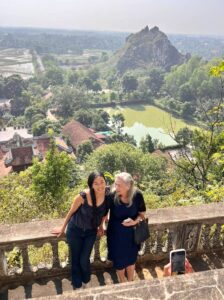
Vietnam is loud at first. Red plastic stools spill onto the pavement, a sea of motorbikes weaving past each other, the constant hum of the local market. But if you stay long enough, past the conical hats, pho, and war remnants, something quieter begins to reveal itself.
Elderly couples moving slowly by the lake in the early morning, breathing in khí. The scent of incense lingering from an ancestral altar. Seasonal flowers arranged carefully in every home. The quiet is easy to miss. It is simple. Subtle.
I moved to Hanoi just over a year ago. Before that, I had spent my whole life in Sydney, Australia. There were many reasons I gave for why my partner and I decided to move, most of them offered to reassure concerned and confused family members. But the truth was that there was no reason. Only a feeling. A knowing that there was something here.
Returning as diaspora, I exist somewhere in between. As a teenager, this felt like something to resolve. Now, it feels like a way of standing slightly to the side. Close enough to recognise what is happening, but not so close that it disappears into habit.
Before moving, I thought I already knew Vietnam. I had spent many summers here as a child, visiting family, moving between cities, eating familiar foods. I recognised the herbs we could also buy in Asian grocery stores in Sydney: bạc hà (mint), ngò gai (sawtooth coriander), húng quế (basil), tía tô (perilla), kinh giới (balm). I knew their tastes, their pairings and the way they could transform a dish with very little effort. But living here as an adult is different. What I knew was only the surface.
After my naturopathic studies, I understood herbs through textbooks, systems, and brown bottles lined on dispensary shelves. I could recall their Latin names, constituents, and their recommended dosages. Often, the only connection I had to the living plant was a small photo on the label.
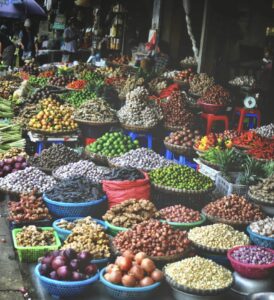
Here, that distance collapses. It is alive. Herbs are rarely something you must seek out. They grow easily in this climate, and so they find their way into everything. The security guard inhaling tobacco from a bamboo pipe can tell you which herbs to eat or drink to cool your liver and support digestion—something he likely learned from his mother or through experience. At the local wet market, if it’s your first time seeing a plant, just ask the vendor. She will tell you exactly how to prepare it and what it is traditionally used for.
At my grandparents’ home in Ninh Bình, my great-uncle grows mã đề (plantain, Plantago ovata) and hẹ (garlic chives) (Allium tuberosum) for my grandmother. Among many plants, these are the ones he tends to most carefully. Plantain because my grandma is prone to UTIs and garlic chives because he knows she loves them.
My sister, who was always bumping into things when she was little, has an aversion to garlic chives. It’s my grandma’s favourite remedy for bruises and to dissolve blood stasis. She would chew the leaves and apply them as a poultice. A whiff of this saliva combination could make anyone gag. But it was important that it was chewed. She would insist that a mortar and pestle could not create the same healing effect.
My grandmother was a nurse for much of her life and had seen the power of plants and spirit firsthand. She was my first introduction to healing. Her kitchen benchtop was always lined with jars of tinctures, ferments, and miscellaneous concoctions. An avid learner, she continues to keep several notebooks filled with herbal recipes and formulas. Whenever a friend visits with an ailment, she sifts through her notes with utmost seriousness for a remedy that might help.
When I lost my period for a time, she made me a traditional mugwort (Artemisia vulgaris) omelette. The leaves were young, so the bitterness was tolerable, almost delicious. That week she cooked for me every day creating dishes to nourish blood and stimulate menses.
Perhaps it is because of this that food has become my favourite way to work with herbs. Even as an herbalist, I struggle to complete a course of pills, decoctions, or tinctures. Thankfully here herbs are already part of the meal. Vietnamese cooking is seasonal, intuitive, and generous with plants.
When sharing a meal, dishes are placed at the centre of the table. There is always soup, vegetables, a protein dish, pickles, and dipping sauce. Plates of fresh herbs sit within reach, piled loosely with fragrant leaves. If you ask what something is, someone will answer and is usually followed by another voice chiming in. Out of the corner of your eye, a pair of chopsticks passes, and your bowl is refilled before you even notice it is empty. This same quiet attentiveness appears in other places, too.
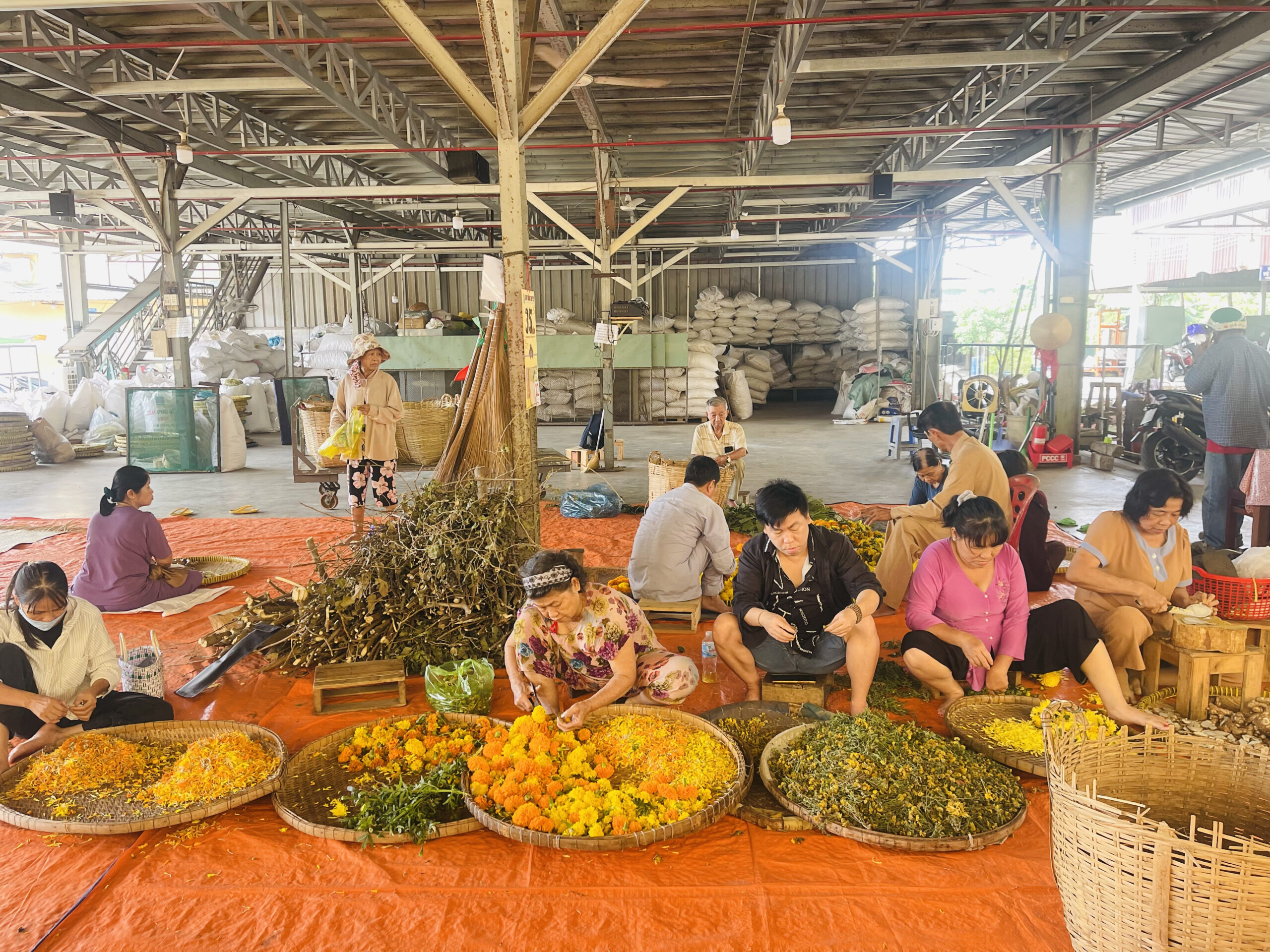
At a temple clinic in Saigon, I spent time volunteering alongside practitioners of traditional Vietnamese medicine and local residents. In the mornings a long line of patients forms outside. For many, this is their only access to healthcare. The clinic runs entirely on donations and the efforts of volunteers, seven days a week.
At the front of the temple is an altar to Đức Tông Sư Minh Trí, the healer who founded the temple and clinic. In the back, herbs move through many hands as they are washed, chopped, dried and sorted. Most of the volunteers are older. They arrive early and stay for hours. Some talk as they work. Others move more meditatively, absorbed in the rhythm of their tasks.
One day, I spent hours slicing turmeric (Curcuma longa) into thin, even pieces. At first, the knife moved clumsily on the tree stump serving as my chopping board until someone showed me how to angle it. The scent deepened as it oxidised, staining everything it touched. By the end of the day, I wore my yellowed fingernails as a badge of honour.
The next day, I separated lotus (Nelumbo nucifera) petals from their base, working gently so as not to bruise them. Just when it feels like you are finished, another bundle appears. The work continues.
As I sat beside the elders, they shared what they knew about the plants we were preparing. Everyone had something to offer. If no one recognised a plant, they would suggest asking one of the herbalists after they had finished seeing patients. Knowledge moved the same way the herbs did—through many hands.
On the streets of Hanoi, small trà đá (tea) stands appear on nearly every corner. Men sit on low stools, pausing between the movements of the day.
During our first summer here, my partner would visit our local trà đá spot regularly. He would drink two iced teas, one after the other, as relief from the humid heat. He grew up in Kathmandu and had never experienced this kind of climate. The tea vendor could tell.
One day, she offered him a glass of nước vối (Syzygium nervosum) instead. She was concerned he was drinking too much tea on an empty stomach. He drank it slowly at first, unfamiliar with the bitterness. Later, he came home and told me about it—how refreshing it felt, calling it “internal A/C.” After that, he returned every day—not just for the herbal tea, but for the unspoken care and the small exchanges that formed. Fruit, snacks, a few words.
This year, the pavements are being cleared. Modern cities are expected to have clear pavements. Her stall is smaller now. Fewer stools. Less space to sit. Vietnam is changing, quickly, but the thread that runs through it remains.

It moves through people. In the gathering, preparation, and sharing of herbs. In the way a stranger becomes familiar through small, repeated exchanges. And in the quiet offering of care, not as something extraordinary, but simply as part of daily life.
I came here thinking I was learning about plants. But again and again, I find myself learning how people take care of each other. And how, more than anything, that is what sustains not only us, but the land, the earth, and the plants themselves.
Stephanie Le is a naturopath and Vedic astrologer based in Hanoi, Vietnam. She is the founder of Uma Collective, where she offers courses, consultations, and immersive experiences rooted in herbalism, astrology, and traditional healing arts. You can connect with her at theumacollective.com