Cascara Sagrada
(Frangula purshiana (Rhamnus))

Overall At-Risk Score: 51
Latin name:
Frangula purshiana (Rhamnus)
Common name:
Bearberry, Cascara, Cascara Buckthorn, Cascara Sagrada, Chittam Bark, Coffee-Tree
Family:
Rhamnaceae (Buckthorn family)
Lifespan:
Long-lived deciduous tree or shrub.
Reproduction:
Cascara Sagrada reproduces using small seeds found inside small black fruits, which are eaten and transported by birds.
Geographic region:
Cascara Sagrada is found in the U.S. states of California, Idaho, Montana, Oregon, and Washington, as well as the Canadian province of British Columbia.
Habitat:
Cascara Sagrada usually grows on the lower portion of mountains in the forests of the Pacific Northwest.
Ability to Withstand Disturbance and Overharvest:
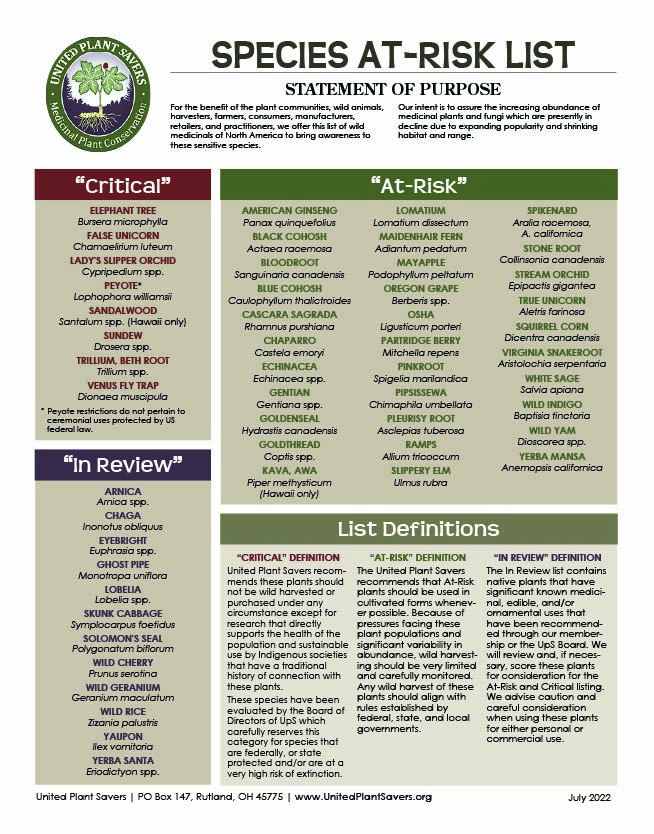
The overharvesting of Cascara Sagrada is so abundant that it is likely to become an issue if we don’t begin conservation efforts now. There are some subspecies of Cascara Sagrada that are limited to small portions of California and are being farmed the same as their more abundant counterparts despite their limited geographic region.
Status of Endangered/Threatened (by state):
Frangula purshiana is listed as being of “Least Concern” by the IUCN Red List.
Part of Plant Used/Active Medicinal Compounds:
Several Native American tribes in the region used portions of the tree as a laxative, a practice still continued by modern pharmaceutical companies, who make dietary supplements out of the bark. It is also occasionally used as a flavoring in food and liquor.
Demand:
Before its ban as a laxative ingredient in over-the-counter medicine, Cascara was one of the most widely used laxatives in the world, and in a single year, over 5 million pounds of bark was processed for use in medicine. Though the market for Cascara has faded over time, it is still sold as a dietary supplement and remains in some demand.
Wild Harvesting Impact On Other Species and Lookalikes:
Cascara Sagrada is used as a food source for wild sheep, bears, foxes, wild cats, and several species of birds. Many species in the Cervidae (deer) family, eat Cascara Sangrada, especially during the winter when other foods may be scarce.
Recommended alternatives for industrial and home use:
United Plant Savers recommends talking to your doctor before taking any new medications or supplements, to make sure they don’t react poorly with you or any other medications you may be taking.
Citations
- Habeck, R. J. 1992. Frangula purshiana. In: Fire Effects Information System, [Online]. U.S. Department of Agriculture, Forest Service, Rocky Mountain Research Station, Fire Sciences Laboratory (Producer). Available: https://www.fs.fed.us/database/feis/plants/shrub/frapur/all.html [2019, July 14].
- Stritch, L. 2018. Frangula purshiana. The IUCN Red List of Threatened Species 2018: e.T61957071A61957074. http://dx.doi.org/10.2305/IUCN.UK.2018-1.RLTS.T61957071A61957074.en. Downloaded on 14 July 2019.
- USDA NRCS. Plants Profile for Frangula purshiana (Cascara Buckthorn). Retrieved from https://plants.usda.gov/core/profile?symbol=FRPU7
- U.S. National Library of Medicine. (2018, June 09). Cascara Sagrada: MedlinePlus Supplements. Retrieved July 14, 2019, from https://medlineplus.gov/druginfo/natural/773.html
Related Posts
A Snapshot of the Shakers as Herb Traders by Steven Foster
In tribute to Steven Foster, we would like to share a piece that he wrote on the Shaker medicinal plant trade for the Journal of …
Creating New Forests for Medicinal Plants
By Michael Pilarski United Plant Savers has done great work with 1) preserving what we currently have; and 2) encouraging more farming of medicinal plants …
The Original Medicinal Plant Gatherers & Conservationists
by M. Kat Anderson USDA NRCS Figure 1. Goldenseal (Hydrastis canadensis). One example of the many medicinal plant species that the American Indians gave non-Indian …