Spikenard
(Aralia racemosa)
Overall At-Risk Score: 53
Latin Name:
Aralia californica, Aralia humilis, Aralia racemosa
Common Name(s):
American spikenard, Aralie à grappes (French), California spikenard, Elk Clover, Spikenard
Family:
Araliaceae

Part(s) of Plant Used:
Various parts and primarily the roots of Aralia californica have traditional medicinal use among the Karok, Mendocino, and Pomo Indigenous groups of the western USA.
Various parts and primarily the roots of Aralia racemosa have traditional medicinal use among the Algonquin, Cherokee, Chippewa, Choctaw, Iroquois, Malicite, Menominee, Meskwaki, Micmac, Ojibwe, Penobscot, and Potawatomi Indigenous groups of the eastern and Midwestern parts of the USA.
Geographic Region(s):
Aralia californica is only known from California and Oregon.
Aralia humilis is only known from Arizona and possibly New Mexico.
Aralia racemosa is known from eastern US, Canada as far west as Utah and as far south as Mexico.
Habitat(s):
Typically found in cool moist conditions in part shade, most often in deciduous forests.
Life History:
All species are perennial plants with fruits eaten and spread by birds.
Endangered/Threatened/Trade Status:
X = Presumed Extirpated H = Possibly Extirpated 1 = Critically Imperiled 2 = Imperiled 3 = Vulnerable 4 = Apparently Secure 5 = Secure NR = No Rank
Aralia californica is ranked G4 globally, and is not ranked at the state level where it occurs in CA and OR.
Aralia humilis is listed G3/G4 globally, and S3 in AZ occuring in only 3 counties and an unspecified area in NM.
Aralia racemosa is listed G5 globally, N5 in Canada, and N4 in the USA.
S5 in IN, NY, PA and Ontario with a S4/5 rating in New Brunswick
S4 in IA, KY, NC, VA and Nova Scotia
S3 in GA, NJ, SD
S2 in Manitoba, Prince Edward Island and S2/S4 MD
S1 in AL, MS, CO, KS, NE, RI, TX, UT
Ability to Withstand Disturbance:
Disturbance to the moisture or shade regime over extant plants could be harmful.
Propagation:
Best to plant fresh seeds. After 40 days of stratification, they germinate in 2 to 3 weeks. Soil should be fairly rich and moist in predominantly deciduous forests. Can also be propagated by root cuttings. Adapts well to domestication.
Vulnerabilities and Threats:
Vunerable to climate change and habitat loss especially because they rarely grow in large groups and are dependent on a moist environment and shade to thrive. A more unusual variant occurs in the west of Aralia racemosa ssp. bicrenata,which may be considered more imperiled than the eastern type A. racemosa ssp. racemosa. Populations in states listed as S1 are very restricted but often occurring in protected areas. The other species A. californica and A humilis should probably not be harvested unless incredibly abundant due to the lack of analysis of their frequency within a rather restricted range.
Wild Harvesting Impact on Other Species:
Not Available
Lookalike(s):
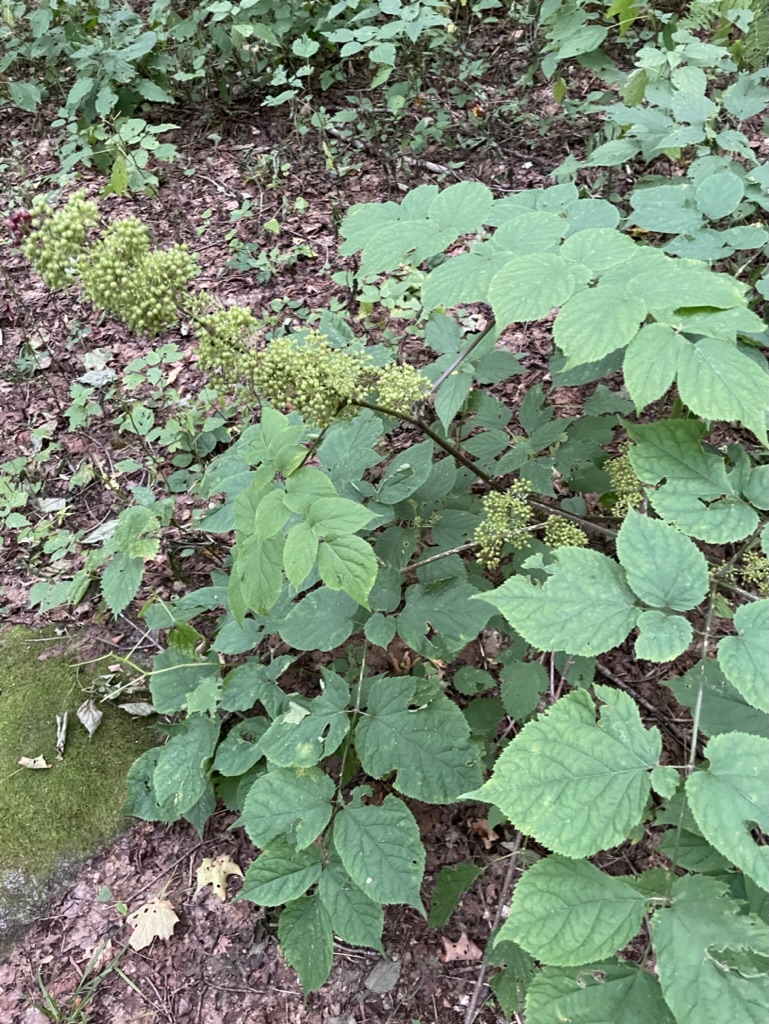
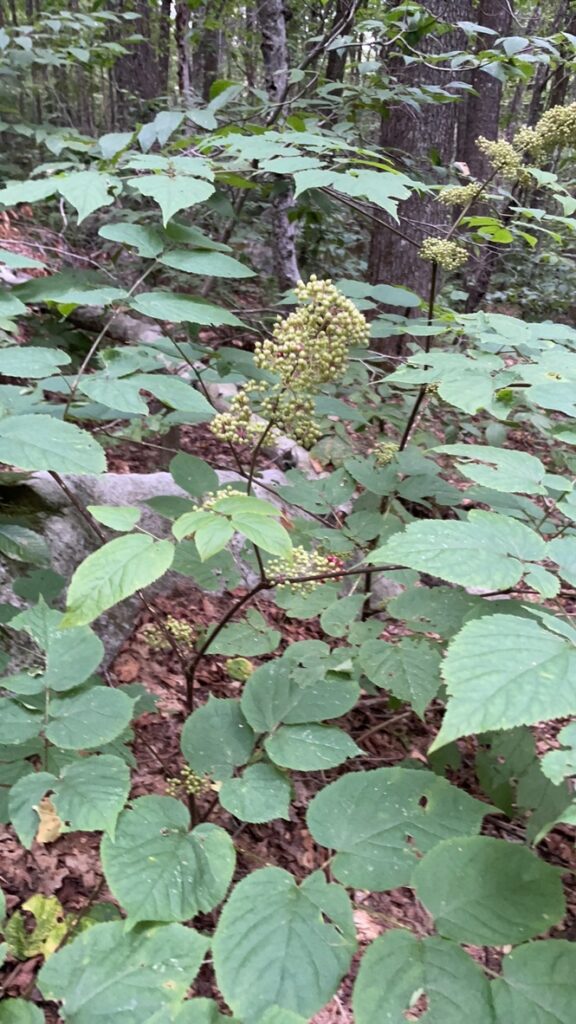
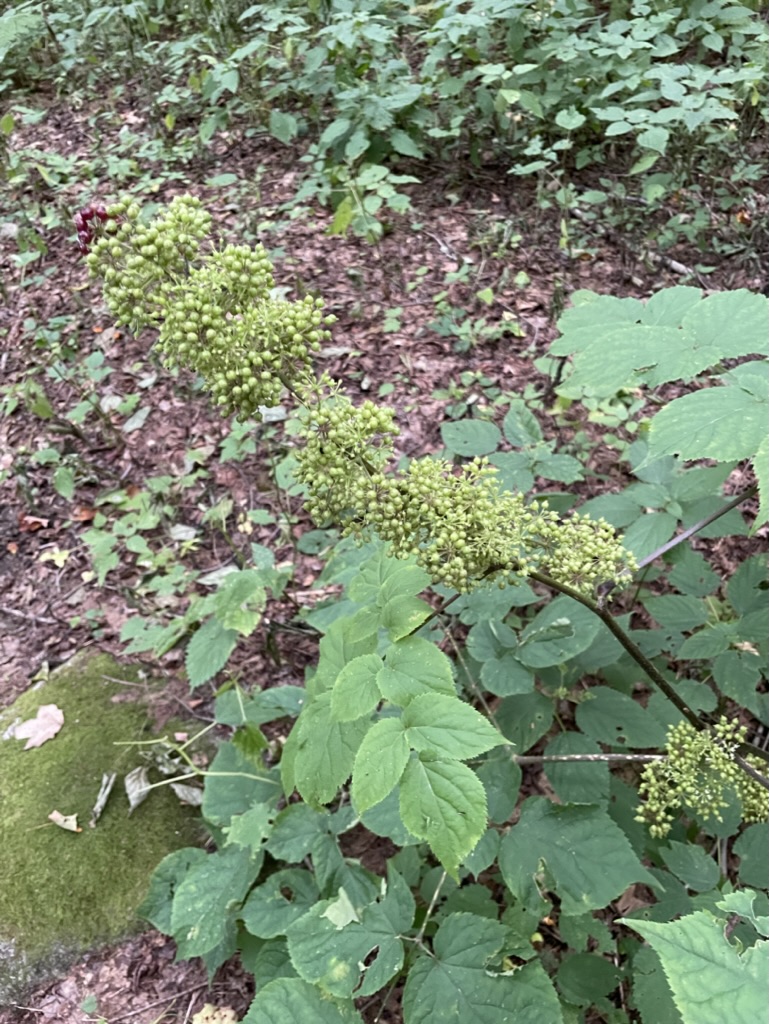
Other plants with large compound leaves might be confused with Aralia spp., such as members of the Aruncus and Astilbe genera, as well as other members of the Araliaceae or closely related Apiaceae genera, especially when not flowering. In theory introduced and naturalized spp. in the Aralia genus might be confused too including A. chinensis, A. cordata and A. elata.
Demand:
Nature Serv reported 500 – 1000 dried pounds of root harvested annually (ca. 2003), with most demand driven by folk level use.
Status Recommendation:
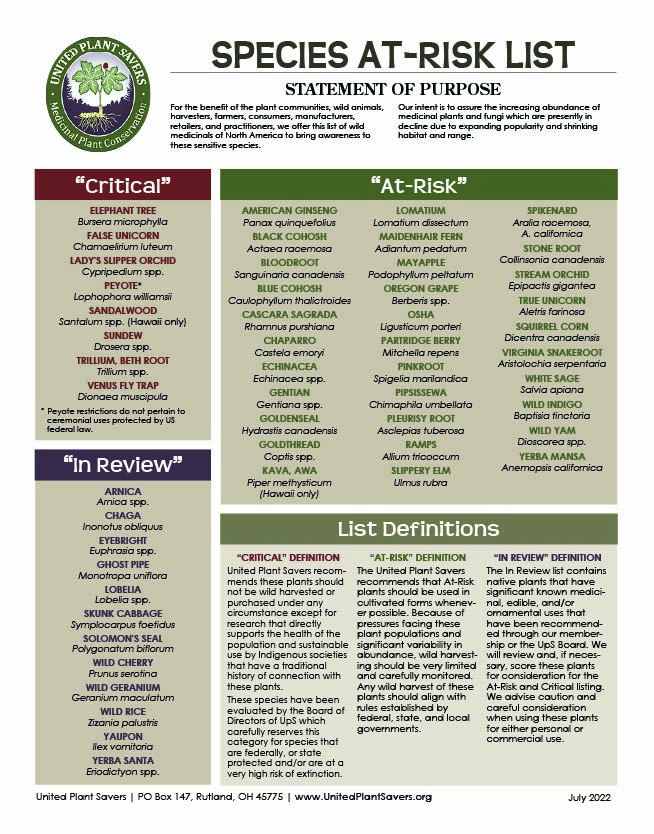
At Risk
The United Plant Savers recommends that At-Risk plants should be used in cultivated forms whenever possible. Because of pressures facing these plant populations and significant variability in abundance, wild harvesting should be very limited and carefully monitored. Any wild harvest of these plants should align with rules established by federal, state, and local governments.
References:
- Cech, R. (2002). Growing at-Risk Medicinal Herbs: Cultivation, Conservation, and Ecology. Horizon Herbs.
- Clement, J., A., & Clement, E., S. H. (2014). The Medicinal Chemistry of Genus Aralia. Current Topics in Medicinal Chemistry, 14(24), 2783–2801.
- Densmore, F. (1974). How Indians Use Wild Plants for Food, Medicine, and Crafts. Dover.
- Duke, J. A., & Foster, S. (2014). Peterson Field Guide to Medicinal Plants and Herbs of Eastern and Central North America (3rd ed.). Houghton Mifflin Harcourt.
- Elliott, D. B. (1995). Wild Roots: A Forager’s Guide to the Edible and Medicinal Roots, Tubers, Corms, and Rhizomes of North America. Healing Arts Press.
- Erichsen-Brown, C. (1989). Medicinal and Other Uses of North American Plants: A Historical Survey with Special Reference to the Eastern Indian Tribes. Dover Publications.
- Gladstar, R., & Hirsch, P. (2000). Planting the Future: Saving Our Medicinal Herbs. Healing Arts Press.
- Hutchens, A. R. (1991). Indian Herbalogy of North America (1st paperback ed). Shambhala.
- Moerman, D. E. (1998). Native American Ethnobotany. Timber Press, Incorporated.
- Vogel, V. J. (1990). American Indian Medicine. University of Oklahoma Press.
- Wen, J., Shi, S., Jansen, R. K., & Zimmer, E. A. (1998). Phylogeny and biogeography of Aralia sect. Aralia (Araliaceae). American Journal of Botany, 85(6), 866–875. https://doi.org/10.2307/2446422
- Xu, Y., Liu, J., Zeng, Y., Jin, S., Liu, W., Li, Z., Qin, X., & Bai, Y. (2022). Traditional uses, phytochemistry, pharmacology, toxicity and quality control of medicinal genus Aralia: A review. Journal of Ethnopharmacology, 284, 114671. https://doi.org/10.1016/j.jep.2021.114671
Additional Source(s) of Interest:
- https://www.wildflower.org/plants/result.php?id_plant=arra
- http://naeb.brit.org/uses/search/?string=Aralia
- https://www.prairiemoon.com/aralia-racemosa-spikenard-prairie-moon-nursery.html
- https://pfaf.org/user/Plant.aspx?LatinName=Aralia+racemosa
- https://explorer.natureserve.org/Taxon/ELEMENT_GLOBAL.2.135208/Aralia_racemosa
- https://explorer.natureserve.org/Taxon/ELEMENT_GLOBAL.2.161750/Aralia_californica
- https://explorer.natureserve.org/Taxon/ELEMENT_GLOBAL.2.143584/Aralia_humilis
- https://plants.usda.gov/home/plantProfile?symbol=ARRAB2
- https://plants.usda.gov/home/plantProfile?symbol=ARRAR
- https://plants.usda.gov/home/plantProfile?symbol=ARHU
- http://bonap.net/Napa/TaxonMaps/Genus/County/Aralia
- https://unitedplantsavers.org/ups-list-of-herbs-analogs