By Shay Clanton
“May we learn to return and rest in the beauty of animal being, learn to lean low, leave our locked minds, and with freed senses feel the earth breathing with us. “
– John O’Donohue
As a Deep Ecology Artist Fellow, I had the privilege of staying at the United Plant Savers Botanical Sanctuary in May and October of 2022. My time at the Sanctuary was heart opening and peaceful in a way that I still contemplate.
I returned to the Sanctuary the following year on the spring equinox, March 20th. I wanted to see the forest at the end of winter and hoped to see the slopes and hollers filled with the ramps (Allium tricoccum) that I had heard so much about.
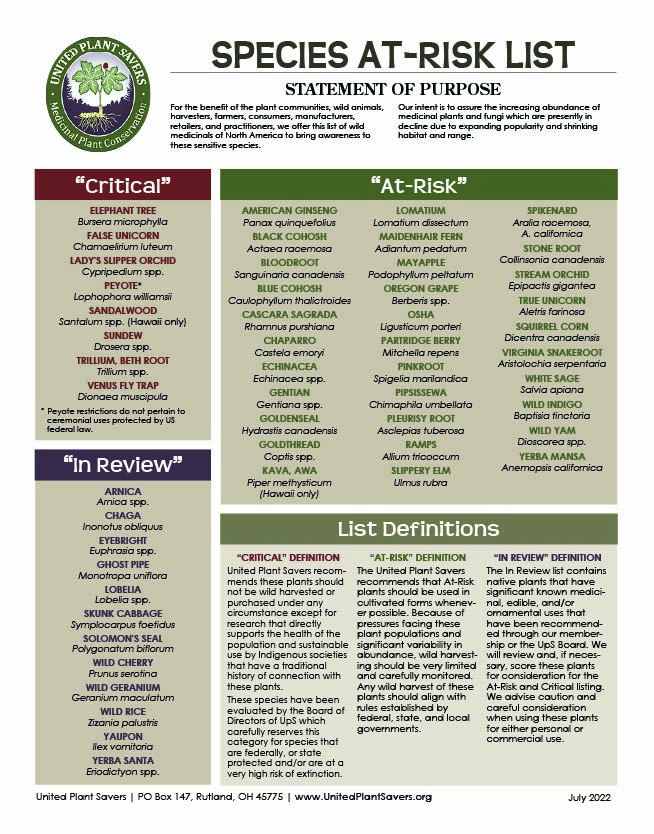
The forest around the yurt still held the quiet of wintertime. The coming energy of spring was barely visible in new violets (Viola spp.) and some green in the forest floor. On the day of the Spring Equinox I walked on the Medicine Trail to the Main Hollow Trail up a ridge and down into a protected hollow of ancient trees. I was suddenly surrounded by the vibrant green of newly emerging ramps. They covered the steep slopes and were growing among the big trees in incredible abundance. The spring energy was palpable. I sat at the base of a rocky ridge dripping with melting ice and ate a few ramp leaves to celebrate spring. Among the ramps, blue cohosh (Caulophyllum thalictroides) were just unfolding their strange dark-purple leaves like the leathery wings of a tiny prehistoric bird species or the tiny hands of a mysterious earth spirit. They are a hallucinatory grayish and dark blue-purple at this stage of life with an underlying red glow. It is thought that the pigment protects them from the sun in the still leafless forest and perhaps from animal and insect browsing (though few animals graze on blue cohosh because of possible toxicity). As the plant matures, it is transformed into green with a blueish tint. In their presence I was given a glimpse into the ancient evolutionary journey of plant consciousness and the intelligence that enables their survival.
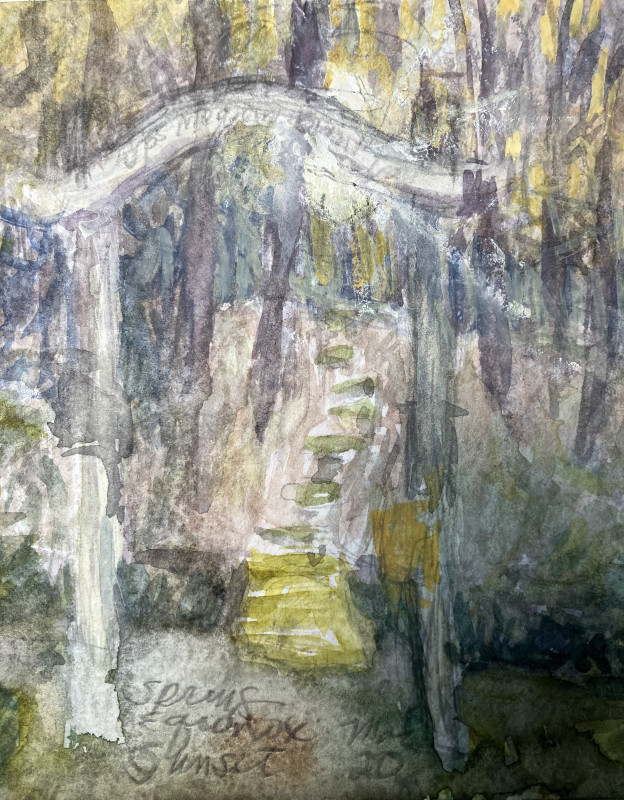
Entrance to Medicine Trail by Shay Herring Clanton
Blue cohosh is an herbal ally for women and was used traditionally by Indigenous peoples and prescribed by early eclectic physicians for women in the last week of pregnancy and during labor to strengthen uterine contractions to aid in childbirth and labor. It was also used to promote menstruation and as an anti-inflammatory (Rosemary Gladstar, Herbal Healing for Women). Herbalists and midwives still consider it to be an effective aid in labor, though it is a powerful plant that must be used with skill and care. My son and daughter in law were expecting a baby in May, my first grandchild, and I respectfully asked blue cohosh to bless her labor.
I was grateful to sit with the ramps and the blue cohosh in the protection of the Sanctuary. Not long ago, I was among a dedicated and persistent group of people who spent 7 years fighting a giant fracked gas pipeline called the Atlantic Coast Pipeline, a project of unprecedented size that was proposed to carry fracked gas from West Virginia to North Carolina through the Appalachian Mountains on steep karst mountain slopes and through mountain rivers and streams. During that long fight, I took part in a plant rescue along the pipeline route in rural Highland County Virginia on a farm that had been cared for by the same family for generations. Their land had recently been seized by the ACP developers through eminent domain. We dug buckets full of blue cohosh, bloodroot (Sanguinaria canadensis), and other companion medicinal plants that would have been destroyed by the pipeline. The plants were so abundant, especially blue cohosh, that their colonies and relationships must have been ancient. The Atlantic Coast Pipeline was eventually cancelled because of rising costs, mainly due to litigation and the fierce fight put up by people who cared about their farms, the mountains, and their watersheds.* Many of the plants from that mountain slope still grow there in their ancient symbiotic relationship with the fungi and minerals and with each other. Some of the blue cohosh we rescued are growing near a small hidden spring on our family’s land in the mountains of western Virginia which is a United Plant Savers Botanical Sanctuary called Walker Mountain Botanical Sanctuary. Other rescued plants were transplanted throughout the mountains on protected private land.
The Sanctuary hollow where the ramps and blue cohosh grow is part of land that was strip mined by coal companies. It was reclaimed and restored with significant effort and love by Paul Strauss and later gifted to United Plant Savers. On the day of the spring equinox, I was reminded that plants and humans share a form of symbiotic relationship. Humans are so much younger than plants, but from our earliest beginnings we have evolved in relationship to them. They are our medicines, our companions, and have helped create our sense of beauty. In this age of blindness to our deep connection there are still many people who live with respect and love for the plants and the earth. I thought of my unborn grandson and was filled with gratitude that he would grow up in a beautiful mountain holler with clean water and all the plants for companions and food and medicine. I hope that someday he will visit the United Plant Savers Botanical Sanctuary to see the ramps, blue cohosh, and ancient trees and meet the people who love them.
*Another fracked gas pipeline called Mountain Valley Pipeline, proposed at the same time, is being built just south of the route of the Atlantic Coast Pipeline. It goes through steep Appalachian Mountain slopes and sensitive watersheds and through farmland that has been in the same families for centuries. It has been enormously destructive. To see the movement, to stop it, and for more info see: appvoices.org/pipelines/mountain-valley-pipeline/
Shay Herring Clanton is an artist who works in both painting and drawing mediums. She taught painting, drawing, and design for 20 years at Mary Baldwin University in Staunton Virginia. She is also a student of medical herbalism with Kat Maier at Sacred Plant Traditions in Charlottesville, Virginia and with Phyllis Light of Arab, Alabama. Since early childhood in her native home in Alabama, Shay has loved plants and the green world. Her years of activism for the protection of the earth were inspired by that love. Her family’s home in Deerfield, Virginia, in a beautiful Appalachian Mountain holler, is a United Plant Savers Botanical Sanctuary called Walker Mountain Botanical Sanctuary. www.shayherringclanton.net