By Maria Christodoulou
In the spirit of remembering those who have passed, I would like to share a trip I took last summer to the Greek island of Kythera. This island was the home of Juliette de Bairacli Levy (1912-2009), who was a well-known and well-loved herbalist, traveler, and writer. Many beloved herbalists in the United States and around the world knew and learned from her the magic and medicine of plants. As she documented in her many books, including Common Herbs for Natural Health, Traveler’s Joy, The Illustrated Herbal Handbook for Everyone, and The Complete Herbal Handbook for Farm and Stable, Juliette immersed herself in a truly natural lifestyle to intimately experience the wisdom of plants. During several points in her life, Juliette lived in Greece, my country of heritage. Visiting the island allowed me to meet with people who knew her, to imagine the herbal life she had, and to be transformed by the magic that happens when we immerse ourselves in beauty.
Kytherians
An eclectic island with 60 villages, Kythera is located between the Peloponnese and the island of Crete. The island feels like a hidden gem away from popular tourist destinations, offering mountains with picturesque views of the Mediterranean Sea and a selection of beaches with clear blue water, worthy of Aphrodite herself. Juliette lived on the island for ten years during the latter part of her life. She was considered an eccentric on the island and lived there with her Afghan dogs in a small stone house on the edge of a small village. Within walking distance of her home was Skandeia Restaurant, where Juliette would sit with her beloved dogs near a patch of rosemary and under the shade of the trees. The owner, Evanthia, was excited to hear that I was interested in learning more about Juliette, who was a regular patron and friend. “She was an amazing woman. She was a pioneer,” she said.

Evanthia shared the story of how Juliette came to the island because of a dream she had about living on “Thira.” Before coming to Kythera, Juliette had visited Santorini, which was called Thira in ancient Greece. Not finding what she wanted there, she came to Kythera. It was this “-thera” that Juliette had imagined: when she arrived and passed by Skandeia, she told Evanthia that this landscape was exactly what had appeared in her dream. “She was brilliant…[and]…she had a wonderful sense of humor,” Evanthia recalled.
Evanthia also shared about Juliette’s collection of heart-shaped rocks that she found on the beach near her home, a symbol that paired well with the myth that the island was the birthplace of Aphrodite, the goddess of love and beauty. In mythological legend, the goddess emerged from the sea foam as a fully grown woman just off the shore.
Another local who knew Juliette is award-winning author, photographer, and filmmaker James Prineas. In his book The Kytherians, James includes stories about Juliette, including her comical relationship with her taxi driver, Tarzan. This is a heartwarming and genuine collection of stories from across the island and over several generations. His book is available on the Pure Kythera website (www.purekythera.com), along with an aerial photography book of all the villages on Kythera and a whimsical film about the island. James was delighted to share his many stories about Juliette with me and offered much support during my visit, including a complementary Map of Kythera signed copy of his book. He also has a collection of photos of Juliette on his photography website (http://jamesprineas. com/kythera/the-kytherians/juliette-de-bairaclilevy/), including a photo of them together at her nursing home in Switzerland.
Visiting Juliette’s Cottage

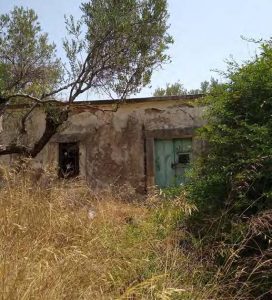
Of course, the highlight of my trip to the island was visiting the cottage that Juliette lived in during her decade on Kythera. The property is currently rented out to a shepherd, but the interior of the cottage has remained empty since Juliette left in the late 1990s. Her beloved former home is tucked away, located off a side road that leads to a quiet beach. A friend and I carefully trekked through high grasses and thorny shrubs at the peak of the midday heat, proven by the scratches on our legs and sweat pouring off our faces. The same olive tree that featured in the film, Juliette of the Herbs, greeted us as we approached the cottage. Unfortunately, not much remains of Juliette’s heart stone pathway or her vibrant garden, as the hot and dry climate of Greece makes it hard to upkeep a garden without regular care and water. What does remain of Juliette’s signature cottage is the green paint on the weathered door.
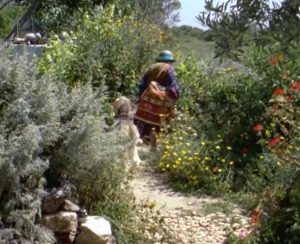
During our special mission to Juliette’s sweet home, we tried capturing similar photos to the scenes in Juliette of the Herbs to compare then and now. Nature clearly follows her own rules when humans are no longer present.
Sharing Stories

There is something about revisiting the past that provides inspiration for the future. Last year, the International Herb Symposium had presented the 1998 film Juliette of the Herbs, as well as a live conversation between celebrated herbalist Rosemary Gladstar and Juliette of the Herbs filmmaker, Tish Streeten. As revealed by their delightful conversation, stories about Juliette continue to spark the memories of her wisdom and eccentricities, even after so many years.
At dinner one night on Kythera with a group of locals, I re-told the story that Rosemary had shared during this conference conversation—how she had invited Juliette to be the guest speaker at one of the very first International Herb Symposiums and how Juliette had agreed. However, shortly before the conference, Rosemary still hadn’t heard from Juliette about her arrival date. As I shared this story, the Kytherian locals were delighted, and not completely surprised, at Juliette’s last-minute change of heart not to travel. But Rosemary, in her retelling, decided on her own last-minute travel to Kythera to bring Juliette to the conference. Rosemary’s adventures were a series of misadventures—from calling the local taxi station just to get in touch with Juliette to realizing Juliette’s passport was expired when they arrived at the Athens airport for their flight to the States. All this happened in true Juliette form.
Both the stories of Juliette on Kythera and in the U.S. reveal her widespread influence during a time when life moved more slowly—before the internet existed and cellphones ruled our lives, when we could capture our routines and experiences more closely to our hearts instead of to the world-wide web. It is these everyday stories of how people got to know Juliette either in-person or through reading her treasured collection of herbal books that continue to keep her brilliant character and plant wisdom very much alive and present.
One Last Moment of Serendipity
If you visit Kythera, be sure to enjoy yourself on perfectly imperfect adventures and leave room for serendipity. In true Juliette magic, a couple of weeks after I left Kythera for Athens, I learned that Juliette’s granddaughter, Adaya Lancha Bairacli, was in Greece to visit the island after 15 years. Adaya and I arranged to meet during the one night she had in Athens before her return to Switzerland. It felt incredible to meet her and hear her childhood stories on the island with her grandmother. As a popular folk singer, Adaya (www.adaya.net) sings the lyrics of her grandmother’s poetry as well as music that captures the treasure and spirit of being human.

During our conversation, Adaya mentioned the unfortunate changes on Kythera that she had noticed. In addition to the dilapidation of her grandmother’s cottage, there is also a lack of seagulls, which hungrily appear in a scene in Juliette’s film. There was also, regrettably, small clumps of oil dotting the beach near Juliette’s cottage, which I had unknowingly stepped on. The result was black tar covering the bottom of my feet for several days. This was caused by a ship that had spilled oil offshore several years earlier and was clearly not held responsible for cleaning it.
There is a certain hope that time can maintain the images from our past. But nature transforms to reflect the way we treat her—from the tall grasses that now hide Juliette’s cottage to the missing sounds of nature we remember from childhood. And yet, time moves us in the direction of our own unmarked path. I choose to marvel at the serendipities of my visit and take delight in the mysteries of how time can reveal the treasures that Adaya so often sings about.