By Kristin Elliott
Joe Pye Weed (Eupatorium purpureum) stood tall in the meadow. This plant seemed to be pulling in the last of summer. I had come to the Sanctuary expecting to be painting and drawing in the shade of the woodland plants and understory, but I found myself here, in the sunlit fields, returning again and again to the same towering stalks. In some way, I too was trying to hold on to what was left of the season. The plant had a quiet and insistent presence that seemed to say: Stay.
In the days that followed, I did stay. I sat beside the plant as the air shifted around me, my body and thoughts slowly settling into their own kind of change. I was in the process of letting go and metabolizing. I moved between this field and Heart Pond, sketching the Joe Pye, Cardinal flower (Lobelia cardinalis), Black-eyed Susan (Rudbeckia hirta), Coneflower (Echinacea spp.), and Milkweed (Asclepias syriaca). I watched as insects gathered the last offerings, each of us absorbing what lingered. These were the places I felt best.
Joe Pye Weed has long been recognized for its medicinal properties. The origin of its common name has been attributed to various sources, leading to some confusion. One account suggests that the name “Joe Pye” is an anglicized version of “Zhopai,” the name of an Abenaki healer known for using this plant to treat fevers and other ailments. Other stories claim the plant is named for Joe Pye, a Mohican sachem from the Stockbridge community in Massachusetts, who is said to have saved settlers from a typhus outbreak.
But the story I hold closest is this: as the Stockbridge people were being forcibly removed from their lands, Zhopai stayed behind. He was too old to make the journey, but before his family left, he handed his grandchildren small bags filled with Joe Pye seeds. “Scatter them on your journey,” he told them. “Whenever you pass a wet, marshy place, leave them there. When I am well enough to follow, I will know the way.”
According to this version of the story, Zhopai never made the journey west, but the plants did. Joe Pye now grows along waterways from the East Coast to Wisconsin—a path of resilience, a map written in petals and stems.
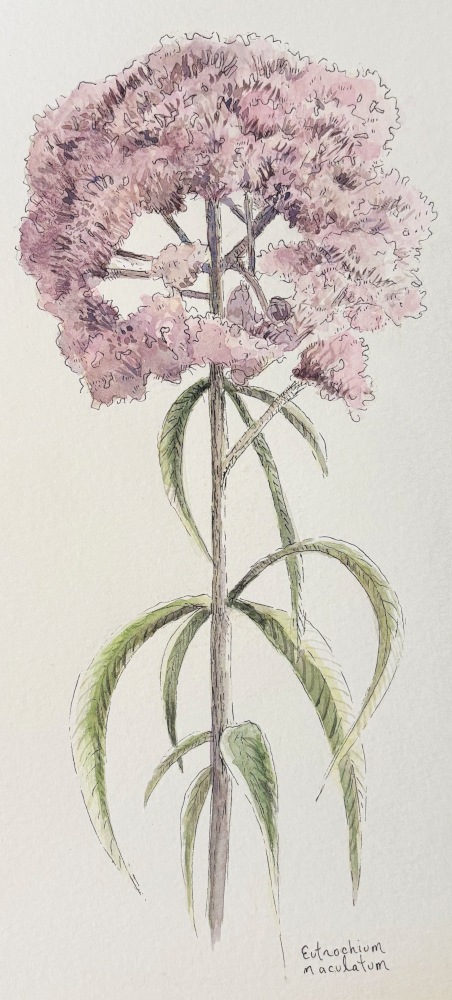
by Kristin Elliott, UpS resident artist 2024
I was unaware of this story as I sat with the plant. It was not until I returned home that I learned its history. But even without knowing it, the plant was a natural guide. I was leaving pieces of myself behind in these waters and in my sketches.
Zhopai’s grandchildren did not know if their grandfather would follow, but they scattered the seeds anyway. Perhaps that is the lesson: sometimes we plant without knowing what will come next. Sometimes, we leave markers for a future self, trusting that we will find our way back to them in time.
Sitting among the Joe Pye, I thought of the ways plants mark time, how they return season after season, even as everything else shifts. The land remembers them, holds them, and allows them to bloom again. This plant, this moment was teaching me to sit in transition to gather what remained before the season turned.
Grief is its own kind of season, and I have been moving through it, unsure of what remains and what will bloom again. I believe this is why I have always found comfort in plants. They return, even after an absence.
Plants and flowers have always been a part of my life, just as they were a part of my grandmother’s. She surrounded herself with them, not just in the garden but in her hands and the patterns of her dresses. I remember the way she cared for the peonies and lilacs, how we spent hours in her backyard picking raspberries, filling our baskets, and setting them in the sun so the insects could return home.
Inside her home, plants thrived under her care—orchids, hibiscus, and snake plants older than I was. African violets bloomed along the sill as well as cacti collected from her travels. She surrounded herself with beauty. Honeybees and ladybugs were her favorite insects, the friends of flowers. Her perfume carried the scent of spring, and her clothing, all hues of rose and lavender. Visitors brought flowers, filling her space with the memories of love and places traveled.
She had known a different life before coming to the States. Before flowers were a comfort, before caring for plants was a quiet prayer, she had lived through a decade of displacement with bombed-out buildings, refugee camps, and spaces where nothing could take root. In those years, there was no promise of a tomorrow in which seedlings could grow.
To care for a plant is to believe in the future, to trust that both you and the green things you nurture will be here in the morning. Perhaps that is why she kept them close. In a life once marked by upheaval, flowers became a kind of refuge, a testament to stillness, to home, and to survival. Now, in her absence, I find myself looking for her in the quiet spaces—in petals, in the steady rhythm of care and making, in the places where beauty lingers.
At the residency, I was doing the same by moving through the fields, sitting in the presence of plants, letting my hands remember the act of creating. Each line was a way of keeping her close.
As I worked, I thought about how she, too, tended to beauty in times of uncertainty, how she made a home through her care for plants and land. I was doing the same, in my own way, rooting myself in the land, learning to be still and carry on, sowing what she has given me.
guide
walking the fields,
joe pye stands,
a quiet companion.
the sun, heavy as thought,
presses low, turning leaves to gold.
mind flutters at the edge.
joe pye holds steady,
gathering what drifts.
hummingbird, mockingbird, vireo,
they follow my steps,
a soft chorus at the edge of the moment.
the flowers are still.
the earth remembers.
Dedicated to my grandmama: Josepha Vasiliauskas
Kristin Elliott creates work that explores the intersections of nature, memory, and transformation. Through drawing, painting, and storytelling, she seeks to honor the relationships between people and the landscapes that shape them.