By Diane Abatemarco
“When you know the fourfoil in all its seasons root and leaf and flower, by sight and scent and seed, then you may learn its true name, knowing its being: which is more than its use. What, after all, is the use of you? or of myself? Is Gont Mountain useful, or the Open Sea?’ Ogion went on a half mile or so, and said at last, ‘To hear, one must be silent.” — Ursula K. Le Guin, A Wizard of Earthsea
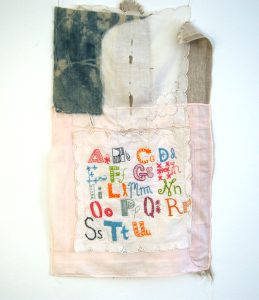
I came to UpS as a fashion maker and designer, hoping for some space and time to work on my embroidery and teach a workshop. This came naturally, and I worked stitches for hours on end daily, working at a slow and steady rate in sync with only the sun, moon, and my body. What I did not expect was to gain a new perspective on how conservationist approaches to herbs could also be applied to clothing.
I pulled Emily Dickinson’s herbarium off the shelf at the UpS Welcome Center Library. This version was printed in Italian. I asked if I could take it back to the Brickhouse Apothecary in Pomeroy, Ohio where the other art residents and I would be living during our two-week stay. It felt like that book was there specifically for me. There was an intersection of Italian language, which I spent a decade studying, a bad-ass poet, who I had been reading all that summer, and herbs, which I had come here to better understand. I am not an herbalist: I grow my own veggies and pot in the summer; I take the tinctures my herbal friends tell me to take, and I’m open to learning more.
I laughed as I further confused myself by looking at Emily’s herbarium. I now had Italian common names, English common names, Latin names, and she even switched over from one scientific naming system to another halfway through her herbarium. Not to mention, as I was learning, many species share common names. I kept asking my fellow residents, who were more familiar with herbs than I, What’s ironwood? (It is the common name for hundreds of different plants.)
This reminds me so much of embroidery with many different names for the same stitch—and so many stitches worked in the same way, under different names (e.g., “Blanket,” “Buttonhole”). The names of things are contextual and referential. The name can be related to how it looks, how it is used, or where it is found on a garment (or in the field). The name is our relationship to the plant/stitch. To give something a name is to come close to describing it, but the truth of what it is will always remain wordless.
Have you ever wondered why people will spend a thousand dollars on a new computer, but expect to buy a piece of clothing for under a hundred? I wince when people talk about clothing without considering its origin from plants or animals and relationship to history and landscape.
The United States became a superpower on the economy of cotton produced by slave labor. The cotton used for textiles and clothing was produced at artificially low prices. Slavery was “abolished,” yet the deflation of labor for clothing persists today. Fast fashion, “microtrends,” and clothing made from fossil fuels are the direct descendants of slavery, with similar humanitarian and ecological devastation. So, when I hear people complaining about the price of new, slow-fashion clothes, I can no longer contain my exasperation. I roll my eyes, shrug my shoulders, and plead in an annoyed tone, Open a book!
I found two old skirts from the early 1900s in an antique store on the main drag in Pomeroy. They were damaged and mothbitten but in otherwise good condition. I planned to mend them and extend their lives. In doing so, I thought, Who has worn these? What stories do they tell? I turned them inside out, looked at the seams, the stitches, and the alterations someone else had made. Maybe they were handed down. Maybe they were dyed black for a widow. Clothing is practical but also a physical record of history and relationship, like land.
The practical life of a computer is, what, five-ten years? Some garments can last eighty or more, especially when cared for and mended. Why do we accept the cost of computers, but not that of clothing?
Clothing: the technology that lets us be outside when it is cold.
She believes that sustainable fashion is not only creating a sustainable product, but using sustainable technologies that will create infrastructure for positive impact. Her creative practice uses embroidery to embellish and adorn garments, telling a personal history worn close to the body. @irrationaldress_mvmt / www.irrationaldress.com