By Madhavi Peters
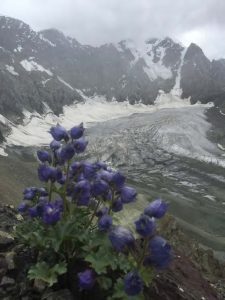
Kargil, in the Trans-Himalaya, lies at the border of India and Pakistan, with China a few hundred kilometers away. The craggy, arid landscape, with its bitterly cold winters, could be the mountainous redoubt of Batman’s nemesis Ra’s al Ghul (Meconopsis betonicifolia sighting included). Come April, however, the rocks spring to life. Apricot trees, brought over from Central Asia many aeons ago, burst into bloom, laying the ground for alpine summers. In small villages, extended families busily work the farms, sowing and harvesting during the brief growing season while their young toddle underfoot. The bucolic setting belies the region’s underlying geopolitical tensions.
As the “ethno” in “ethnobotany” is particularly important here, the ethnic composition of Kargil should be noted. Tibeticspeaking people dominate the Trans-Himalaya. In Kargil, a majority has converted to Islam from Buddhism or other animist traditions; nonetheless, they still observe the indigenous ways of life necessary to survival in a harsh environment. This includes a recognition of the abilities of native medicinal plants to maintain the health of both the land and the people who live off it. For their healthcare needs, especially in the more remote areas, Kargilis turn to the still-Buddhist amchis, practitioners of Sowa Rigpa, the traditional medicine system of this region.
On any given day, amchis, young and old, can be spotted nimbly climbing the mountains to collect rare medicinal plant species, which they bring home to dry and mix into compounds according to the principles of Sowa Rigpa. It is noteworthy that they do not engage in external trade of these species. A family of amchis typically serves a clade of villages over generations. Each generation of healers keeps detailed health records and passes them on to the next, creating a handwritten repository of that community’s medical history, along with notes on treatment methods. While it may seem rudimentary, it is a sophisticated system of community and public health with outcomes that would be the envy of more developed nations.
With creeping modernization, however, the inhabitants of this region are increasingly turning to allopathy. The next generation of would-be amchis are eschewing their hereditary profession in favor of other, more lucrative ones. Those who remain dispense their medicines for a nominal sum, perhaps more out of a desire to honor their traditions than anything else.
For a long time, because of the region’s distance from the center, the Indian state felt like an abstraction here; yet, because of recent geopolitical considerations, not to mention technological advancements, the state has increasingly encroached upon quotidian realities. Till 2019, Kargil was administered as part of the state of Jammu, Kashmir, and Ladakh (an unwieldy name for an unwieldy polity). In an attempt to bring peace to the entire, troubled region, the central government cleaved Jammu, Kashmir, and Ladakh in two, placing Ladakh under central government control. Kargil is now administered as part of Ladakh, which is divided into two key regions: the Buddhist-majority Leh, which is the seat of the administrative agencies, and the Muslim-majority Kargil. The implications for the millennia-old practice of Sowa Rigpa are manifold.
First, with an eye to the growing and lucrative global LOHAS (Lifestyles of Health and Sustainability) market, the Indian government has made the promotion of traditional systems of medicine a strategic priority. In the 2020-2021 budget, the Ministry of Ayurveda, Yoga, Naturopathy, Unani, Siddha, Sowa-Rigpa, and Homoeopath (or AYUSH for short) received an allocation second only to the military, a 40 percent increase over the previous year. The top-down stimulus has resulted in a marked uptick in interest in the commercial cultivation and harvesting of medicinal plants in the cold desert Himalayas, including Kargil. Suddenly, private actors are eyeing resources long held in common, at which point the gears of the state regulatory apparatus must kick into motion, balancing the multiple interests at play.
These interests include those of the local Muslim residents of Kargil, Kargil’s small Buddhist minority, the Leh-centric Sowa Rigpa community and then the Ayurveda community, dominated by other groups from other parts of India, but whose national/global footprint is by far the most significant. (Sowa Rigpa and Ayurveda share a common ancestry, although they seem to have diverged at some point in history.) Additional actors to consider include the environmental conservation community, the state, which has an imperative to deliver sustainable economic development to a sensitive border region, and large multinational corporations such as Himalaya Botanicals and Dabur.
Our trust, The Tropicalist Trust in Kargil (www.ttink.org), was created a few years ago for the purpose of the sustainable development and conservation of Kargil’s valuable medicinal plant species. The trust was formed with considerable input from local actors, who understand that as Kargil integrates to a greater degree with the Indian state, some degree of social upheaval is inevitable. They are keen to maximize opportunities for economic empowerment while minimizing the impact on their way of life. The political developments mentioned above have imposed limits on local sovereignty, which poses certain challenges to meeting these objectives. Nonetheless, a thoughtful approach to the exploitation of local natural resources could offer a pathway.
To date, the trust has focused on creating awareness among local school children about these medicinal plant species. As we consider our work a form of heritage education, we take a multidisciplinary approach to engage all students, not just the ones interested in biological sciences. Nonetheless, for the latter, we have also organized career counseling sessions wherein we educate them on opportunities in scientific research, for example within pharmacology that would allow them to translate traditional ethnobotanical knowledge into a modern livelihood.
In addition, the trust has worked to document the hitherto undocumented medicinal plant species of Kargil. As the centre of the Sowa Rigpa community is in the Buddhist-majority region of Leh, most documentation work has focused on that region with no systematic efforts being made in Kargil till now. We are currently creating the first ever field guide to Kargil’s medicinal plants. We are also working with the local government to set up an herbarium in Kargil.
For the next phase of our work, we are exploring the economic feasibility of the cultivation of certain commercially valuable species of aconitum. Ultimately, we hope to convince local farmers to turn over a portion of their land to cultivate them. It is not without local precedent: government initiatives to promote the commercial cultivation of native species of sea buckthorn (Hippophae rhamnoides), also a medicinal plant, have met with some success.
The three species of aconitum, A. heterophyllum, A. rotundifolium, and A. violaceum, were chosen for our pilot cultivation project because they have the potential to become an attractive cash crop. In preliminary interviews with buyers from the Ayurvedic community all expressed the need for greater supply of aconitum in the market, as it is a medicinal plant with many applications. One kilogram of A. heterophyllum (heterophobic) can fetch prices as high as ₹7000 or USD100. Nonetheless, the Indian buyer is very price sensitive, and producers thus have incentives to cut corners. Prices for cheaper A. heterophyllum substitutes can run as low as ₹300 or USD5 per kilogram. Farmers who wish to cultivate medicinal plants according to good agricultural and collection practices are thus often advised to seek Western or overseas buyers instead. This of course raises questions around the ethics of who should have access to quality— not an issue when amchis harvested wild species to mix into compounds they administered to their “flocks.”
Interestingly, there remains a perception in the traditional medicine community that wild-harvested medicinal plants are the most potent, and therefore, cultivated plants will never be perfect substitutes. Still, with appropriate quality control measures in place, cultivation can reduce pressures on wild populations.
Hopefully, it should be evident to the reader at this point that the conservation and sustainable commercialization of medicinal plants in Kargil involves a complicated balancing of interests. India, being one of the world’s 12 megadiverse countries and a provider of genetic resources, has a long and unfortunate history with biopiracy. The possessors of traditional knowledge (TK) on medicinal plants have typically derived no monetary benefit from the exploitation of their knowledge by other actors. In recent years, there is greater awareness of the need to regulate access to medicinal plants and to ensure the benefits are distributed equitably. While much thought has been put into creating the appropriate framework, the reality often falls short of the ideal.
One of the earliest examples of access and benefit sharing in India dates to the late 1980s and involves a native medicinal plant species, Trichopus zeylanicus, used by the tribal physicians of the indigenous Kani tribe. Researchers from Indian scientific institutions convinced the tribal physicians to share their TK on this species, and building upon that, they successfully applied for several patents. They then licensed this technology to a large Ayurvedic corporation and proposed sharing the ensuing benefits 50/50 with the Kani tribe. In a novel arrangement, a trust, the Kerala Kani Community Welfare Trust, was set up for the purpose of channeling benefits earned from the exploitation of the Kani’s TK back to the tribe itself.
The case of the Kani tribe predates the Convention on Biological Diversity (CBD) and the Nagoya Protocol on Access and Benefit Sharing. It was ground-breaking, although it was later argued that more could have been done to empower the active participation of the Kani. Since then, Article 15(4) and (5) of the CBD stipulates that parties ought to insist on prior informed consent and mutually agreed terms before access can take place. Given the considerable power differentials between the various parties, however, this can be nearly impossible to put into practice.
A second issue, and perhaps a thornier one, is which indigenous group holds the rights to the TK of Kargil’s medicinal plants. As mentioned, the inhabitants of Kargil are converts to Islam from Buddhism, and the practice of Sowa Rigpa is now confined primarily to the Buddhist amchis. Nonetheless, there are still a few Muslim amchis in practice. Moreover, many of the region’s medicinal plants are also used in Ayurvedic formulations. Given the underlying ethno-religious tensions in this region, determining ownership of TK will likely be contentious. What is more, Indian law does not actually recognize the concept of indigeneity, as it considers all Indians to be indigenous to India. (That much said, these matters are always subject to political considerations. Recent jurisprudence and legislation concerning the restive northeast of the country have conceded the indigeneity of the residents of that region; there is no reason to think that similar concessions won’t be made to the northwest, that is, the region that we work in. Certainly, some groups are more indigenous than others.)
And finally, there is the issue of navigating India’s notoriously convoluted licensing and regulatory framework, especially for a small organization such as ours. There are thirteen steps between submitting an application for access to resources and receiving final approval from the National Biodiversity Authority. In addition, the application is subject to approval from various bodies, some of which, like the grassroots Biodiversity Management Committees or BMCs, a key component of the framework, are not even operational in our region. There are also national, state, and local level bureaucracies to navigate, and bureaucratic fiefdoms are not always clearly demarcated in a nascent field. We would not be the first to note the potentially dampening effect of so much red tape.
In conclusion, I do not think it too bold a statement to say that of the many countries in the world where traditional health systems still flourish, India is the only one that, on paper at least, tries so hard to achieve fair and equitable outcomes for all the parties involved. Nonetheless, put into practice, the pitfalls and challenges are manifold. There is no doubt we will get it wrong many times. Still, the more opportunities there are to work through the knottier issues, the more precedents there will be for future aspirants, who will hopefully figure out how to do things better the next time.
Madhavi Peters is a Toronto-based lawyer and founder of The Tropicalist, a non-profit platform for sustainable development initiatives in South and Southeast Asia. https://www.thetropicalist.press/