By Susan Leopold
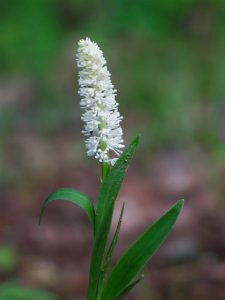
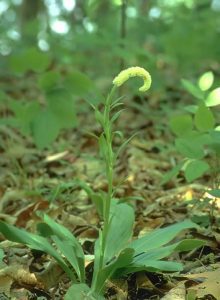
It was early spring in 2021 when visiting a friend in southern Virginia that I had a rare encounter with a small colony of just emerging false unicorn root (Chamaelirium luteum). This sacred fertility herb was thriving in the woods nestled throughout a graveyard of rusty old farm equipment. Hiding in plain sight along a winding creek there were about 20 or so plants spread out in small clusters. Listening to the sound of the trickling creek, I was in awe of these divine forest beings. A part of me deeply hoped that diggers’ hands would never find this population and that the rusty old farm equipment would be a deterrent, a strategic decoy. We don’t yet understand how to successfully cultivate this plant. Though it can be germinated from seed, it takes years to grow and needs a certain type of soil to thrive. It produces separate male and female plants, which complicates its ability to reproduce under cultivated circumstances. So, ironically, we do not know how to propagate and cultivate a plant that is highly desired for women’s reproductive health. If there were one plant that I feel strongly about taking out of commerce in Appalachia, this is the plant I would choose.
In the last decade, I have been the director of United Plant Savers. With boots on the ground, I have met with landowners, diggers, dealers, growers, suppliers, and herbal formulators, so my experience comes from a humble perspective and my inquisitive nature. False unicorn root is one of the most valuable roots for a digger to sell along with wild American ginseng (Panax quinquefolius). The difference is that ginseng is a plant people have been planting the seeds of for many decades. It has been tended by rural people for generations to ensure its future. Only a few dedicated growers of native plants have tried to germinate false unicorn root, and its future is in serious decline. The herb trade in the U.S. is completely unregulated and very much an underground secretive trade. It is important to know that we have little data on what is going on except for the prices advertised on digger and dealer pages on Facebook and the prices of herbal formulas that are being sold online. The current price for dried root on Etsy (2021) is 40 dollars for one gram or 161.00 dollars for 4 ounces (butterfly express). That amounts to around $2,500.00 a pound, and lastly, an 8-oz tincture sells for 100.00 dollars (Vita Living). A digger would likely get around 100-200 dollars a pound, which is roughly around 75 plants or many more depending on the size and if the roots are dried. The roots themselves are like a small carrot and lose around 1/3 of their weight when dried.
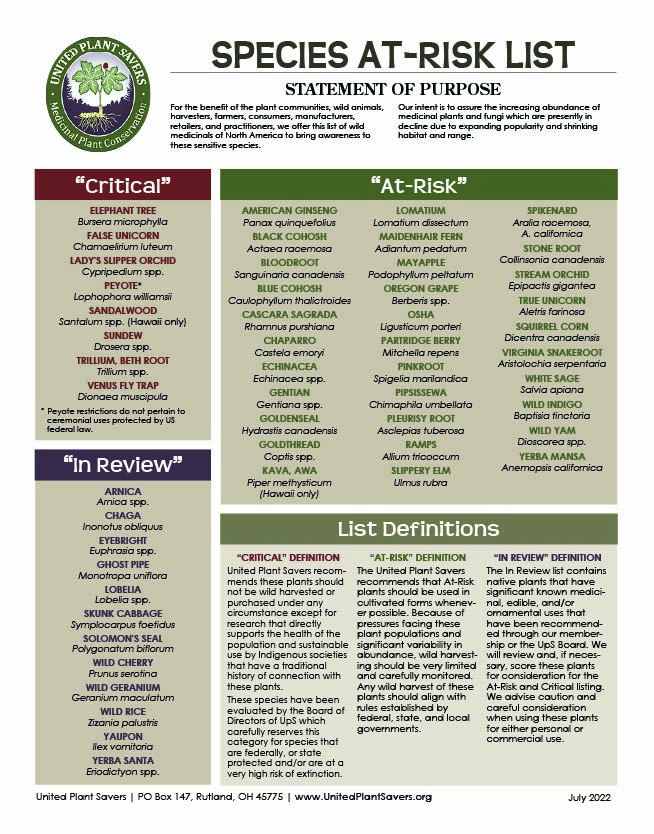
United Plant Savers publishes the Journal of Medicinal Plant Conservation, which is on our website along with all kinds of resources for free to download and explore. Dalene Barton-Schuster, CH, Doula wrote an article, “Saving a Sacred Fertility Herb, False Unicorn Root.” In this article she discusses the medicinal properties of false unicorn, and within that framework she also suggests similar herbs. She writes, “Tribulus (Tribulus terrestris), vitex or chaste tree berry (Vitex agnus-castus), and dong quai (Angelica sinensis) are some examples of fertility herbs with similar actions to false unicorn aiding in the increase in estrogen and helping with fertility. As for aiding in the prevention of recurrent miscarriage, partridge berry (Mitchella repens) is a great alternative.” United Plant Savers encourages herbalists to consider using analogs to “At-Risk” plants when possible. On our website is a wonderful list of analogs provided by Herbalist Jane Bothwell.
I often try to convey that there is a bounty of herbs that are not “At-Risk” and that companies can quickly reformulate, but once a plant is in decline and especially when its habitat is diminishing, nature cannot so easily renew itself. Certain plants can take decades to repopulate, and, in some cases, they are dependent on relationships we do not even understand nor know how to replicate. United Plant Savers created the “At-Risk” Tool, a simple list of questions based on five categories: the life cycle of the plant, the part that is harvested, the habitat, threats, and demand. These questions can help guide the user to determine for themselves the ethical impact on plant biodiversity. A critical aspect to herbalism is getting to know the plant and understanding where it grows, its life cycle, and the part of the plant being harvested. In Appalachia many of the herbs in trade are roots of long-living perennial native plants that grow in only healthy forests. In eastern Europe, many of the herbs in trade are leaves, berries, and flowers, so there are different challenges to maintaining healthy ecosystems and to sustaining annual harvesting of plant populations. There are also social implications to those harvesting the plants as well as how they are treated and compensated. These are all important questions to ask suppliers and herbal product companies when making informed decisions. Ecological herbalism is an awakening to the deep connection between the health of the planet and human health. I cringe at the thought of plants in peril at the cost of an herbal formula, and I am also in awe at the amazing diversity of plants that support women’s health.
Another plant that I strongly discourage from use in herbal formulas is trillium (Trillium erectum). This woodland spring ephemeral, also known as beth root, is slow-growing and takes decades to establish. Its seed produces what is called an elaiosome, which is a fatty white substance that attracts ants that then disperse the seeds. It can take two years before this seed might germinate, and when the bulb is harvested, the life is over for that plant. Each bulb harvested could be a plant that has lived in the forest for 20-30 years. There is more to this story. There are 43 species of trillium worldwide with 38 species in N. America and 5 in Asia. Trilliums are often dug in early spring before they flower as they have distinctive three leaves. The epicenter of diversity is found in southern Appalachia where most digging takes place. Many of these species are endangered and face all kinds of pressures such as deer predation, loss of habitat, and an increase in invasive species. I wrote an article, “How We Protect Trillium” that details the diversity of trilliums in N. America, and I worked on a committee with the IUCN on red listing the N. American trillium species. As I have mentioned, the herb trade in the U.S. is very secretive. Diggers are often on private and public lands, so they want to remain anonymous, and dealers are often trading cash or drugs for plants, so it is challenging to ensure that the correct plant is being harvested and/or harvested in a sustainable way and that people who are harvesting are also paid and treated fairly and that private land and public lands are being respected.
There are few regulations in the underground plant trade of Appalachia, and in general, the United States is very much a plant blind society that dedicates very few resources to the study or protection of plants. Information we have on plant populations is often decades outdated if we have data at all. Certainly, trilliums could be cultivated for herbal formulas but currently, all trilliums in the herbal supply chain are wild harvested. A very interesting article in the last Journal covers efforts in Pakistan to grow the native Trillium govanianum due to overharvesting pressure. United Plant Savers takes a strong stand on trilliums being removed from herbal products unless they come from a cultivated source.
Black Cohosh (Actaea racemosa), according to the 2019 market report produced by the American Botanical Council, was number 15 on the list of the topmost traded herbs, generating $28,078,996 in sales, and it is almost all wild harvested. The issue with black cohosh beyond the sustainability of tons of root being harvested each year is that there are several similar species, and adulteration in herbal products is an issue. Therefore, a few companies have dropped cohosh from their product or have switched to growing black cohosh since it can be propagated to ensure that the roots are indeed black cohosh. In our annual Journal we published an article on the look-alike cohoshes and a simple guide for how to distinguish these species. United Plant Savers strongly encourages conservation through cultivation, and therefore we launched the forest grown program to support forest farmers of botanicals. The FGV program provides important growing and life cycle information on five plants: ginseng, goldenseal (Hydrastis canadensis), cohosh, bloodroot (Sanguinaria canadensis), and ramps (Allium tricoccum). We hope to expand this program to other native forest herbs such as Solomon’s seal (Polygonatum spp.) and wild yam (Dioscorea villosa) that have solid cultivation information.
Women’s herbs of Appalachia are a pharmacopeia of phyto-rich saponins that reduce inflammation and support the female reproductive system through the many stages of life. These roots are understudied in their potential and undervalued in how the forests are managed. This article has not covered the in-depth practical use of these plants in herbal practice, but that information is abundant on many websites and books. What is lacking is balancing that information with transparency in the supply chain and the ecological understanding of what these plants need from us to survive the pressures of today’s rapidly growing marketplace. These are challenging times, and as herbalists, we must advocate and speak for the herbs as an integral part of our practice. We must ask difficult questions about the supply chain and try to understand the reproductive challenges for plants to survive, just as we are seeking their support to help us navigate the wellbeing of our reproductive organs. As we seek support from plants to help us navigate the challenges of women’s health, we must find ways we can reciprocate this gift.
Resources
- Jane Bothwell/Analogs, List-of-Herbs-Analogs-by-Jane-Bothwell.pdf
- Cohosh lookalikes, https://unitedplantsavers.org/species-at-risk-list/
- “At-Risk” Tool, https://unitedplantsavers.org/species-at-riskassessment-tool/
- A diggers perspective on ending the trillium trade, https://www.youtube.com/watch?v=pk3nu6cAszU
- Forest Grown Resources, https://unitedplantsavers.org/fgv/
- ABC 2019 market report, https://www.herbalgram.org/media/15608/hg127-hmr.pdf