by Dale Helm
My primary interest is rural development. I was a Peace Corps volunteer in Paraguay, 1989 to 1991, working in soil conservation. I have lived in Paraguay continuously since 1995, without organizational backing. I selected medicinal plants, wanting to develop them as alternative cash crops for small farmers and ease pressure on incursions into wild spaces to extract native species. I worked on various medicinal plant projects as an extensionist in different places in Paraguay’s interior. The small farmers taught me a lot.
MARKETS
The national market is huge because of the national culture of consuming yerba mate (Ilex paraguariensis) where either cold water or hot water is poured into a cup and then the tea is drunk through a metal straw with a filter on the bottom—and terere, a cold-brewed mate mixed with fruit juice and other herbs. Different herbs are either put in the water or on top of the yerba mate. This cultural practice is very important to keep hydrated and is a social event as both terere and mate are drunk in small groups of 3 to 4 people. Use of medicinal plants for curing is also important but does not have the same demand as fresh herbs for terere. Throughout populated areas small venders sell medicinal plants for terere or mate.
Due to the enormous international market, there is potential for native species to be exported. All species must be cultivated for sustainability. Paraguay cannot participate on the international markets as all native species are extracted directly from wild places with no thought for sustainability.
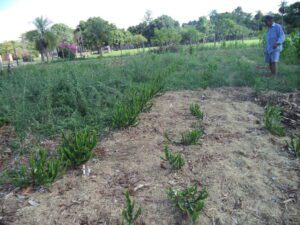
Entire families can be seen walking roadsides or trespassing on private land looking for product to sell. Small vendors and their associates should cultivate all their products in gardens instead of spending hours in the sun. Gardens could be small plots of a selected species planted every two weeks to ensure continuous supply.
SUSTAINABILITY
Many herbs, found on the national and international markets, are on Paraguay’s endangered or threatened lists. There are no national programs for cultivating native species. The ignored law Vida Silvestre (Wild Life) No 96 prohibits extraction from wild places but gives incentives for preserving species. If a species goes extinct, the culture will change, with an introduced species taking its place.
All introduced species are cultivated, but all native species are extracted from wild spaces. ALL species should be cultivated, whether they are perennials or annual weeds. Cultivation should meet international clients’ needs of quantity, quality, and time frame.
EXPERIENCE WITH GROWING NATIVE SPECIES
In the Villeta district, Departamento Central small demonstrative plots were developed to gain experience with different species, develop simple techniques for small farmers without investing in infrastructure, and to show the public how to cultivate species. In this text, neither medicinal properties nor uses are mentioned. Please do an online search for medicinal plant properties or uses, using the scientific name. Thank you.
Doradilla (Hemionitis rufa) is a fern. It is on the endangered list. It needs shade, and quantity is unknown. Until a couple of years ago, it was being offered, roots and all in the biggest public market in Asuncion. It is easy to grow from crowns. Spore germination is not easy. Popular uses are menstrual regulator and blood circulation.
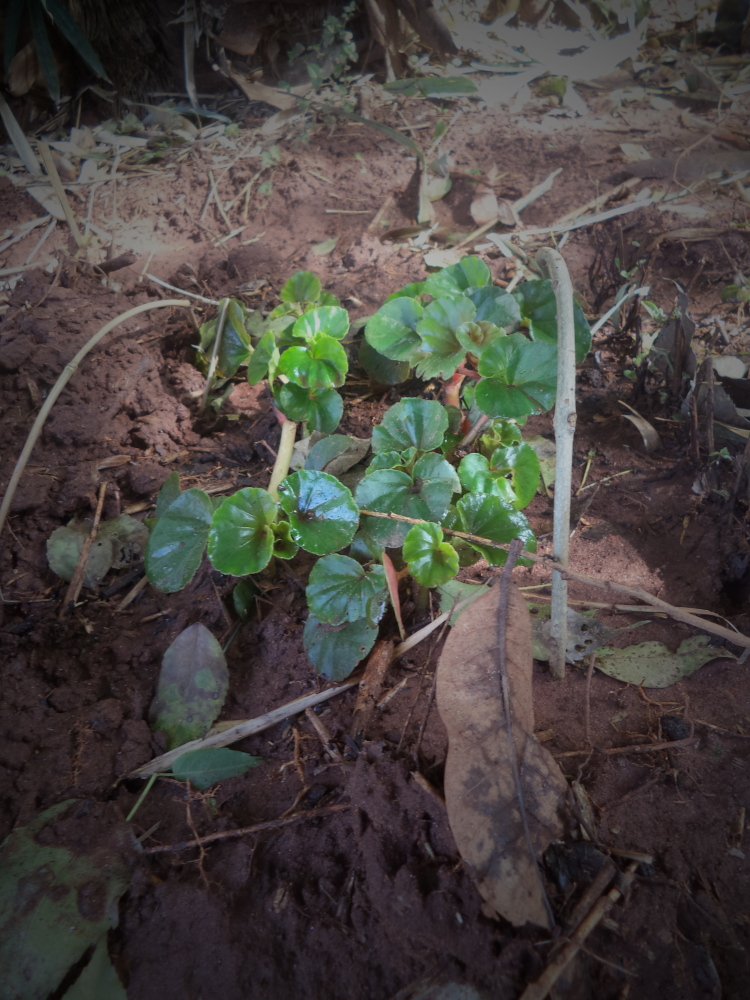
Jaguarundi (Piper regnellii) is endangered. It needs shade and water, and quantities are unknown. There is an international market. It is easily propagated through rhizomes and cuttings.
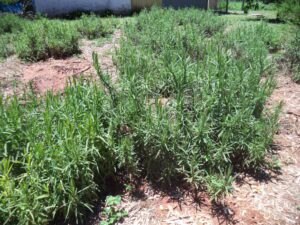
Espartillo (Elionurus muticus) is a medicinal grass. There are hectares growing wild. Selected plants have different flavors. The one that is used and propagated by small farms for daily use has a taste similar to lemon grass. The species is easy to propagate and can generate an important income. It is harvested every three months.
Jaguarete ka’a (Baccharis spp.), also known as Carqueja, has two species on the endangered list. It is easy to grow from cuttings. It needs water, but the quantity is unknown. It dies in saturated soil. It could be a reliable source of income from very few plants, with harvests three to four times a year.
Jatei ka’a (Achyrocline alata) is easy to cultivate. It has high water needs and tolerates saturated soil but does not prosper. Seed germination declines fast after flowering in late summer, with a winter sowing not viable. It can be propagated through cuttings. Five-hundred plants were transplanted using soil cover. They grew well until hot temperatures in October killed all plants. It was suggested that a fungal disease from the soil cover killed the plants, but new evidence suggests that it was a lack of sufficient soil moisture. It is an aromatic plant and could possibly be planted with vegetables to act as an insect repellent.
Colita (Cordia ecalyculata) is a tree that is part of the intermediate forest stories. It is easily propagated by seeds. In Brazil, it is used for weight loss.
Horsetail (Equisetum spp.) is propagated through cuttings; fresh stems are placed in saturated soil without standing water. Cultivated horsetail will be able to withstand serious droughts as the rhizomes extend to four meters deep (Husby, 2013). There is little competition with other plants, except grass species.
Cangorosa (Maytenus ilicifolia) is an easy to grow woody bush. It is endangered with extinction in Paraguay because the local culture uses root bark. Gatherers pull up whole root systems for sale with no replantings. Internationally, the leaves are used for medicinal purposes but not the roots. It looks exactly like a holly tree, with its spiny leaves and red berries. The ripe red fruits can be sown without removing the peel. It takes 1 to 2 months for the seedlings to emerge. A seed bed, under a shade cloth or shade tree, is prepared, and the seeds and fruits are sown on bare soil and then topped with a thin layer of compost. The sowing should be kept moist. The transplanted crop should be watered for 2 years. Cangorosa can be found in very poor sandy soils and very clayey soils. The limbs with leaves are harvested and dried in the shade until the leaves are easily separated by hitting with a stick. The leaves are then milled. Harvesting the spiny leaves without pain takes creativity.
CLIMATE CHANGE
Experience growing perennial species might show the importance of using ground cover in agriculture in extreme hot weather. Two experiences were physically far apart and cannot scientifically prove anything by themselves, but they suggest further investigation.
In Guayaibi district, Departamento San Pedro, one hectare, 33,000 Baccharis plants were grown in well fertilized bare soil with drip irrigation and irrigated weekly, 6,000 kg per year or 181 grams per plant per year.
In Villeta district, Departamento Central, 25 Baccharis plants were grown by a small farmer with more than 5 cm of soil cover, made up of fallen leaves and grass clippings. Some irrigation was done when it was very dry. The first harvest was 27 kg, and the second harvest 5 months later was 100 kg.
True, in Guayaibi, it was a multiple year experience and in Villeta there were only 2 harvests, and there is no way to compare weather, soil fertility, etc. Some type of morphological need of the Baccharis species should explain such large differences in yield. Soil humidity should not be a factor as Guayaibi was irrigated weekly, and in Villeta it was done sparingly. Soil surface temperature is proposed as an explanation for the stark difference. Soil cover keeps the soil cool during hot summer weather allowing Baccharis roots plants to prosper.
In Villeta, Departamento Central the months of October, November, and December, 2023 were normal regarding temperature and rainfall. Harvests of Baccharis, Espartillo, and Lemon verbena (Aloysia citriodora) reached records in demonstration plots. January 2024 was also normal, but during all of February and March the high day temperatures were well over 40oC with little rainfall. January’s regrowth was damaged in all of the three species. Ninety percent of the Baccharis was lost, a third of the Espartillo was lost, and the branches of lemon verbena were killed. The following harvest was after six months, three months later than normal. The extended, abnormally hot temperature is thought to be the cause.
The plots are mowed every month, leaving cuttings of the surface with no turning of the soil surface as a protection from hot summer temperatures. The mowed material decomposes fast, not allowing any accumulation. Apparently, there was not enough soil cover to give adequate protection.
How much soil cover is necessary for crop protection? With Climate Change forecasted to cause havoc, this question is worth following up.
Dale Helm is a U.S. Navy veteran and agricultural specialist with a master’s degree from Washington State University. He served in the Peace Corps doing soil conservation work in rural Paraguay, where he has lived permanently since 1995. He continues to work in rural development with a focus on native medicinal plants and sustainable land use.
REFERENCE
Husby, C., 2013. Biology and Functional Ecology of Equisetum with Emphasis on the Giant Horsetails. Bot. Rev. 79:147–177