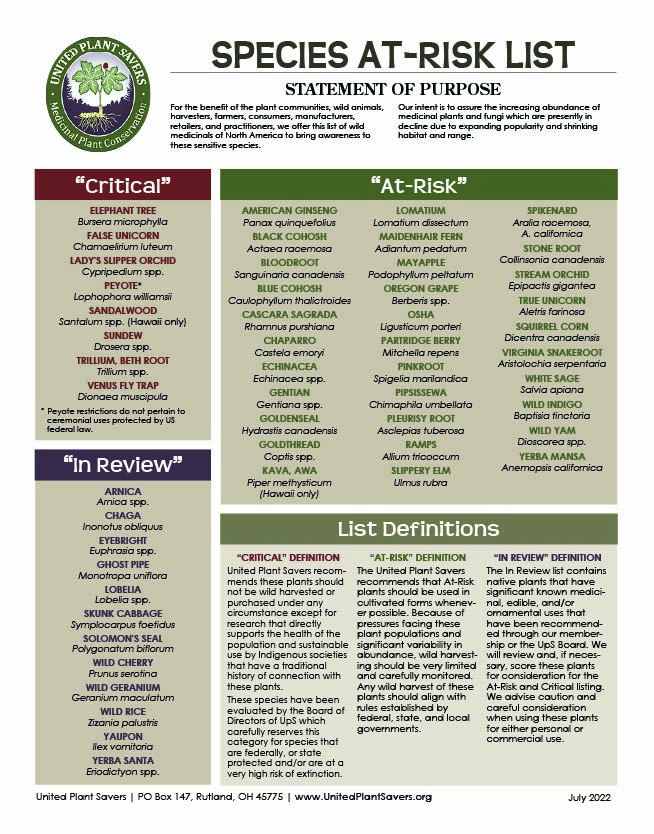
We offer this species at risk list of wild medicinals of North America for the benefit of the plant communities, wild animals, harvesters, farmers, consumers, manufacturers, retailers, and practitioners. We hope to bring awareness to these sensitive species. Our intent is to assure the increasing abundance of medicinal plants and fungi which are presently in decline due to expanding popularity and shrinking habitat and range.
“Critical”
- Elephant Tree – Bursera microphylla
- False Unicorn – Chamaelirium luteum
- Lady’s Slipper Orchid – Cypripedium spp.
- Peyote – Lophophora williamsii
- Sandalwood – Santalum spp. (Hawaii only)
- Sundew – Drosera spp.
- Trillium, Beth Root – Trillium spp.
- Venus Fly Trap – Dionaea muscipula
“At-Risk”
- American Ginseng – Panax quinquefolius
- Black Cohosh – Actaea racemosa
- Bloodroot – Sanguinaria canadensis
- Blue Cohosh – Caulophyllum thalictroides
- Butterfly Weed – Asclepias tuberosa
- Cascara Sagrada – Frangula purshiana
- Chaparro – Castela emoryi
- Echinacea – Echinacea spp.
- Gentian – Gentiana spp.
- Ghost Pipe – Monotropa uniflora
- Goldenseal – Hydrastis canadensis
- Goldthread – Coptis spp.
- Kava – Piper methysticum (Hawaii only)
- Lomatium – Lomatium dissectum
- Maidenhair Fern – Adiantum pedatum
- Mayapple – Podophyllum peltatum
- Oregon Root – Berberis spp.
- Osha – Ligusticum porteri
- Partridge Berry – Mitchella repens
- Pink Root – Spigelia marilandica
- Pipsissewa – Chimaphila umbellata
- Ramps – Allium tricoccum
- Slippery Elm – Ulmus rubra
- Spikenard – Aralia racemosa
- Squirrel Corn – Dicentra canadensis
- Stone Root – Collinsonia canadensis
- Stream Orchid – Epipactis gigantea
- True Unicorn – Aletris farinosa
- Virginia Snakeroot – Aristolochia serpentaria
- White Sage – Salvia apiana
- Wild Indigo – Baptisia tinctoria
- Wild Yam – Dioscorea villosa
- Yerba Mansa – Anemopsis californica
- Yerba Santa – Eriodictyon californicum
“In Review”
“CRITICAL” DEFINITION
United Plant Savers recommends these plants should not be wild harvested or purchased under any circumstance except for research that directly supports the health of the population and sustainable use by Indigenous societies that have a traditional history of connection with these plants.
These species have been evaluated by the Board of Directors of UpS which carefully reserves this category for species that are federally, or state protected and/or are at a very high risk of extinction.
“AT-RISK” DEFINITION
The United Plant Savers recommends that At-Risk plants should be used in cultivated forms whenever possible. Because of pressures facing these plant populations and significant variability in abundance, wild harvesting should be very limited and carefully monitored. Any wild harvest of these plants should align with rules established by federal, state, and local governments.
“IN REVIEW” DEFINITION
The In Review list contains native plants that have significant known medicinal, edible, and/or ornamental uses that have been recommended through our membership or the UpS Board. We will review and, if necessary, score these plants for consideration for the At-Risk and Critical listing. We advise caution and careful consideration when using these plants for either personal or commercial use.
Download the Species At Risk List
Our intent is to assure the increasing abundance of the medicinal plants which are currently in decline due to expanding popularity and shrinking habitat and range. UpS is not asking for a moratorium on the use of these herbs. Rather, we are initiating programs designed to preserve these important wild medicinal plants.
Analog List for At-Risk and To-Watch Herbs
Compiled by Jane Bothwell, March 2000, revised 2006
After introduction to the United Plant Savers list of “At-Risk” plants, students always ask, “Well, what can we use in its place?” Often times the choice is simple: choose a cultivated species rather than one harvested from the wild. When cultivated species are not available, then it is best to find a plant analog. An analog is something having an analogy or similarity to something else. For our purposes, this indicates parallels in function or end results between two or more medicinal herbs.
Following is an alphabetical list of most of the United Plant Savers “At-Risk” and “To-Watch” lists, accompanied by suggested analogs. This list is compiled by the author and does not necessarily reflect the opinions of UpS.

Related News
Rural Action and United Plant Savers received a two-year grant to study Goldenseal propagation from the USDA Ohio Specialty crop grant program.
Rural Action and United Plant Savers will conduct research into multiple cultivation methods for the commercially valuable forest crop goldenseal, Hydrastis canadensis.
Learning To Define Sustainability: Lessons For Essential Oil Consumers
by Erika Galentin, MNIMH, RH (AHG) The Elephant in the Room Define sustainability. “Sustainability” is a not-so-new term floating around the shelves of our global …
Cultivation Demonstration Videos
These videos will walk you through the lifecycle, site selection, planting techniques and maintenance of ramps, ginseng and goldenseal as outlined in The Forest Farmers …