By Bill Chioffi , United Plant Savers Board Secretary
Professor Emeritus Emil John Staba
College of Pharmacy, University of Minnesota Pharmacognosy, Medicinal Chemistry, and Philanthropy

Materia Medica
E. John Staba, Ph.D. has generously donated 5,849 books to United Plant Savers and the newly formed Duke Ethnobotanical Archives & Teaching Gardens (www. unitedplantsavers.org/dukearchives). The books were collected by Professor Staba over the course of his long career in academics and natural products research and development. Professor Staba’s academic career began with a B.S. in Pharmacy in 1952 from St. John’s University, a M.S. from Duquesne University in 1954, and his Ph.D. from the University of Connecticut in 1957. The University of Nebraska is where he got his start as an assistant professor of Pharmacognosy in 1957 until he would become Professor and Chairman Department of Pharmacognosy in 1965. From 1968-1982 John served as Professor and Chairman, Department of Pharmacognosy at the University of Minnesota where he also served as Assistant Dean for Professional Curriculum from 1974-76. John has served as a consultant for the National Aeronautics and Space Administration (NASA), World Bank, USAID, National Academy of Sciences, and various food, pharmaceutical and industrial concerns. He’s got over 160 publications, 4 patents, and a book on topics that include plant tissue culture, phytochemistry, herbal remedies, and Pharmacy Education. When John retired from the University of Minnesota in 1995, he was not finished with his work and continued as a consultant through his firm Plants Personified, Inc. Notably in the field of Natural Products, John worked as Interim Director of Research and Product Development for Toms of Maine, Inc. in Kennebunk, Maine from September of 1996-July of 1997.
I was introduced to Professor Staba by Roy Upton from the American Herbal Pharmacopeia. John had donated part of his collection to the Lloyd Library in the E. John Staba Papers 1946-2006 (https://lloydlibrary.org/wpcontent/uploads/2021/05/E-John-Staba-Finding-Aid.pdf). This collection includes reports, correspondences, conference brochures, publications, teaching materials, and research notes. Other materials include resumes, awards, certifications, clippings, applications, evaluations, and directories. Most of the materials are directly related to his positions at the University of Nebraska and the University of Minnesota. It is a curated documentation of a life’s work dedicated to the understanding of plants, people, and their interactions. The Lloyd Library in Cincinnati, OH is a place many herbal researchers make a pilgrimage to in search of these types of original primary sources. There were certain items they had limited in the collection they received, and John wanted to be sure they were located somewhere scholars and the public could access them. Through my work with United Plant Savers assisting with development as well as my work at SCNM and the Ric Scalzo Institute for Botanical Research, Roy thought I might be able to help John find a home for the remainder of his collection of books in addition to a collection John built and dedicated to Ginseng. I immediately thought of United Plant Savers and the Duke Library and connected Susan Leopold, Ph.D. and Dr. Staba. We began making a plan to incorporate these resources into the Duke Archives. Plans are in store to digitize the Duke Archives and make them even more accessible. I will note strongly that this would not have been possible without the generous donations to UpS and the fundraising efforts and ground floor efforts of its staff and volunteers that went into making the physical space and gardens a reality. Although digitization is crucial to the preservation and dissemination of this information, the preservation of the hard copy texts, research notes, flyers, and correspondence is also crucial to the evaluation of Primary Sources.
I’m a novice rare book collector with budget as a key limiter of my collection. The first Antique Book I purchased really got me hooked on what treasure troves these are. The book was written by Samuel Thomson a famous (or infamous depending on your opinion) New England botanist and herbal practitioner from the 19th century who developed a very popular system of medicine known as “Thomsonian Medicine”. I cannot look at or read about Lobelia (Lobelia inflata L.) without thinking of Thomson, who extolled its virtues and employed its use widely. This book; The Thomsonian Materia Medica, or, Botanic Family Physician: Comprising a Philosophical Theory, the Natural Organization and Assumed Principles of Animal and Vegetable Life; To Which Are Added the Description of Plants and Their Various Compounds (Photo 1), when purchased came with a “Patent” and gave the person certain rights to practice the system of medicine described therein for the sum of $12 which is equivalent to around $380 in today’s US currency by historical inflation rates. It came replete with its own certificate. The copy I have is the 12th Edition Published By J. Munsell 1841 in Albany, NY and purchased by a person named Geo W. Smith, who had his “patent” authorized by an agent of Samuel Thomson on November 24th, 1841 as noted on his certificate signed in Ink. When I opened the book to look at the exquisite color plates of Lobelia (Lobelia inflata L.) and Lady’s Slipper (Cypripedium acaule Aiton but labeled in Thomson’s as C. pubescens), there were newspaper clippings on each. Thomson was well known for his use of Lobelia as an emetic and it was controversial at the time, as new medicines were being used such as preparations of mercurous chloride (calumel) to treat virulent disease. Thomson was put on trial for the murder of one of his patients, Ezra Lovett in 1809 and spent much of his time promoting his system of medicine on tour through New England from town to town, and then later in his life defending his “patent” on a system of medicine from both his own licensees and many others. For more information on this topic please read the article here: https://www.ncbi.nlm.nih.gov/pmc/articles/PMC128961/ by Michael A. Flannery of the Lister Hill Library of the Health Sciences at the University of Alabama. It places the Thomsonian movement in the framework of the Jacksonian political system that was dominant in the thinking of 19th century Americans. Also for more on the trial of Samuel Thomson please read Paul Bergner’s article from Medical Herbalism: http://medherb.com/Materia_Medica/Lobelia_-_Legal_considerations_in_the_Samuel_Thomson_trial.htm Paul points out the legal issues of the case in which Thomson was tried for killing a patient by use of Lobelia leaves yet not allowed to respond to the accusations in court.
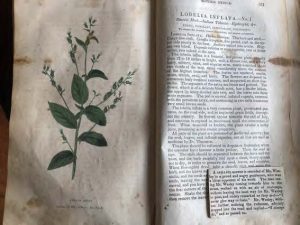
with newspaper clipping
The article clipping placed in the text perhaps intentionally on the page describing Lobelia (Photo 2) indicates a documentation of a public dispute. Without further research into the individuals, it may be a bit of a leap to associate this relic with the plant on which it was placed in the book. It certainly warrants more investigation into Mr. Wesley mentioned here and of course Mr. Geo W. Smith, the Thomsonian practitioner using this tome in practice. It gives some insight into the social context and polarizing nature of the use and practice of herbal medicine during those times, the struggles of those wanting to promote the safe and effective use of plants, and the power of the legal system’s influence on those who are brave enough to challenge the standing thought paradigms of their time. It makes me wonder if things have changed all that much in the last 181 years.
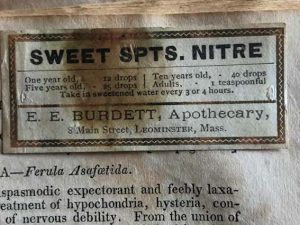
There was a label from a bottle of medicine (Sweet Spirits of Nitre or Ethyl Nitrite ) placed on page from a pharmacy in Leominster, MA (Photo 3), which happened to be a town less than twenty miles from where I was living when I ordered this book online. Sweet Spirits of Nitre was reclassified by the FDA due to safety concerns and toxicology reports showing a correlation to Methemoglobenemia (The Merck Index. 10th ed. Rahway, New Jersey: Merck Co., Inc., 1983., p. 554). It is currently regulated under 21CFR172.515 by the FDA as a Food Additive Permitted for Direct Addition to Food for Human Consumption. This list also contains ingredients you may recognize such as Piperine and Pine Tar Oil. Did Mr. Geo W. Smith also have concerns and was he looking to use Asafoetida or some other plant as an alternative? It was opposite the page containing Thomson’s famous “Composition Powders,” also a possible alternative to Sweet Spirits of Nitre? I couldn’t even have thought to ponder this question if I had referenced the online versions of the Thomsonian Materia Medica that are thankfully available.
There were notes about which plants acted like poison written on scraps of paper stuck in the text. These kinds of details are not always captured in the digitization process, but other researchers and book collectors will attest to the insightful nature of these notes and clippings that past owners have left behind.
Professor Staba’s collections contain multiple gems similar to the one described above, and I am looking forward to researching the collection in more depth to see what kind of details were left behind perhaps not in the original print. John was also active in the early years of herbal commerce in the United States and participated in the Herb Trade Association Meetings in Santa Cruz, California (1978-79). I asked John how he became involved with the Herb Trade Association, and he mentioned that he was asked to present on Ginseng to the group at a meeting in Santa Cruz. He remembered meeting many herbalists including Mark Blumenthal whom John delightfully recalled “Introduced me to Guacamole” and upon checking in with Mark on a phone call, he quipped quickly, “If John was an Ethnobotanist he would have already known about Guacamole, but he’s a Pharmacognocist”. Mark went on further to describe many visits with John and his wife Joyce and how this consummate gentleman, scholar, and expert in his field had become a good friend over the years. John was happy to say the plants brought him to those meetings, specifically Ginseng. John was a regular presenter and attendee at the International Ginseng Symposium, Seoul, Korea (1976, 1978, 1980, 1984). We look forward to integrating his Ginseng Collection into the Duke Archives and adding to the Learning Garden’s power through the availability of these documents. John’s great hope is that we continue to stress the importance of cultural knowledge as it relates to plants, and that without that transfer of cultural knowledge and spiritual relevance of the natural world in the research and stewardship of plants, we may tend towards furthering more humanistic practices without necessarily intending to do so. Perhaps John was more of an Ethnobotanist than his friend anticipated!
In addition to his donations to the Lloyd Library and United Plant Saver’s Duke Archives, John also made a donation to UMD’s Kathryn A. Martin Library and the blossoming Mishoomis Collection Library in the American Indian Learning Resource Center (AILRC). John’s collection consists of American Indian/Alaskan Native scholarly research materials, which are unique because they cover the indigenous people, not settlers, from South America to Canada during the development of the western United States from 1700 to 1900. It is a shame that this is unique information and all the more reason to call attention to it so that it can be well referenced by others. The collection is primarily non-fiction: history, culture, dance, music, art, and painting. As with any other important historical collection, Professor Staba hopes it attracts even more scholars to the resources at the institution he spent years contributing to. These resources are even more important to bring to awareness now as finally indigenous practices are being valued and embraced for ecological restoration and reclamation of indigenous lands.

With the recent passing of botanist, photographer, researcher, plant lover, and friend to many, Steven Foster, I took stock of the many contributions he made that will continue to provide meticulously researched information and pristine images of our beloved plants for years to come. I may not always have a battery charged in my phone to reference a digital image of a text, but the copy of Peterson’s Field Guide to Medicinal Plants and Herbs (Duke&Foster) fits nicely in my backpack, and it reads well by candlelight if need be. So long as I don’t leave it on a log in the woods or spill another cup of coffee on it, I’ll be able to refer to my own scribbled notes in the margin, and maybe someday with any luck, it will be used by another fellow human on the green journey. There are many herbal enthusiasts and practitioners across the globe and certainly in the US who have carefully collected references for their practices and pleasure. It would be wonderful if there were a central repository dedicated to N. American herbal practice and tradition where they could leave them in good hands and in places the herbal public can reach them. The hope for future generations is that there will be both digital and centrally located repositories for physical books, documents to be stored in perpetuity so that primary sources of North American herbal traditions and practices can be referred to inform and remind people of their existing and intricate connection to the plants.