By Sara Katz
In November 1978 Ed Smith and I drove 5 hours south from Portland, Oregon, to Ashland, on the California border, in order for Ed to teach a class on medicinal herbs. People knowledgeable about how to use medicinal plants was a rarity at this time when Ed had already earned the nickname “Herbal Ed,” a moniker he wears to this day.
We were looking to move to a rural community and had been told that southern Oregon was a place we might want to settle; it satisfied our environmental, geographical and climate criteria. So, during his class in Ashland, Ed announced our search for a new home, and we were happy when an attendee enthusiastically suggested we make our way fifty miles west, through the Applegate Valley, to the small mountain valley of Williams, where we would find a fertile herbal community. And so we did.
In the 1970s herbalism was not so deeply integrated into every segment of American society as it is today. Rather, after decades of denigration and persecution by the AMA, FDA, and Big Pharma, herbalism persisted mostly in small rural and urban pockets across America. It turns out one of these pockets of herbal activity and creativity was the Williams Valley of southern Oregon.
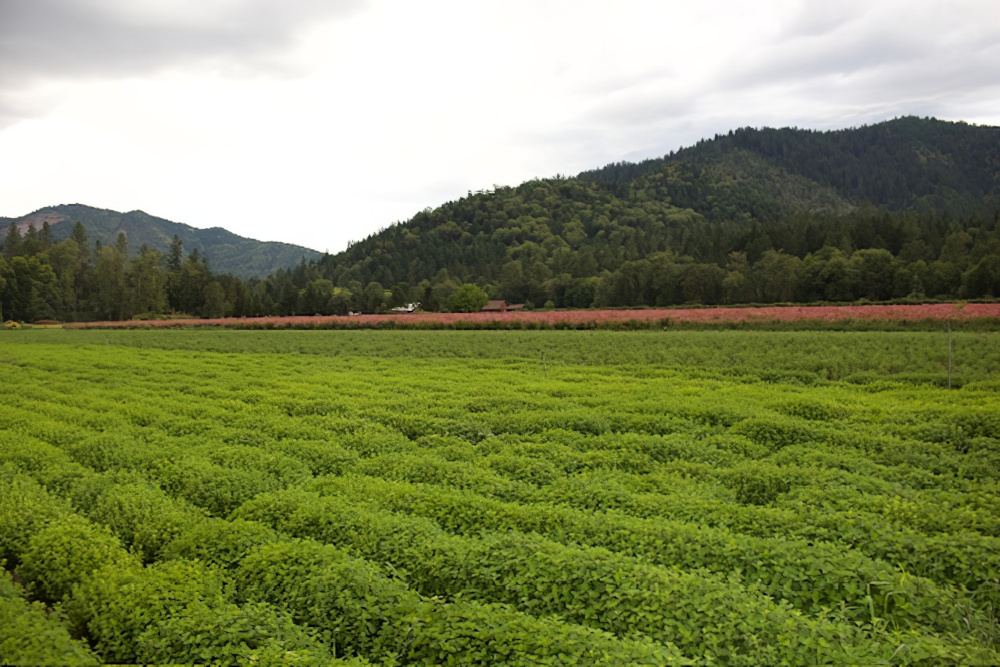
Echinacea (Echinacea purpurea) at Herb Pharm
After the class in Ashland, Ed and I drove directly to Williams, enchanted by the beauty of the Applegate Valley as we made our way to the Williams General Store. There we asked where we might find people working with medicinal plants and were directed to go a mile down a bumpy road to a rustic farm where we walked in on a meeting of SWOHA, the Southwestern Oregon Herb Association. Circling the warmth of a fire were a fascinating array of plant nerds, and we knew right away we had found our new home. So we returned to Portland, packed up our car full of worldly belongings, and moved to Williams, where Herb Pharm was born and has lived ever since.
Amongst that colorful array of inspired plant geeks, no one called themselves an herbalist per se, although they were impressively knowledgeable about collecting wild medicinal plants, growing abundant and artistic herb gardens, and honoring the earth using medicinal plants in prayer and ceremony. They became our herbal colleagues and our community.
Most of these plant-loving people had come to Williams from all over the country. Like us, they were attracted by the culture of community, the moderate climate, and the geography—a valley with mountain ranges on three sides, the Pacific coast 60 miles to the west, and significantly, being located at the end of a 6-mile road that continues only as logging roads into the wilderness.. This means no one comes through Williams on their way to somewhere else. Williams is a destination unto itself.
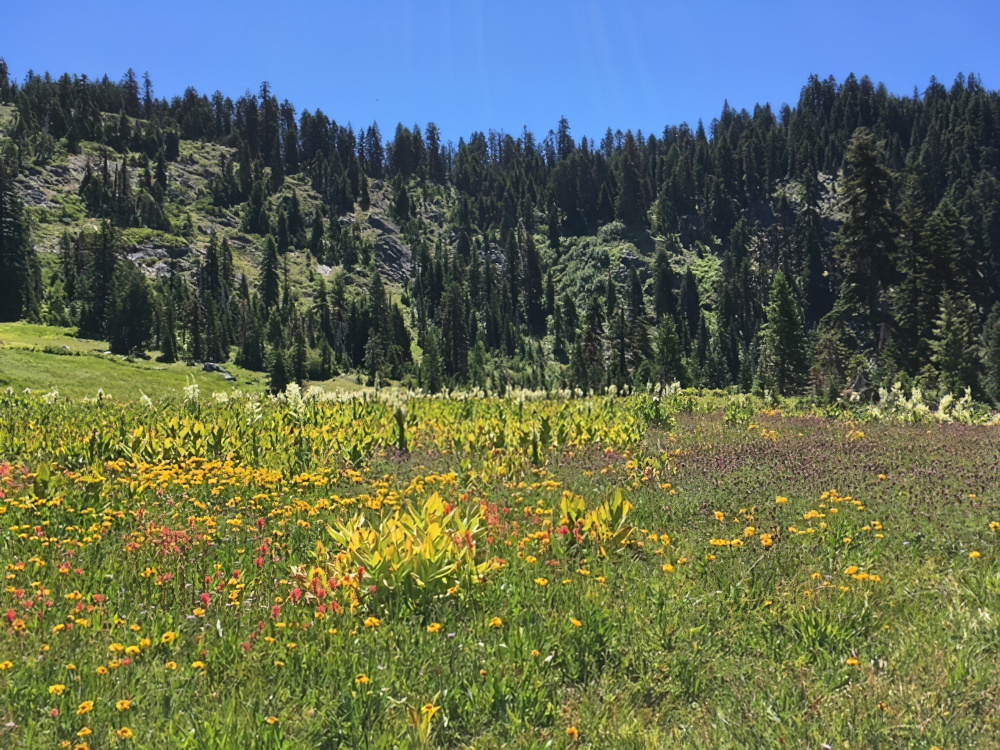
For a variety of geological and climate reasons, southern Oregon is endowed with wonderful plant diversity and many endemic plants. Field guide in hand, and with the help of our new botanical buddies, we were thrilled to find so many medicinal plants growing all around in meadows, mountains, streams, and the nearby Pacific coast. Over the years Ed and I wildcrafted an abundance of herbs from these environs: yarrow (Achillea millefolium) and milk thistle (Silybum marianum) at the coast; pipsissewa (Chimaphila umbellata), St. John’s wort, goldenrod (Solidago gigantea), and elder (Sambucus nigra) in the mountains; shepherd’s purse (Capsella bursa-pastoris) in the meadows and petasites (Petasites hybridus) in the creeks, and so many more—most of the herbs a nascent extract company needed!
Soon after we moved to Williams, Ed and I became close friends with the gifted herbalist/gardener/plant spirit Gabriel Howearth, who created vibrant and colorful mandala herb and flower gardens throughout the valley and generously shared his encyclopedic knowledge. I had the good fortune to be Gabriel’s gardening sidekick for a few illuminating years when we first moved to Williams.
Jim and Dottie Becker began Goodwin Creek Gardens in 1977, selling popular and hard-to-find herb and flower plants, including 120 varieties of lavender (Lavandula spp.). Goodwin Creek is the birthplace of the favorite “Goodwin Creek Grey” lavender and the “Chelsea Pink” lavender. Goodwin Creek provides beautiful plant starts to this day under the stewardship of Jered Grzybowski and his lovely family.
Soon after we moved to Williams, Ed and I became close friends with the gifted herbalist/gardener/plant spirit Gabriel Howearth, who created vibrant and colorful mandala herb and flower gardens throughout the valley and generously shared his encyclopedic knowledge. I had the good fortune to be Gabriel’s gardening sidekick for a few illuminating years when we first moved to Williams.
Jim and Dottie Becker began Goodwin Creek Gardens in 1977, selling popular and hard-to-find herb and flower plants, including 120 varieties of lavender (Lavandula spp.). Goodwin Creek is the birthplace of the favorite “Goodwin Creek Grey” lavender and the “Chelsea Pink” lavender. Goodwin Creek provides beautiful plant starts to this day under the stewardship of Jered Grzybowski and his lovely family.
When we met Mark Wheeler, who began farming in Williams in 1979, he was growing gorgeous fruit trees and market vegetables. At our request, Mark began growing Echinacea purpurea and a few other medicinal plants for Herb Pharm. Over the decades, Pacific Botanicals, the company Mark founded and grew, now with 90-plus acres and more than 60 different herb species under cultivation, has become the largest highly diversified organic herb farm in North America.
Richo Cech and his family moved to Williams around that same time. A gifted and passionate plant lover and seedsman, when Richo discovered there was a little herbal extract company a mile down the road, he offered to come over in the evenings to press tinctures in order to be close to the magic. Richo became Herb Pharm’s herb buyer and overseer of production during the day, and in the evenings he and his family collected and catalogued herb seeds for their family home business, Strictly Medicinals, which is now one of our country’s most comprehensive sources of organic medicinal plant seeds and starts.
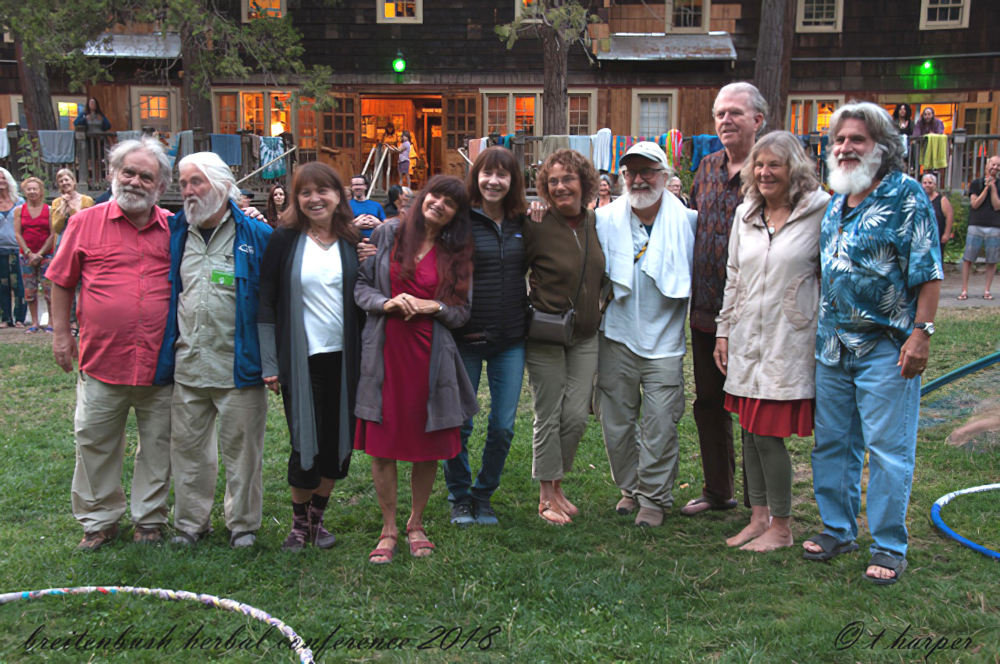
In the 1980s this concentration of herb growers, medicine-makers, seedsmen, and herbalists, made Williams an attractive destination for Rosemary Gladstar’s yearly bus journeys with the California School of Herbal Studies. Also, herbalist Jane Bothwell has been bringing her Dandelion Herbal School students from Arcata, California every summer for decades to soak in this abundance of herbal activity. Our herb-company-in-our-home was also a welcoming rest stop for herbalists traveling up and down the west coast, especially each September when the tribe gathered for the most iconic of herb conferences at Breitenbush Hot Springs, situated on the lushly forested western slopes of the Cascade Mountains. This land of healing waters is stewarded by a dedicated community who care lovingly for the land, its facilities, and guests. The Breitenbush Herb Conference, three-days of sharing knowledge of herbal medicine and ceremony in the beautiful lodge, stone-lined natural hot pools, and steam house, has been a highlight on herbalists’ calendars since the original conference organized by Rosemary Gladstar over 40 years ago.
By the mid-nineties consumer demand for herbal medicines was growing rapidly across the U.S., meaning herbal products could be found on the shelves of increasing numbers of herb and natural food stores, and soon in less-natural food stores as well. The growing popularity and acceptance of herbal medicine seemed a positive development for those of us who had been using and teaching about herbs for decades. However, this popularity turned out to be detrimental for some wild medicinal plant species, especially popular roots like ginseng (Panax quinquefolius), goldenseal (Hydrastis canadensis), echinacea (Echinacea spp.), and black cohosh (Actaea racemosa) that were being harvested too aggressively. To address this issue, Rosemary Gladstar gathered herbalists at the 1993 International Herb Symposium to discuss concerns about the over-harvesting of wild medicinal plants, and there, my friends, as you may know, United Plant Savers was born. As would be expected, participation in and support for United Plant Savers from the Williams Valley began early on and continues to this day.
Ed and I always considered ourselves conscientious wild-harvesters and did our best to work only with wildcrafters who understood what made for sustainable harvest. More recently studies are being done, and more need to be done, on what actually constitutes sustainable harvest of a wild plant, but we did the best we could with what we knew at the time. So when United Plant Savers formed in 1994, we were completely on board with participating and supporting the mission of protecting wild herbs in any way we could, as did many of the other herbalists and herb businesses in the Williams Valley.
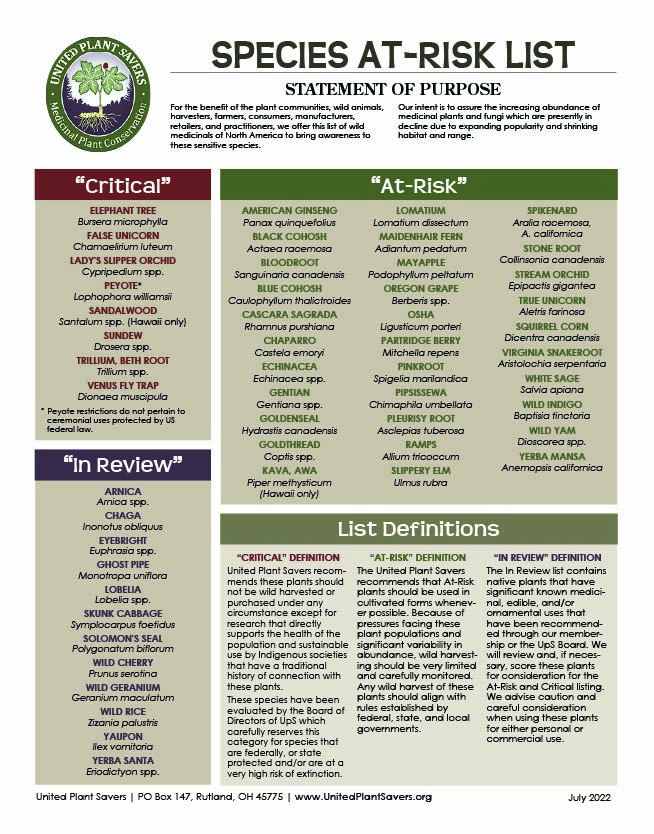
Richo Cech was Herb Pharm’s herb buyer at that time, so Herb Pharm sponsored Richo to join the UpS board. Once the UpS “At-Risk” List was established, Herb Pharm began to grow any herbs on that list that we could and discontinued making herbal extracts from wild-sourced “At-Risk” herbs that we couldn’t grow successfully, including false unicorn (Chamaelirium luteum), slippery elm (Ulmus rubra), and partridge berry (Mitchella repens). Today an At-Risk-Herbs bed is featured prominently in Herb Pharm’s Herbal Education Garden.
With his herb seed business growing robustly, Richo departed Herb Pharm to devote his attention to Strictly Medicinals, providing people with seeds and starts for many plants on the UpS “At-Risk” List. At that time I officially joined the UpS board, a seat I held for over 20 years, 9 of them as board president. Mark Wheeler, herb farmer extraordinaire, joined the UpS board for a number of years as well, and, as one of the earliest and most successful organic herb growers, Pacific Botanicals has played a key role in providing companies and individuals with cultivated “At Risk” medicinal plants, many previously available only in the wild. According to Mark, “There was so much going on back then and so many people involved, UpS meetings and conferences, many herb schools visiting, tours etc. But mostly nonstop work to keep it all together.” I’m thrilled to report that Pacific Botanicals was awarded the 2024 Herbal Leadership Award by the American Herb Products Association (AHPA) for excellence in quality, integrity, sustainability, and customer service.
One of the main ways that United Plant Savers spreads its message about protecting wild medicinal plants has been through herb conferences. These spirited gatherings have been significant fund-raisers as well. Herb Pharm has hosted four very successful UpS conferences over the years amid the herb gardens and crops of the “Pharm Farm”, and I hear there may be another in the near future!
More recently, the Williams Valley has been graced with another notable herb company, Oshala Farms. Owners Elise and Jeff Higley are go-getters of the very best kind, growing and selling beautiful medicinal herbs and herbal products, offering a myriad of herbal education opportunities, and actively supporting our local environment and community. Jeff and Elise are also significant advocates and supporters of UpS and its mission.
Williams today doesn’t look that much different than it did when Ed and I first arrived 45 years ago. The main visual change as you drive in are the Herb Pharm and Strictly Medicinal buildings that occupy a good portion of the don’t-wink-or-you’ll-miss-it downtown. Herb businesses of all kinds proliferate in the surrounding mountains and valleys. Small organic vegetable, herb, and flower farms as well as wineries are widespread.
Ed sums up our life in Williams thusly: “As life-long herbal enthusiasts,
Sara and I have always had a love for the Williams Valley. How could we not? What a blessing to have your life, work and love of Mother Nature be as one.”
With gratitude for living so much of my life in this peaceful mountain valley and community, for the love of plants and the people who care for them, Sara Katz
***
Sara Katz is co-founder of Herb Pharm and past president and long-time supporter of United Plant Savers.